
How Long Does Solar Installation Take in Minnesota?
The crew is on your roof for a day or two. Permits, utility approval and inspection take the rest. Here's a realistic step-by-step Minnesota solar timeline.
Reviewed by John Ihle, MN Master Electrician (AM005101) · NABCEP-credentialed · iSolar, Saint Paul Park, MN · Last reviewed October 2026
The short answer: The physical install on a typical Minnesota home takes 1 to 2 days on site. The full process, from signing to permission to operate, usually takes about 2 to 4 months. Most of that is design, city permits, utility interconnection approval and inspection. Panel upgrades, reroofing, busy utility queues and winter weather are the most common causes of delay.
The honest answer: 1–2 days on the roof, 2–4 months overall
When people ask how long solar installation takes, they usually mean one of two things. The physical install on a typical home takes our crews 1 to 2 days on site. The full process, from signing a contract to flipping the system on with the utility's blessing, usually takes about 2 to 4 months in Minnesota.
Almost all of that time is paperwork, engineering and waiting on other parties: the city or county that issues permits, the electrical inspector, and the utility that approves the grid connection. Knowing what each step involves helps you plan, and helps you spot a sales rep who's promising a timeline nobody can control.
The full timeline, step by step
| Step | What happens | Typical time |
|---|---|---|
| 1. Site visit and proposal | Roof, electrical panel and shade check; usage review; quote | 1–2 weeks |
| 2. Contract signed | Final equipment, price and financing locked in | Day 0 |
| 3. Design and engineering | Final layout, electrical one-line diagram, structural review; stamped plans where required | 1–3 weeks |
| 4. Permits | Building and electrical permits from your city or county | 1–4 weeks, varies by city |
| 5. Utility interconnection application | Application to Xcel or your co-op/muni for approval to connect; incentive paperwork where it applies | Several weeks; often the longest wait |
| 6. Installation | Racking, panels, wiring, inverters or microinverters, disconnects | 1–2 days on site |
| 7. Electrical inspection | State or local inspector reviews the work | About 1–2 weeks to schedule |
| 8. Permission to operate (PTO) | Utility verifies paperwork, meter is set or reprogrammed, written approval to turn on | Days to a few weeks |
These ranges reflect our experience on residential jobs in the Twin Cities and greater Minnesota. Some steps run in parallel. We usually submit the interconnection application and permits around the same time, so the total isn't simply the sum of every row.
For a deeper look at the paperwork side, see our guide to permits, inspections and interconnection in Minnesota, and our installation process page for what each stage looks like with iSolar.
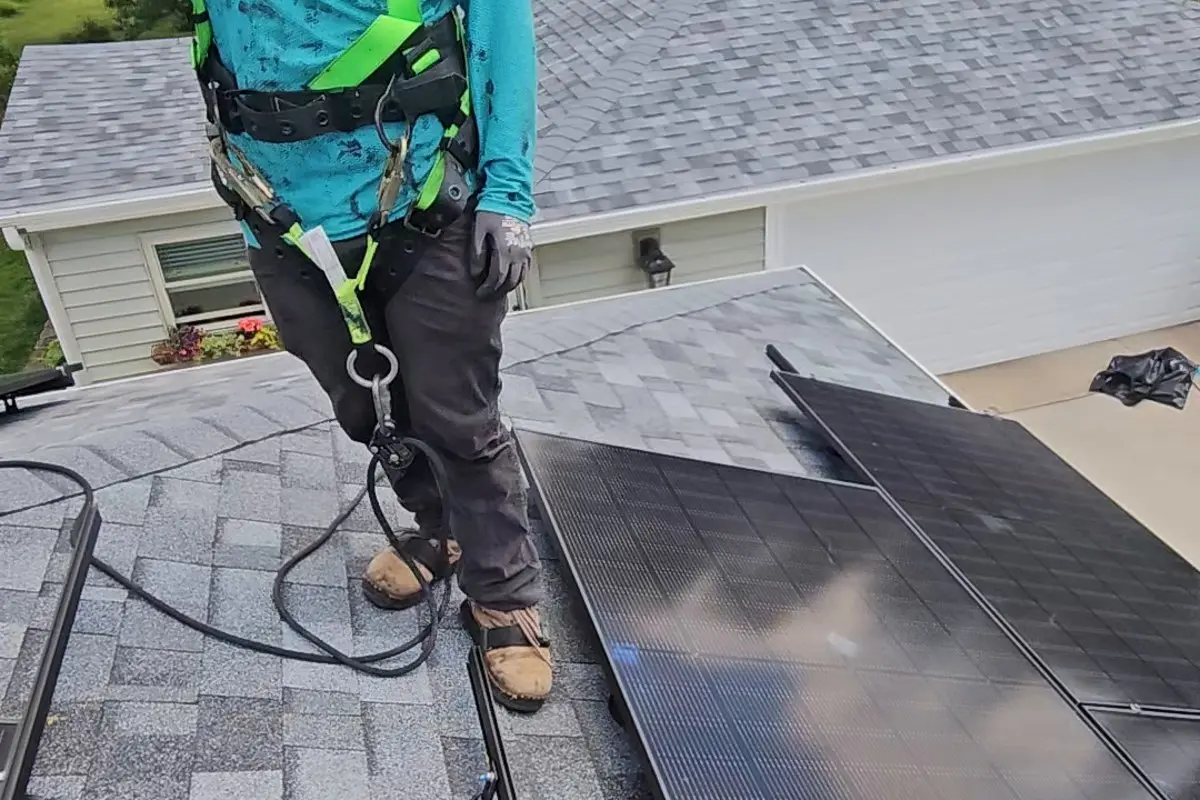
What happens on installation day
Install days are the fast part. On a typical residential roof, here's what you'll see:
- Morning setup. Crew arrives, sets up fall protection and ladder access, and stages materials.
- Attachments and racking. Roof mounts are located on rafters and flashed to keep water out. Rails go on next.
- Electrical on the roof. Microinverters or optimizers mount to the rails, and wiring is run and managed so nothing rests on the shingles. Rooftop systems also need rapid shutdown under the National Electrical Code (NEC 690.12).
- Panels. Modules are set, clamped and grounded.
- Ground-level work. Conduit runs to the electrical panel, the solar breaker or line-side tap goes in, and the required disconnect and placards are installed.
- Commissioning prep. Monitoring is set up, but the system stays off until the inspection and PTO are complete.
Bigger systems, steep or complex roofs, ground mounts and battery installs can add a day or two. You don't have to be home for most of it, but we'll need access to your electrical panel, and power may be off briefly while we connect. Before the crew leaves, we walk the site and clean up, so the only sign we were there is the array.
What slows it down in Minnesota
Utility interconnection queues
The utility has to review every system before it connects to the grid. Minnesota utilities follow structured interconnection processes with defined review steps. For example, the municipal-utility process for inverter-based systems up to 20 kW sets business-day windows for each stage: a completeness review, a technical review, a signed agreement, the inspection certificate and permission to operate. Even with defined timelines, a busy season, a missing document or a feeder that needs extra study can stretch things.
Xcel follows the statewide interconnection process approved by the Minnesota PUC. In spring and summer, when everyone wants solar, expect the application stage to take longer.
City and county permits
Some Twin Cities suburbs turn residential solar permits around in days. Others take a few weeks, especially if plans need structural sign-off or corrections. Townships and counties in greater Minnesota vary just as much. We know most of the local quirks, but we can't control a backlog.
Electrical panel upgrades
Older homes with 100-amp service, or a full 200-amp panel, may need an upgrade or a line-side tap. Under NEC 705's 120% rule, a 200-amp panel with a 200-amp main can typically take up to a 40-amp solar backfeed breaker. If yours can't, a service upgrade usually requires coordinating a utility disconnect and reconnect, which adds scheduling time. Our guide on panel upgrades for solar explains when you'll need one.
Roof work first
If your shingles are near the end of their life, we'll recommend reroofing before solar goes on. That adds a step, but it's much cheaper than removing and reinstalling panels later. Our sister company, Three Rivers Contracting, handles roofing, so it can be coordinated as one project. See re-roofing and solar.
Winter
We install year-round, but Minnesota winter slows things down. Snow and ice on a roof have to be cleared safely, short days limit crew hours, and frozen ground makes trenching for ground mounts harder. Wind chill days can push work back. If you sign in late fall, it's realistic to expect a winter install or an early-spring one depending on weather and the queue.
Incentive program timing
Xcel's Solar*Rewards opens capacity in rounds each year, and Xcel's Income-Qualified Solar*Rewards program has its own enrollment windows. If you're using an incentive, its schedule can set the pace. We're currently taking 2027 Income-Qualified Solar*Rewards sign-ups, with a December 31, 2026 deadline. Details are on our income-qualified solar page.
How to keep your project on schedule
- Send a full year of utility bills early, so the system is sized right the first time and the interconnection application doesn't bounce.
- Sign and return the utility agreement promptly. Applicants typically have a set window to return it, and every day you hold it is a day added.
- Decide on batteries before design. Adding a battery after permits are issued usually means revising plans and paperwork.
- Check HOA rules up front. Minnesota law generally prevents HOAs from prohibiting rooftop solar, but reasonable restrictions apply and some associations want to review plans.
- Keep the electrical panel accessible for install day and inspection.
Red flags about timelines
Be cautious if a salesperson promises your system will be "running in two weeks" or tells you to turn it on before the utility says so. Nobody can guarantee a city permit or utility approval date, and operating a grid-tied system before permission to operate isn't allowed. Out-of-state companies that sell door to door sometimes overpromise speed and then hand the job to whoever is available. Ask who will actually install your system and who pulls the permits.
We use in-house crews on residential work, our master electrician oversees the electrical side, and we'll give you a realistic schedule and a same-business-day callback when you have questions.
Start the clock
The sooner design and paperwork begin, the sooner you're producing. Check whether your home is ready with our solar readiness tool, or request a quote and we'll map out a timeline based on your city, your utility and the current queue.
Sources
Frequently asked.
How long does it take to install solar panels on a house?
The on-site work for a typical residential system takes 1 to 2 days. Larger systems, complex roofs, ground mounts or battery installs can add a day or two.
How long from signing to turning on solar in Minnesota?
Usually about 2 to 4 months. Design, permits, the utility interconnection review, inspection and permission to operate take far longer than the install itself.
Why is my solar system installed but not turned on?
A grid-tied system can't operate until it passes electrical inspection and the utility grants permission to operate. That final approval can take days to a few weeks after inspection.
Can solar panels be installed in winter in Minnesota?
Yes, roof-mounted systems are installed year-round. Snow, ice, short days and extreme cold can delay individual install days, and frozen ground makes ground-mount trenching harder.
How long does Xcel take to approve solar interconnection?
It varies with application volume and whether your system needs extra review. It's often the longest single wait in the process, commonly several weeks. Complete paperwork and prompt signatures keep it moving.
Do I need to be home during solar installation?
Not for most of it. The crew needs access to your electrical panel and the work area, and power may be off briefly while the system is connected. We'll confirm details before install day.


Have a question we haven't covered?
Talk to a local iSolar expert — free, no pressure. Call (651) 565-1140.