
Solar Panel Glare and Your Neighbors: How Much Is Real and What to Do About It
Solar panels are built to absorb light, not reflect it. Here is when glare actually happens, what Minnesota law says, and how to handle a neighbor's complaint.
Reviewed by John Ihle, MN Master Electrician (AM005101) · NABCEP-credentialed · iSolar, Saint Paul Park, MN · Last reviewed October 2026
The short answer: Modern solar panels reflect as little as about 2 percent of sunlight, roughly the same as water and less than ordinary windows, thanks to anti-reflective coatings and textured glass. Glare can still occur briefly at low sun angles toward uphill or second-story neighbors, but it is usually short-lived and solvable with simple screening or layout choices.
How much light do solar panels actually reflect?
A solar panel's whole job is to absorb sunlight, not bounce it away. Every photon reflected off the glass is energy the panel did not turn into electricity, so manufacturers work hard to keep reflection low.
The numbers back that up. The National Renewable Energy Laboratory points to U.S. Department of Energy guidance that modern panels reflect as little as about 2 percent of incoming sunlight, roughly the same as water and less than soil or wood shingles. NREL also notes that PV modules produce less glare than ordinary windows and water, and that panels are increasingly made with anti-reflective coatings.
Two design features do most of the work:
- Anti-reflective (AR) coatings on the front glass, which cut surface reflection so more light reaches the cells.
- Textured or stippled glass, which scatters the light that is reflected instead of bouncing it back as a single bright beam.
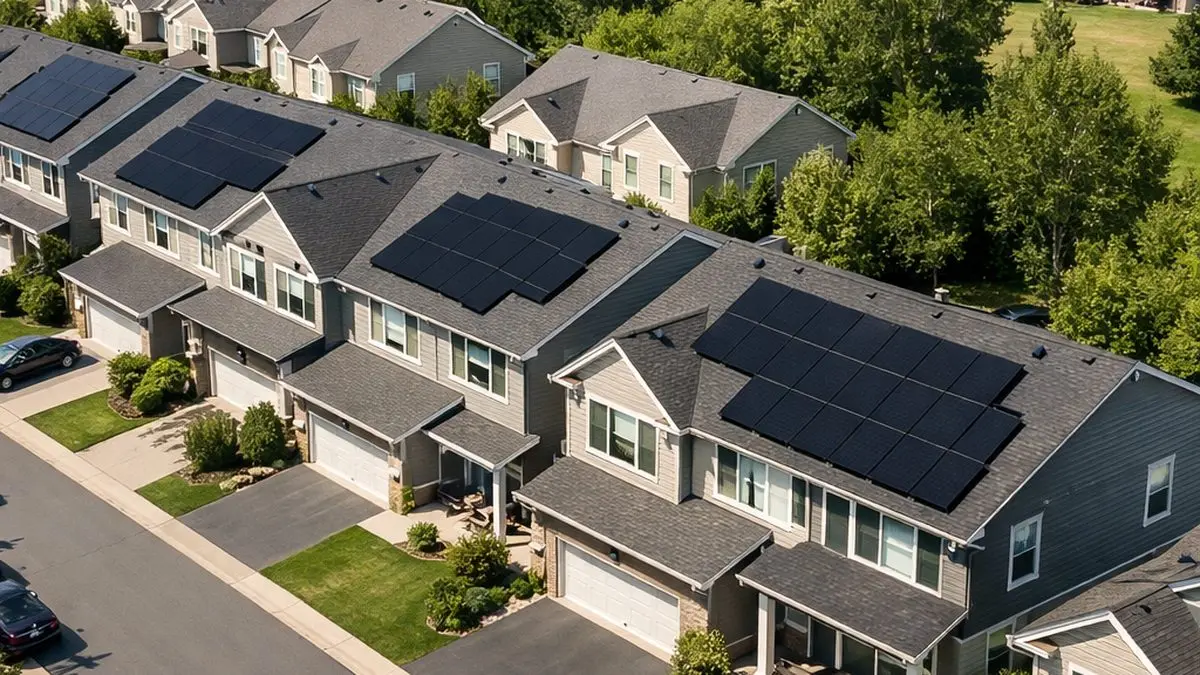
The all-black panels most Minnesota homeowners choose today combine both, which is part of why they look so dark from the street.
Glare vs. the other shiny things in your neighborhood
When a neighbor says your panels are blinding them, it is worth checking what is actually causing it. In our experience, the culprit is often something else on the same house.
| Surface | Glare potential | Why |
|---|---|---|
| Windows, patio doors, storm doors | Higher | Smooth, uncoated glass reflects as a mirror-like beam |
| Still lake or pond water | Higher at low sun angles | Smooth surface; NREL compares PV glare hazard to smooth water |
| Skylights and glass railings | Higher | Flat glass, often tilted toward neighbors |
| Bare or light-colored metal roofs and flashing | Moderate to high | Bright, smooth finish |
| Modern solar panels with AR-coated, textured glass | Low | Designed to absorb light; reflection is reduced and diffused |
Minnesotans also live with the brightest reflector of all for several months a year: fresh snow. A sunny February morning after a snowfall throws far more light into a neighbor's windows than any rooftop array, and nobody files a complaint about the lawn.
None of this means panels never glint. It means panel glare is usually brief and less intense than the window glare everyone already lives with.
When panel glare actually happens
Glare is a geometry problem. It needs the sun, the panel and someone's eyes lined up so the reflection angle points right at them. That happens only at certain times of day, in certain seasons, from certain spots.
The situations most likely to produce a complaint:
- Low sun angles. Early morning and late afternoon light, and Minnesota's low winter sun, reflect at flatter angles that can reach neighboring windows.
- A neighbor who is uphill or looks down on the array, such as a second-story window or a walkout home on a slope.
- East- or west-facing arrays pointed toward a neighbor's house.
- Low-tilt arrays on flat roofs or garages, which can reflect toward the horizon.
Even in those cases, glare at any single spot typically lasts a short window each day and comes and goes with the seasons as the sun's path shifts. Professional tools exist to model exactly when and where reflections land over a full year. NREL highlights Sandia National Laboratories' Solar Glare Hazard Analysis Tool, developed for larger projects.
What airports and glare studies tell us
If panels were a real glare hazard, airports would be the last place you would put them. Instead, NREL notes that PV has been installed at many airports without incident.
The Federal Aviation Administration's policy, finalized in May 2021, applies to solar on federally obligated airports with control towers. Rather than requiring airports to submit a detailed glare study to the FAA, it requires them to confirm the project will not cause ocular impact to the air traffic control tower cab, and to fix any impact at their own expense if one shows up later.
That rule does not apply to a home rooftop. But it shows how glare is handled where it matters most: by measuring it, not by assuming it. Formal glare studies are standard for large ground-mounted projects near airports and highways. For a home system, a careful layout and a conversation are usually enough.
Minnesota law, HOAs and glare complaints
If you live in a homeowners association, glare sometimes comes up as an objection during approval. Minnesota law limits how far an association can go.
Under Minn. Stat. 500.216, an association cannot prohibit or refuse to permit a roof-mounted solar system on a single-family dwelling. It can impose reasonable restrictions, but those cannot reduce the system's projected generation by more than 10 percent or add more than $1,000 to the cost of a PV system. The association can require a licensed contractor and can require that panels not extend above the roof peak or beyond the roof edge. If it fails to deny a complete application in writing within 60 days, the application is generally deemed approved.
In practice, that means an HOA cannot block solar over speculative glare, but it can reasonably ask about placement. Our guide to solar and your HOA in Minnesota covers the approval process in detail. The statute protects roof-mounted systems; ground-mounted arrays depend on city zoning and your association documents, so check setbacks and screening requirements first.
How to respond to a neighbor's glare complaint
Most glare disputes are solved by neighbors talking, not lawyers. A sensible sequence:
- Listen and get specifics. Which window, what time of day, what time of year, and how long it lasts.
- Confirm the source. Stand where your neighbor stands at that time. Window glass, a storm door, a skylight or a car windshield is often the real culprit.
- Take photos with timestamps over a few days. Glare that only appears for a few weeks a year is a very different conversation from daily glare.
- Call your installer. We can review the array orientation and tilt and tell you whether the reflection geometry adds up.
- Talk through options. A tree or shrub line, a fence panel, an awning, or a window shade often solves it cheaply. On ground mounts, adjusting the tilt or adding a screen may be possible.
- Put any agreement in writing, especially if you share costs.
Moving or replacing a rooftop array is rarely necessary or cost-effective. Small, targeted fixes almost always work.
Designing to avoid glare from the start
If you are still planning your system, a few choices reduce any chance of glare issues:
- Choose panels with AR-coated, textured glass. Our guide to reading a solar panel spec sheet shows where to find the glass specs.
- Favor south-facing planes, which also produce the most energy. See the best roof direction for solar in Minnesota.
- Be thoughtful with east- or west-facing arrays that look straight into a close neighbor's upper windows.
- Give a heads-up to the neighbors most likely to see the array. Most complaints come from surprise, not glare.
- On a ground mount, think about sight lines from the road and nearby homes. A row of evergreens on the right side of the array screens the view and any reflections, and it can be planted the same season the array goes in.
Plan a layout your whole street can live with
We design every system around your roof, your neighbors and your HOA rules, not just the sun. If you want to see how many panels fit and where, try our free roof solar estimator, or request a quote and we will walk through placement with you.
Sources
Frequently asked.
Do solar panels cause glare for neighbors?
Occasionally, and usually briefly. Modern panels reflect only about 2 percent of sunlight, but at low sun angles a reflection can reach a neighbor's window for a short stretch of time in certain seasons. Ordinary window glass usually produces more glare.
Are solar panels more reflective than windows?
No. NREL notes that PV modules produce less glare than windows and water. Panels use anti-reflective coatings and textured glass because reflected light is lost energy.
Can my HOA reject solar panels because of glare?
Under Minn. Stat. 500.216, an HOA cannot prohibit roof-mounted solar on a single-family home. It can impose reasonable restrictions, but they cannot cut projected production by more than 10 percent or add more than $1,000 to a PV system's cost.
What can I do if my neighbor's solar panels are blinding me?
Note the times and dates, confirm the panels are the source rather than a window or skylight, and talk with your neighbor. A shade, awning, tree or fence panel usually solves it, and their installer can review the array geometry.
Do solar panels need a glare study?
Home rooftop systems generally do not. Formal glare studies are common for large ground-mounted projects near airports and highways, and the FAA requires airports with control towers to confirm solar projects will not affect the tower cab.
Do all-black solar panels reduce glare?
All-black panels typically combine dark cells and backsheets with anti-reflective, textured glass, which keeps reflection low. Check the panel's spec sheet for the glass type and coating.


Have a question we haven't covered?
Talk to a local iSolar expert — free, no pressure. Call (651) 565-1140.