
Solar Panels for Commercial Buildings: Which Roof Types Work in Minnesota?
Your roof decides more about a commercial solar project than the panel brand does. Here is how each common Minnesota commercial roof type handles an array, and what to sort out first.
Reviewed by John Ihle, MN Master Electrician (AM005101) · NABCEP-credentialed · iSolar, Saint Paul Park, MN · Last reviewed October 2026
The short answer: Most commercial roofs can carry solar if the membrane has 20+ years of life left and the structure has spare capacity. Single-ply membranes (TPO, EPDM, PVC) and standing-seam metal are the easiest. NREL puts a typical array at about 3 lb per square foot, with ballasted systems at 4 to 6 lb, so a structural check and roof-warranty sign-off come first.
Solar panels for commercial buildings start with the roof
When owners ask us about solar panels for commercial buildings, they usually start with panel wattage or payback. On a commercial job, the roof sets the rules. It decides the racking type, the weight the structure has to carry, whether the roof manufacturer will keep honoring its warranty, and whether you will be paying to pull the array off in eight years to reroof.
A commercial array is designed to sit on the building for 25 to 30 years. NREL's solar-ready buildings guide makes the same point: panels often carry 25-year warranties, so the roof under them should last at least that long. If your membrane is 15 years into a 20-year life, the cheapest solar project you can buy is usually a reroof first.
This guide walks through the roof types we see on Minnesota warehouses, shops, churches, offices and farm buildings, and what each one means for commercial building solar panels.
Commercial roof types and how solar attaches to each
| Roof type | Typical racking | Penetrations | What to watch |
|---|---|---|---|
| TPO or PVC single-ply membrane | Ballasted or ballasted with a few anchors | Few or none | Slip sheets under every foot; membrane age; manufacturer approval |
| EPDM (rubber) membrane | Ballasted or attached | Few or none | Older EPDM seams; compatibility of slip sheets and flashing |
| Standing-seam metal | Clamps on the seams | Usually none | Seam profile must match the clamp; panel gauge and attachment to purlins |
| Exposed-fastener metal (R-panel, corrugated) | Rail or rail-less mounts screwed through to purlins | Yes, sealed | Purlin spacing and condition; sealant quality; common on farm and shop buildings |
| Built-up or modified bitumen | Ballasted or attached with flashed posts | Sometimes | Gravel surfacing, ponding and age; often better to reroof first |
| Ballasted river-rock membrane | Usually not recommended as-is | Varies | NREL advises avoiding these for solar; plan a roof change |
For a deeper look at how ballast trays, wind deflectors and block counts work on flat roofs, see our guide to ballasted racking on flat commercial roofs. Below we focus on choosing between roof types and the decisions that come before racking.
Single-ply membranes: the easiest flat roofs
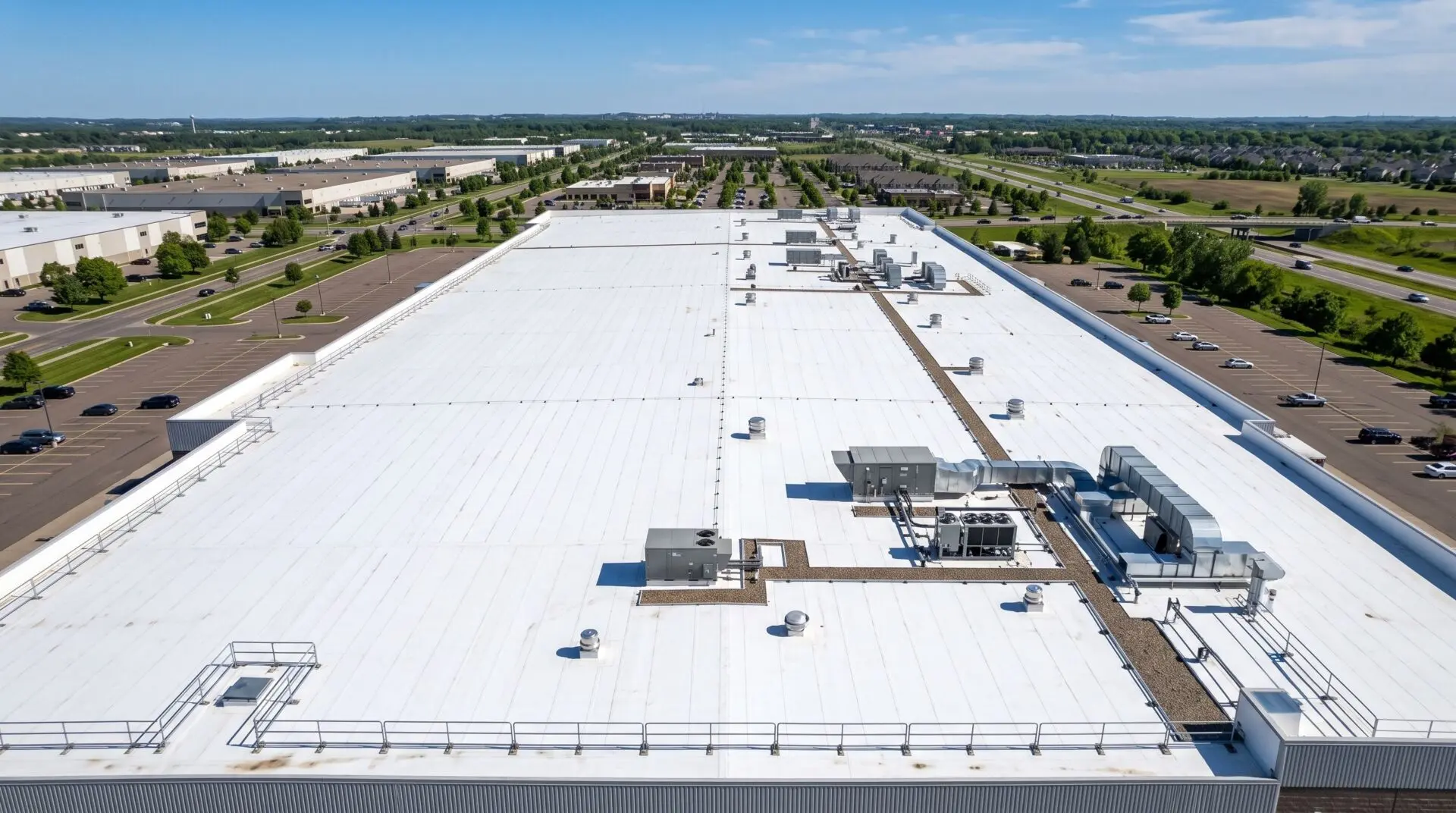
NREL calls a fully adhered TPO membrane the best flat-roof choice for solar, with EPDM and PVC also working well. These roofs are smooth, light and easy to protect. Racking sits on pads or slip sheets, and most of the array is held down by its own weight and ballast blocks rather than screws.
Metal roofs: often the best roof you already have
Standing-seam metal is a favorite. Clamps grip the raised seams, so the roof skin is never drilled, and the roof usually outlasts the array. Exposed-fastener metal, common on pole barns and shops across greater Minnesota, needs mounts screwed into the purlins with sealed fasteners. That is routine work, but the purlin condition and spacing matter more than the panel brand. Our post on solar on metal roofs covers the attachment details.
Built-up and modified bitumen roofs
Older tar-and-gravel and modified bitumen roofs can hold solar, but they are where we most often recommend a reroof first. Gravel has to be cleared for each foot, ponding areas need to be mapped, and once a roof is past mid-life, the cost of a later detach and reset usually outweighs a few years of delay.
Ballast vs. attached: weight, wind and penetrations
On flat roofs the main choice is how the array resists wind: weight, anchors, or a mix.
- Ballasted. Concrete blocks hold the racking down. No or few roof penetrations, faster installation, easy to remove for roof work. The tradeoff is weight. NREL's planning guide estimates ballasted mounts at 4 to 6 pounds per square foot of collector area.
- Attached (mechanically fastened). Racking is bolted to flashed posts tied into the structure. Lighter, often around the roughly 3 pounds per square foot NREL cites for a typical PV array, and better for high-wind zones and roof edges. Every penetration is a flashing detail that has to stay watertight for decades.
- Hybrid. Mostly ballast, with a handful of anchors at corners and edges where wind uplift is highest. This is common when a building is close to its structural limit.
The racking engineer sets the final layout based on wind exposure, building height, parapet height and roof zone. Ballast counts change at corners and edges, so a ballast plan is a stamped document, not a rule of thumb.
Load capacity: the Minnesota snow question
Solar adds a modest dead load. Snow is the big number. Minnesota's building rules set the design ground snow load at 50 pounds per square foot in most counties, including the Twin Cities metro, and 60 pounds per square foot in 29 northern counties such as St. Louis, Itasca and Otter Tail. Flat-roof snow loads are calculated from that ground value (a common starting factor is 0.7 times the ground load, before exposure and other adjustments).
So a ballasted array adding 4 to 6 pounds per square foot is small next to the snow load, but it is not free. Older buildings were sometimes designed with little spare capacity, and arrays can change where snow drifts, especially next to parapets and rooftop units. NREL notes that drift and snow runoff loads can be many times the weight of the array itself.
What we ask for before quoting a commercial roof:
- Original structural drawings, if you have them, or the building's design year.
- Any known roof repairs, ponding areas or deflection.
- A structural review by a licensed engineer, which most commercial permits will require anyway.
Roof warranty coordination
Commercial roof warranties are written by the membrane manufacturer, and most have conditions for rooftop equipment. NREL's guide notes that roof warranty terms may require a specific mount style or a specific flashing at each penetration. One major membrane maker's PV guide, for example, requires the owner to register the PV system with the manufacturer before installation, use sacrificial slip sheets of like membrane under every point where racking touches the roof, flash penetrations with the manufacturer's own details, and pass pre- and post-installation inspections. It also states plainly that the roof guarantee does not cover the PV system itself.
Practical steps:
- Find your roof warranty and call the manufacturer before signing a solar contract.
- Ask whether the original roofing contractor must do any flashing work.
- Get the manufacturer's approval in writing and keep it with the building records.
- Budget for any inspection fees the manufacturer charges.
Access, setbacks and the rest of the roof
A commercial roof is shared space. Minnesota's fire code requires access pathways and setbacks on roof-mounted PV, and the exact layout depends on building size and roof type. Rooftop units also need service clearance, drains need to stay clear, and roof hatches need a path. Expect the usable area to be noticeably smaller than the gross roof area once those are drawn in.
Electrically, larger commercial arrays usually land on the building's main switchgear or on a new service connection. The utility interconnection timeline is often the long pole in the schedule, which matters right now: under the One Big Beautiful Bill Act, commercial projects that begin construction after July 4, 2026 must be placed in service by December 31, 2027 to claim the Section 48E credit. Our overviews of commercial solar incentives in Minnesota and the commercial solar installation process cover the timeline in detail. Talk to your tax advisor about your specific project.
A quick roof readiness checklist
| Question | Good sign | Red flag |
|---|---|---|
| Roof age | Under 5 years, or 20+ years of rated life left | Past mid-life with no replacement plan |
| Membrane condition | Smooth, adhered, few patches | Blisters, open seams, ponding |
| Structure | Drawings available, no visible deflection | Unknown design, sagging bays |
| Warranty | Manufacturer approves PV in writing | Warranty silent or voided by equipment |
| Layout | Large open areas away from units and drains | Chopped up by units, skylights and hatches |
Get a roof-first commercial assessment
If you are weighing solar for a warehouse, shop, church or office, start with the roof and the numbers together. Our commercial solar team reviews roof type, structure and warranty before we design an array, and our sister company Three Rivers Contracting handles roofing when a reroof should come first. You can also run a first pass with the commercial solar ROI calculator.
Sources
Frequently asked.
Can you put solar panels on a flat commercial roof?
Yes. Flat roofs are the most common commercial solar roofs. Arrays are usually ballasted with concrete blocks, sometimes with a few anchors at corners and edges, and tilted at a low angle to reduce wind load and row shading.
How much weight do solar panels add to a commercial roof?
NREL estimates a typical PV array adds about 3 pounds per square foot of collector area, and ballasted systems 4 to 6 pounds per square foot. A licensed engineer should confirm the building can carry that on top of Minnesota's design snow loads.
Will solar panels void my commercial roof warranty?
Not if you follow the roof manufacturer's rules. Most require you to register the system, use approved slip sheets and flashing details, and pass inspections. Call the manufacturer before you sign a solar contract and get approval in writing.
Should I replace my commercial roof before installing solar?
If the roof is past the middle of its rated life, usually yes. Removing and reinstalling an array later costs money and downtime, so most owners reroof first and then install solar on a roof that will outlast it.
What is the best commercial roof for solar panels?
Standing-seam metal and fully adhered single-ply membranes such as TPO are the easiest. Standing seam lets racking clamp on without drilling, and smooth membranes make ballasted systems simple to protect and service.
Do commercial solar panels need roof penetrations?
Not always. Ballasted systems on flat roofs often need few or no penetrations, and standing-seam clamps need none. Exposed-fastener metal roofs and high-wind zones usually need sealed attachments into the structure.
Have a question we haven't covered?
Talk to a local iSolar expert — free, no pressure. Call (651) 565-1140.