
How Much Does a 400 Watt Solar Panel Produce in Minnesota, and How Many Do You Need?
A 400-watt panel on a good Twin Cities roof makes roughly 460 to 520 kWh a year. Here's what that means month by month, and how to turn your electric bill into a panel count.
Reviewed by John Ihle, MN Master Electrician (AM005101) · NABCEP-credentialed · iSolar, Saint Paul Park, MN · Last reviewed October 2026
The short answer: In the Twin Cities, a 400 watt solar panel produces roughly 460 to 520 kWh a year on a well-oriented, unshaded roof, from about 20 kWh in December to nearly 60 in July. The average Minnesota home used about 8,550 kWh in 2024, which works out to roughly 17 to 19 panels of 400 watts, or about 6.8 to 7.6 kW.
What a 400 watt solar panel produces in the Twin Cities
A 400 watt solar panel is rated at 400 watts under standard test conditions: bright sunlight of 1,000 watts per square meter and a cell temperature of 25°C. Your roof rarely sees those exact conditions, so the useful number is annual energy, not peak watts.
In the Twin Cities, a well-installed system produces roughly 1,150 to 1,300 kWh per kW of panels per year, with south-facing, unshaded roofs near the top of that range. A 400 W panel is 0.4 kW, so:
- Low end: 0.4 × 1,150 = about 460 kWh a year
- High end: 0.4 × 1,300 = about 520 kWh a year
- East- or west-facing roofs: roughly 10% to 20% less
That's about 38 to 43 kWh a month on average, but Minnesota doesn't do averages.
Month by month: one panel through a Minnesota year
Spreading 500 kWh across the year using NREL's long-term monthly sunlight data for Minneapolis, on a south-facing panel, gives this pattern. Snow cover lowers the winter months further in years when panels stay buried.
| Month | Peak sun hours per day (Minneapolis) | Approx. output from one 400 W panel |
|---|---|---|
| January | 3.1 | about 29 kWh |
| April | 5.3 | about 47 kWh |
| July | 6.4 | about 59 kWh |
| October | 3.9 | about 36 kWh |
| December | 2.3 | about 21 kWh |
July produces nearly three times what December does. That swing is why Xcel's monthly net metering, which carries surplus credits forward, matters so much: summer surplus covers part of the winter shortfall. Our peak sun hours guide has every month and city.
How many 400 watt solar panels do I need?
Start with your annual electricity use, from 12 months of bills or your utility account. The U.S. Energy Information Administration reports that Minnesota homes averaged about 712 kWh a month in 2024, roughly 8,550 kWh a year. Divide your annual use by 460 to 520 kWh per panel:
| Annual use (kWh) | Panels needed (400 W) | System size |
|---|---|---|
| 6,000 | 12 to 13 | 4.8 to 5.2 kW |
| 8,550 (Minnesota average, 2024) | 17 to 19 | 6.8 to 7.6 kW |
| 10,000 | 20 to 22 | 8.0 to 8.8 kW |
| 12,000 | 24 to 27 | 9.6 to 10.8 kW |
| 15,000 (EV or electric heat) | 29 to 33 | 11.6 to 13.2 kW |
Two limits shape the final count. Xcel's Solar*Rewards requires systems to be sized at or under 120% of annual usage, and many homes aim below 100% on purpose; our post on solar offset explains why. And the roof has to physically fit the panels, with fire-code pathways and setbacks around them.
For a quick estimate from your own bills, try the solar system size estimator. For the whole-home version of this question, including electrification plans, see how many solar panels a Minnesota home needs.
How big is a 400W solar panel, and will enough fit?
Panel size follows from wattage and efficiency. A 400 W panel at about 20.5% efficiency needs roughly 1.95 square meters, about 21 square feet. For a real-world reference, Qcells' Q.TRON BLK M-G2+ panels in the 415 to 440 W range measure 1,722 by 1,134 mm, about 21 square feet each, and weigh about 47 pounds.
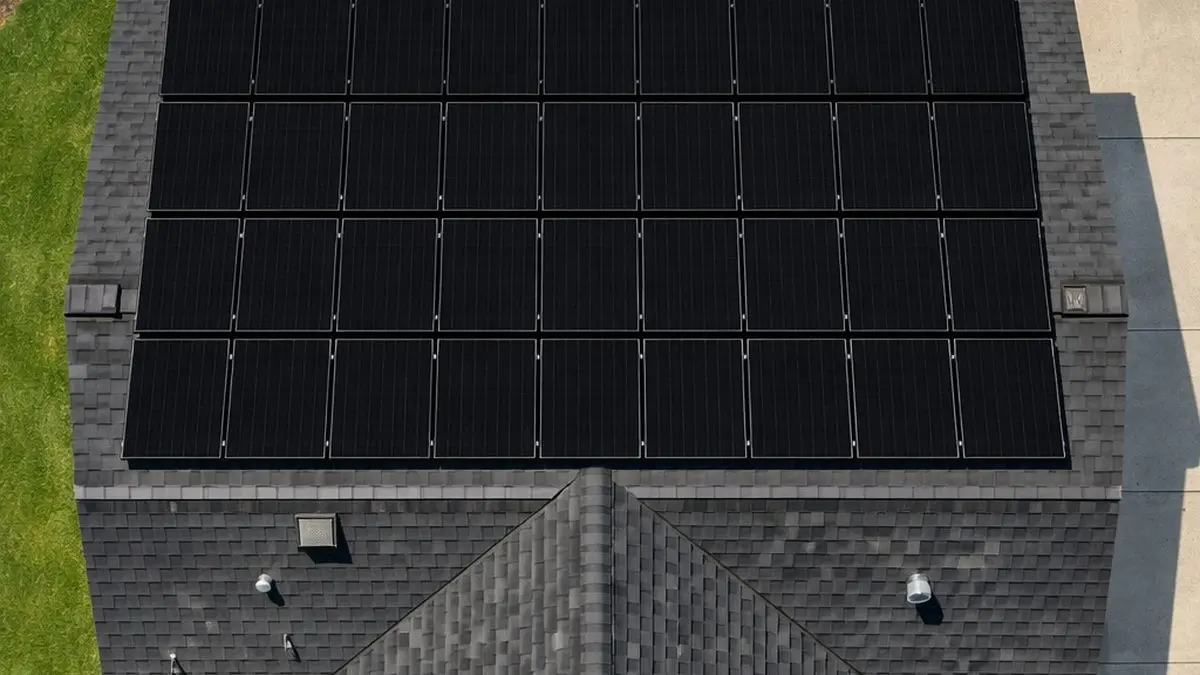
So 18 panels covers roughly 380 square feet of roof before spacing and code pathways. On Twin Cities homes we often find the south-facing plane fits fewer panels than the bill calls for, especially on hip roofs and homes with dormers or skylights. That's when higher-wattage panels or a second roof plane enter the conversation; our guide to solar panel efficiency covers that trade-off.
Weight is rarely the limit, but it's worth knowing. At about 47 pounds each, 18 panels add roughly 850 pounds before racking, spread across dozens of roof attachments. On older homes, or where you're planning heavy snow loads and a re-roof soon, have the roof structure and shingles checked before the panels go on, not after.
A worked example: two roof planes, one bill
Here's how the math plays out on a common Twin Cities layout. Say a home uses 10,000 kWh a year, and the roof has a south-facing plane that fits 14 panels and a west-facing plane with room for more.
- South plane: 14 panels × about 500 kWh = roughly 7,000 kWh a year.
- Gap to cover: 10,000 − 7,000 = 3,000 kWh.
- West plane: a west-facing panel makes roughly 10% to 20% less, so call it about 425 kWh. 3,000 ÷ 425 ≈ 7 panels; we'd likely design 8 to leave some margin.
- Result: 22 panels of 400 W, about 8.8 kW, producing roughly 10,400 kWh a year.
- Solar*Rewards check: 10,400 kWh is well under 120% of 10,000 kWh, so the system qualifies on size. Xcel's incentive, currently $0.05 per kWh for 10 years, would be worth about $520 a year at that production. We confirm the current rate at quote time.
- Price check: 8.8 kW at about $3.00 to $3.25 per watt is roughly $26,400 to $28,600 before incentives.
Change one input, such as shade on the west plane or an EV in the garage, and the panel count moves. That's why the table above is a starting point, not a design.
Why panel wattage isn't the whole story
- Orientation and shade beat wattage. A 400 W panel on an unshaded south roof will outproduce a 430 W panel under a maple tree.
- Inverter matching. Each microinverter or optimizer has its own rating. Pairing panels and electronics badly can clip output on the best days.
- Heat and cold. Panels lose output as they heat up and gain a little in cold. Qcells lists a temperature coefficient of −0.30% per degree C, so cold, clear spring days often produce strong midday readings.
- Degradation. Quality panels lose roughly 0.25% to 0.5% a year. Qcells warrants at least 90.58% of nominal power after 25 years.
- Price is per watt, not per panel. Minnesota installs commonly run about $3.00 to $3.25 per watt before incentives, so 17 panels at 400 W (6.8 kW) works out to roughly $20,400 to $22,100. A higher-wattage panel costs more per panel but about the same per watt.
400 watt panels for cabins, RVs and DIY kits
Search results for "400 watt solar panel" mix rooftop modules with portable and RV kits. Off-grid kits pair panels with charge controllers and batteries and play by different rules than a grid-tied home system. If you're powering a lake place, see our guide to solar for a Minnesota lake cabin. For a grid-tied home, remember that permits, inspection and utility interconnection apply no matter how the panels are bought.
Turn your bill into a panel count
The math above gets you within a few panels. A real design uses your exact roof planes, shade and 12 months of usage. Request a quote and we'll show you how many panels fit, what they'll produce month by month, and the price per watt.
Sources
Frequently asked.
How many kWh does a 400 watt solar panel produce per day?
In the Twin Cities it averages roughly 1.3 to 1.4 kWh a day over a year, from about 0.7 kWh on a typical December day to around 1.9 kWh in July, on a south-facing, unshaded roof.
How many 400 watt solar panels do I need for my house?
Divide your annual kWh use by about 460 to 520. The average Minnesota home, using about 8,550 kWh a year, needs roughly 17 to 19 panels, or 6.8 to 7.6 kW, before roof-space and offset decisions.
How much does a 400 watt solar panel cost installed?
Installed residential solar in Minnesota commonly runs about $3.00 to $3.25 per watt before incentives, or about $1,200 to $1,300 per 400 W panel as part of a full system. Smaller systems cost more per watt.
How big is a 400 watt solar panel?
Roughly 21 square feet. A 400 W panel at about 20.5% efficiency needs about 1.95 square meters; Qcells' 415 to 440 W panels measure 1,722 by 1,134 mm.
Will a 400 watt solar panel produce 400 watts?
Rarely, and only briefly. The rating is measured at 1,000 watts per square meter of sunlight and a 25°C cell temperature. Real output depends on sun angle, heat, shade and inverter limits, which is why annual kWh is the better measure.
Can 400 watt panels power a house in winter in Minnesota?
They produce far less in December than in July. Under Xcel net metering, summer surplus credits carry forward to offset winter use, so the annual total is what matters for sizing.


Have a question we haven't covered?
Talk to a local iSolar expert — free, no pressure. Call (651) 565-1140.