
How Does Solar Power Work on a Minnesota House?
Solar on a house is a short chain: panels, inverter, your breaker panel, and Xcel's meter. Here's what each link does, and why your system makes three times more in July than December.
Reviewed by John Ihle, MN Master Electrician (AM005101) · NABCEP-credentialed · iSolar, Saint Paul Park, MN · Last reviewed October 2026
The short answer: Solar cells turn sunlight into direct current (DC). An inverter converts that to the alternating current (AC) your home uses and feeds it into your breaker panel. Your house uses solar power first; any extra flows out through Xcel's bidirectional meter and earns bill credits. At night or on dark winter days, you draw from the grid as usual.
How does solar power work, in one minute
If you're wondering how does solar power work on an actual house, think of it as a chain with five links:
- Panels on the roof turn sunlight into DC electricity.
- Inverters turn DC into AC, the kind your outlets use.
- Your breaker panel receives that AC power through a dedicated breaker or connection.
- Your home's loads (fridge, furnace blower, lights) use the solar power first.
- The utility meter measures what flows out to the grid when you make more than you use, and what flows in when you don't.
Nothing is stored unless you add a battery. Solar power is used the instant it's made, either in your house or by your neighbors through the grid.
Inside the panel: how sunlight becomes electricity
Each panel is a grid of solar cells, usually silicon, wired together and sealed under glass. The U.S. Department of Energy describes it simply: when sunlight hits a panel, the PV cells absorb its energy, and that energy "creates electrical charges that move in response to an internal electrical field in the cell, causing electricity to flow."
In plain terms, the silicon is treated so that one layer has extra electrons and the other has room for them, which builds an electric field at the junction. Light knocks electrons loose, the field pushes them one direction, and metal contacts on the cell collect them as current. Wire cells in series and the voltage adds up; that's a panel.
A few practical consequences for homeowners:
- More light, more current. Output tracks sunlight intensity closely, which is why clouds, shade and snow cut production.
- Cold helps. Panels convert sunlight a bit more efficiently when they're cool, so a bright March day in Minnesota can be surprisingly productive.
- Efficiency is about space, not quality alone. A higher-efficiency panel makes more watts per square foot. Our post on solar panel efficiency explains what the percentage means.
The inverter: DC in, AC out
Panels make direct current, but your home and the grid run on alternating current. The inverter converts it and also syncs your system to the grid's voltage and frequency. On Minnesota homes you'll see two main designs, and we install both:
| Design | Where conversion happens | Strengths | Trade-offs |
|---|---|---|---|
| Microinverters (e.g., Enphase IQ8) | A small inverter under each panel | Shade on one panel doesn't drag down others; panel-level monitoring | More electronics on the roof |
| String inverter + optimizers (e.g., SolarEdge) | One wall-mounted inverter; optimizers at each panel | Central inverter is easy to service; panel-level monitoring | Central inverter is a single point of failure |
| Hybrid inverter | One inverter for solar and a battery | Simplifies adding storage | Battery and inverter choices are tied together |
Either way, rooftop systems include rapid shutdown under the electrical code, so firefighters can de-energize the array quickly. For the full comparison, see microinverters vs. string inverters.
A day in the life of a Minnesota system
Here's how a clear June day plays out on a typical Twin Cities home. Before sunrise, the house runs on grid power and the meter spins forward. Around 6 a.m. the inverters wake up as panels reach their minimum voltage, and production climbs. By mid-morning, the panels are out-producing the house, and the meter starts recording energy sent to the grid. Production peaks around solar noon, which in Minnesota summer is after 1 p.m. because of daylight saving time. Through late afternoon, the AC and evening cooking catch up with falling production, and by sunset the house is back on the grid. Your monitoring app shows that whole curve, panel by panel on most modern systems.
Your breaker panel and the meter: where solar meets the grid
The inverter output lands in your breaker panel through a dedicated breaker, or through a line-side connection when the panel can't accept one. From there, electricity does what it always does: it flows to whatever is using power. If your house is using 1.5 kW and your panels are making 5 kW, your loads take 1.5 kW and the other 3.5 kW flows backward through the meter to the grid.
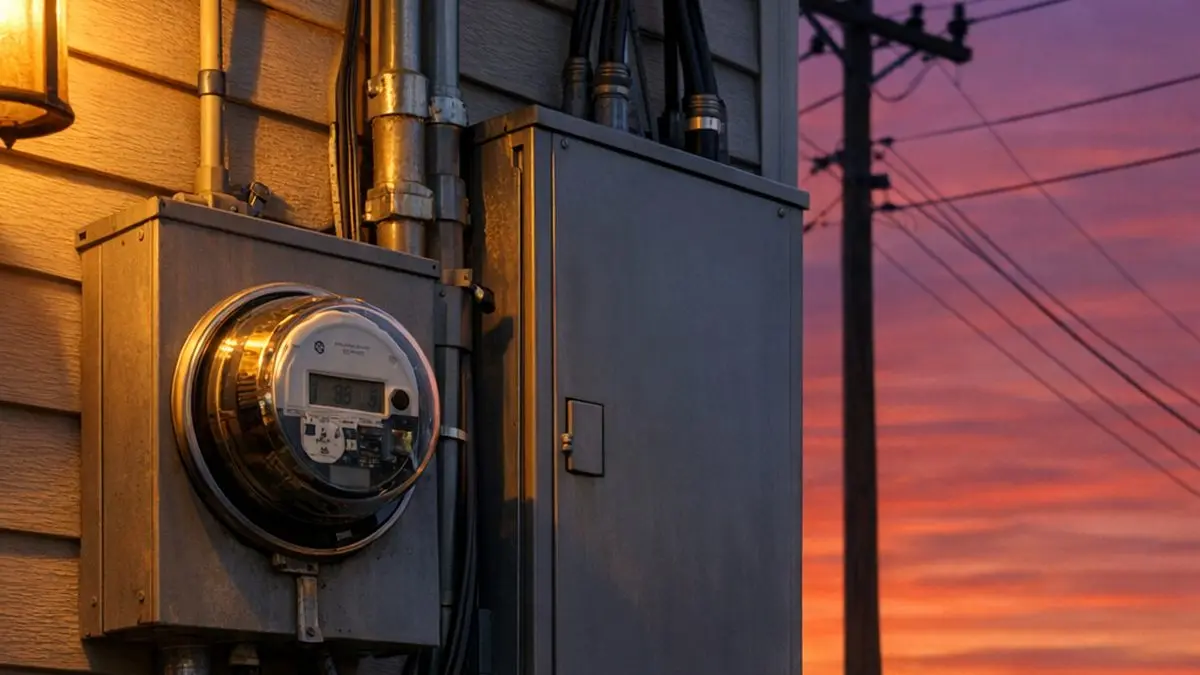
That's why Xcel installs a bidirectional meter that records energy delivered to you and energy you send back. Our post on Xcel solar meters shows how to read it.
For Xcel customers with systems up to 40 kW, net metering is monthly: surplus is credited at the average retail energy rate, credits roll forward, and Xcel pays out by check when the balance gets large enough. Co-ops and municipal utilities can treat year-end surplus differently, so check your utility's tariff. Our net metering guide has the details.
Why solar shuts off during an outage
Grid-tied inverters must stop sending power when the grid goes down, so they don't energize lines that utility crews think are dead. Under the IEEE 1547-2018 standard, equipment must cease to energize and trip within 2 seconds of an island forming. Unless you have a battery or a backup-capable system, your panels sit idle during an outage. More in do solar panels work in a power outage.
Winter vs. summer: what Minnesota sun actually delivers
The chain works the same in January as in July, but the fuel supply doesn't. NREL's long-term solar data for Minneapolis shows a south-facing panel gets about 6.4 peak sun hours a day in July and about 2.3 in December, nearly a three-to-one swing. Real systems convert roughly three-quarters of that to usable AC after heat, wiring and inverter losses.
| Example: 8 kW south-facing system, Twin Cities | July day | December day |
|---|---|---|
| Peak sun hours (NREL, Minneapolis) | 6.4 | 2.3 |
| Approximate production | ~38 kWh | ~14 kWh, less if snow-covered |
| Annual total (1,150–1,300 kWh per kW) | ~9,200–10,400 kWh for the year | Close to a typical Minnesota home's 9,000–10,000 kWh |
That swing is the reason net metering matters so much here: July surplus becomes credits that carry you through November and December. Snow usually slides off tilted panels within a day or two of sunshine. Our post on solar in Minnesota winters goes deeper.
What it takes to turn it on
A home system isn't live until the paperwork matches the hardware. In Minnesota that means an electrical permit and inspection, Xcel's interconnection review and meter, and written permission to operate before you flip the switch. Solar*Rewards, currently $0.05 per kWh produced for 10 years on qualifying Xcel systems, is applied for in that same process. The physical install on a typical home takes one to two days on site; the permits, inspection and utility steps on either side take longer, which is why a system can sit finished on the roof for a few weeks before it's allowed to run. Your installer should handle every step and tell you when each one clears.
See how it would work on your roof
Want numbers for your own house? Our free system size estimator sizes an array from your usage, or request a quote and we'll walk you through the design, from panels to meter, with a same-business-day callback.
Sources
- U.S. Department of Energy — How Does Solar Work?
- U.S. Department of Energy — Solar Photovoltaic Technology Basics
- NREL — Solar Radiation Data Manual for Flat-Plate and Concentrating Collectors (NREL/TP-463-5607), Minneapolis station
- NREL — A Primer on the Unintentional Islanding Protection Requirement in IEEE Std 1547-2018
Frequently asked.
How do solar panels work on a house?
Panels turn sunlight into DC electricity, an inverter converts it to AC, and that power feeds your breaker panel. Your home uses it first, and any extra flows out through the utility meter for bill credits under net metering.
How do solar panels convert sunlight into electricity?
Solar cells are made of treated silicon that has a built-in electric field. Sunlight absorbed by the cell frees electrical charges, the field pushes them in one direction, and metal contacts collect them as direct current.
Does solar power go to the grid first or my house first?
Your house first. Electricity flows to the nearest load, so your appliances use solar power as it's produced. Only the surplus flows out through the meter to the grid.
Do solar panels work at night?
No. Panels need light to produce power, so at night your home draws from the grid or from a battery if you have one. Net metering credits from daytime surplus offset that grid use on your bill.
Why doesn't my solar work when the power goes out?
Grid-tied inverters are required to stop energizing within 2 seconds of a grid outage to protect utility workers. To keep power during an outage, you need a battery or a backup-capable system.
How much less do solar panels produce in a Minnesota winter?
NREL's Minneapolis data shows about 2.3 peak sun hours a day in December versus about 6.4 in July, so December production can be roughly a third of July's before accounting for snow cover.


Have a question we haven't covered?
Talk to a local iSolar expert — free, no pressure. Call (651) 565-1140.