
What Is a Journeyman Electrician, and When Does a Master Matter?
Minnesota licenses electricians in tiers. Knowing who can do what, and who answers for the work, protects you on solar, EV chargers and service upgrades.
Reviewed by John Ihle, MN Master Electrician (AM005101) · NABCEP-credentialed · iSolar, Saint Paul Park, MN · Last reviewed October 2026
The short answer: A journeyman (journeyworker) electrician in Minnesota holds a state license earned with at least 48 months of qualifying experience and a passed exam, and can do electrical work for a licensed contractor. A master electrician needs 60 months of experience and a harder exam. Every licensed electrical contractor must have a responsible licensed master who answers for all of its work.
What is a journeyman electrician in Minnesota?
If you're asking what is a journeyman electrician, the short version is this: it's a licensed electrician who has finished the apprenticeship-level years, passed a state exam, and is allowed to do electrical work without someone standing over their shoulder. Minnesota's Department of Labor and Industry (DLI) uses the term "journeyworker," but you'll hear "journeyman" on every job site.
To sit for the Class A journeyworker exam, DLI requires a minimum of 48 months of qualifying experience. That's roughly four years of full-time work wiring buildings under supervision. Once licensed, a journeyworker renews every two years with 16 hours of continuing education, at least 12 of them on the National Electrical Code.
What a journeyworker can't do on their own is contract with you. In Minnesota, the license that lets a company take your money for electrical work is the electrical contractor license, and that license is tied to a master electrician.
Master electrician vs. journeyman: the real differences
A master electrician has more field time, passed a tougher exam focused on design and code, and can serve as the person legally responsible for a company's electrical work. DLI lists a minimum of 60 months of experience for the Class A master license. Its licensing page also describes paths that include one year as a licensed journeyworker or an electrical engineering degree.
| Minnesota credential | Minimum experience (DLI) | What it lets the person do |
|---|---|---|
| Registered unlicensed electrician | None (must register) | Electrical work only under direct, constant supervision of a licensed electrician from the same contractor |
| Class A journeyworker | 48 months | Perform electrical work for a licensed contractor; supervise up to two unlicensed workers |
| Class A master | 60 months | Everything a journeyworker can do, plus serve as a contractor's responsible licensed master |
| Power limited technician | 36 months | Low-voltage systems such as alarms and communications |
| Electrical contractor (business license) | Requires a responsible master, a $25,000 bond, liability and workers' comp insurance | Contract with the public for electrical work |
Master licenses expire on the last day of February in odd-numbered years, and masters also complete 16 hours of continuing education per renewal.
Supervision rules that matter on your job
Here's the rule homeowners rarely hear about: an unlicensed electrician (an apprentice) in Minnesota must be directly supervised at all times by a licensed journeyworker or master employed by the same contractor. One licensed electrician can supervise no more than two unlicensed workers, and a licensed person from one company can't supervise another company's crew.
That has practical consequences. If a crew of five shows up and only one person holds a license, the ratio doesn't work. It's fair to ask the crew lead who is licensed on site that day. A good contractor won't be offended by the question.
Who does what on a typical solar install day
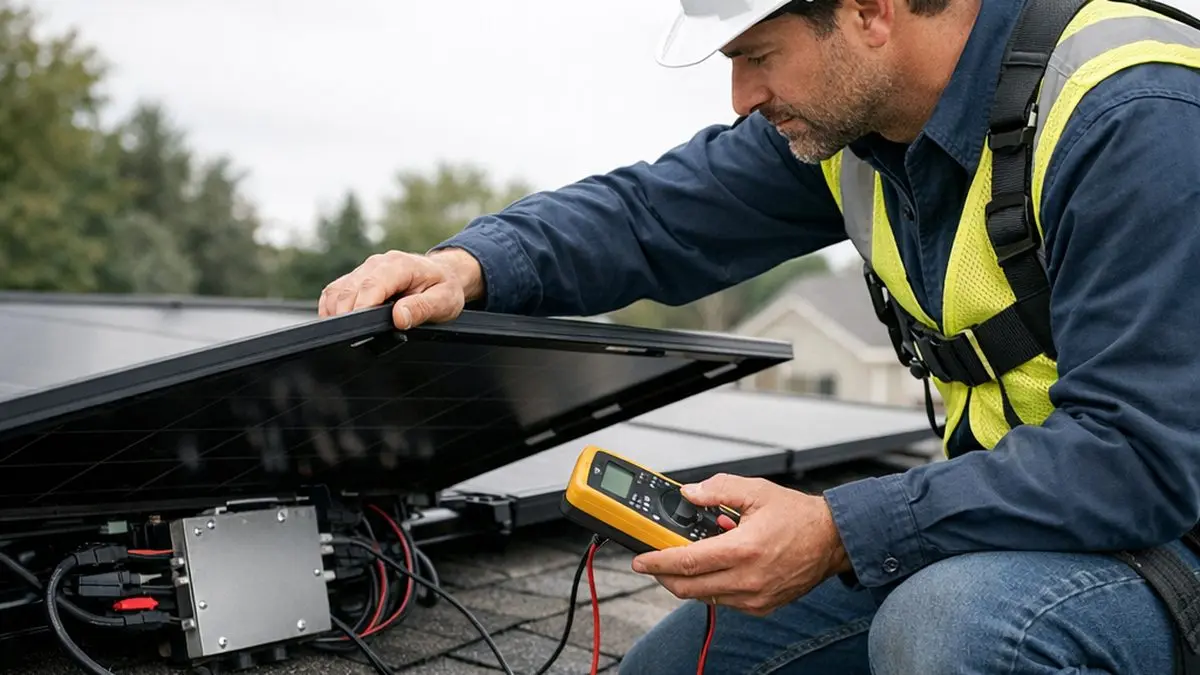
On a residential install, the split usually looks like this. Racking and panel setting is physical roof work, and crews do it as a team. The electrical side, which includes the conduit run, the inverter or microinverter wiring, the AC disconnect, and the tie-in at your panel, is licensed electrical work. A journeyworker can perform it; an apprentice can help only under direct supervision. Before the job, the master electrician has signed off on the design, including the breaker size, wire gauge and point of connection. After the job, the state or city electrical inspector checks that work before Xcel will let the system turn on.
Why the responsible master matters on solar, EV and service work
DLI requires every licensed electrical contractor to name a responsible licensed master electrician who is "responsible for all electrical work performed by the company's employees." That person must be an owner, officer, member or W-2 employee actively involved in the company's electrical work, and can't lend their license to another business.
For solar specifically, DLI is blunt: the actual installation of a solar PV system must be performed by a Minnesota-licensed electrical contractor. Since July 1, 2023, companies that sell residential solar must also hold a residential building contractor or remodeler license, which gives homeowners access to the state's Contractor Recovery Fund if a job goes unfinished.
Why we care about this on our own jobs:
- Solar ties into your service. Backfeed breakers, line-side taps, rapid shutdown and the NEC's 120% busbar rule (705.12 in the 2023 edition) are design decisions, not just wiring. A master signs off on that design under the company's license.
- EV chargers and panel upgrades are load decisions. A 48-amp charger on a 100-amp service needs a load calculation, not a guess.
- Code changes land on the master's desk. Minnesota adopted the 2026 NEC for electrical permits filed on or after August 17, 2026. Someone has to own the change in section numbers and requirements.
On Twin Cities installs we typically see the same pattern on troubled systems we're called to fix: the panels were fine, but the electrical tie-in was rushed. That's the part a master's oversight is meant to catch. Our post on what goes wrong with solar walks through the common failures.
How to become a master electrician in Minnesota
If you're on the career side of this question, the path in Minnesota looks like this:
- Register as an unlicensed electrician with DLI and work under a licensed electrician at a licensed contractor. Many people do this through a union or non-union apprenticeship program.
- Log qualifying experience. DLI counts experience in months and sets the minimum totals by license type. Some approved coursework can count toward certain licenses.
- Pass the journeyworker exam after reaching 48 months, then keep up continuing education.
- Qualify for and pass the master exam. The master minimum is 60 months of experience, and DLI's licensing page lists one year as a licensed journeyworker as one qualifying route.
- Optional specialty credentials. For solar, many installers add a NABCEP certification on top of the state license. It isn't a substitute for the license, but it shows PV-specific training.
Our own work runs under master electrician John Ihle (MN AM005101), who also holds a NABCEP credential, with iSolar's contractor license EA761814.
How homeowners can check a license before signing
Checking takes five minutes and is worth it on any job that touches your panel:
- Look up the company's electrical contractor license on DLI's license lookup and confirm it's active.
- Ask who the responsible master is. The name should match the license record.
- For solar, ask for the residential building contractor license number too. Ours is BC810322.
- Confirm a permit will be pulled. Unpermitted electrical work can cause trouble with Xcel interconnection, insurance claims and home sales.
- Ask who will be on site. Licensed electricians, not just installers, should be making the electrical connections.
Homeowners can legally do some of their own work in Minnesota, with limits. Our DIY solar guide explains where that line sits. For everything else, compare bids on licensing as carefully as on price; our solar bid checklist includes the license questions.
Getting master-licensed electrical work from iSolar
iSolar's electrical team handles panel upgrades, EV chargers, generators and surge protection as well as solar, all under the same contractor license and master. If you're weighing a service upgrade for solar, start with our guide to an electrical panel upgrade for solar or request a quote and we'll call you back the same business day.
Sources
- Minnesota DLI — Experience requirements for an electrical license
- Minnesota DLI — Electrical licensing basics (supervision, renewal, master qualifications)
- Minnesota DLI — Electrical contractor licensing basics (responsible licensed master, bond, insurance)
- Minnesota DLI — Solar installer licensing requirement
Frequently asked.
What is the difference between a journeyman and a master electrician?
Both are state-licensed. In Minnesota a Class A journeyworker needs at least 48 months of experience and a passed exam, while a Class A master needs 60 months and a harder exam. Only a master can serve as an electrical contractor's responsible licensed master, the person accountable for all of the company's electrical work.
Can a journeyman electrician pull permits in Minnesota?
Electrical work for hire in Minnesota is done under a licensed electrical contractor, and that contractor must have a responsible licensed master. A journeyworker typically works for and under that contractor rather than contracting with homeowners directly. Ask your contractor who is pulling the permit and under which license.
How long does it take to become a master electrician in Minnesota?
DLI's minimum experience for the Class A master license is 60 months, roughly five years of full-time work. Most people get there by working as a registered unlicensed electrician, passing the journeyworker exam at 48 months, then qualifying for the master exam.
How many apprentices can a journeyman supervise in Minnesota?
A licensed journeyworker or master can supervise no more than two unlicensed electricians, and they must be employed by the same licensed electrical contractor. Supervision must be direct and constant.
Does solar have to be installed by a licensed electrician in Minnesota?
DLI says the installation of a solar PV system must be performed by a Minnesota-licensed electrical contractor. Companies selling residential solar also need a residential building contractor or remodeler license. Owner-occupants have a limited exemption to do work on their own home with a permit and inspection.
How do I check if an electrician is licensed in Minnesota?
Use the Minnesota DLI license lookup to search the company and individual names. Confirm the electrical contractor license is active and ask which master electrician is responsible for the work.

Have a question we haven't covered?
Talk to a local iSolar expert — free, no pressure. Call (651) 565-1140.