
Solar Panels and Hail in Minnesota: Ratings, Insurance and What to Do After a Storm
Most certified panels are tested against one-inch hail, and they usually outlast the shingles around them. Here is what happens with bigger stones and how to handle a claim.
Reviewed by John Ihle, MN Master Electrician (AM005101) · NABCEP-credentialed · iSolar, Saint Paul Park, MN · Last reviewed October 2026
The short answer: Most certified solar panels are tested to survive 1-inch (25 mm) hail at about 23 m/s under IEC 61215, and one-inch hail rarely breaks quality panels. Golf ball hail and larger can crack glass or cells. Hail damage is usually covered by homeowners insurance, not the panel warranty, so check your wind/hail deductible and get an inspection after big storms.
Minnesota hail: how often and how big
If you live in Minnesota long enough, you will replace a roof because of hail. Spring and summer thunderstorms routinely drop stones big enough to dent siding and shred shingles, and the metro is not spared.
One day shows the scale. On May 19, 2022, University of Minnesota Extension counted 98 reports of hail one inch or larger across ten counties, mostly in east-central and southeastern Minnesota. Stones near Albert Lea reached about three inches, and Twin Cities hail ranged from marble to ping-pong size. That was one storm day.
So the question for a solar buyer is not whether your panels will see hail. It is how big the hail will be, and what happens when it lands.
What solar panels are tested to withstand
Most certified panels sold in the U.S. pass the hail test in IEC 61215, the international module qualification standard. The test fires 25 mm (about 1 inch) ice balls at about 23 meters per second (roughly 51 mph) at specific points on the panel. To pass, the panel cannot crack, lose its insulation or lose more than a small amount of power.
A one-inch test is a minimum, not a ceiling. Many panels survive much larger stones, but the energy climbs fast as hail gets bigger, because a ball twice as wide weighs about eight times as much and falls faster.
| Hail size | Common comparison | How it relates to panel testing |
|---|---|---|
| 1 inch (25 mm) | Quarter | The IEC 61215 baseline test; most certified panels are tested to this |
| 1.75 inch (44 mm) | Golf ball | Above the baseline; outcome depends on glass, frame and cell design |
| 2 inch (50 mm) | Hen egg | Used in PVEL's tougher independent Hail Stress Sequence, fired at 32 m/s |
| 2.75 inch (70 mm) | Baseball | Can break panel glass and roofing alike |
By our arithmetic, PVEL's 50 mm stone at 32 m/s carries roughly 15 times the impact energy of the IEC test stone. PVEL reports it has not observed glass breakage at the IEC baseline, which matches what we see in the field: one-inch hail rarely breaks a quality panel. Golf ball hail and up is where damage starts.
A useful perspective: hail that cracks a panel has usually already ruined the shingles around it. In many storms, panels act as armor for the roof underneath.
How to choose tougher panels
If you are buying in a hail-prone area, you can tilt the odds in your favor:
- Read the hail line on the spec sheet. Some manufacturers list hail testing beyond the IEC baseline. Our guide to reading a solar panel spec sheet shows where to find it.
- Look for independent extended testing. Third-party labs such as PVEL publish results from hail tests well beyond the certification minimum.
- Understand glass-glass vs. glass-backsheet. In PVEL's early hail stress results, glass-glass panels resisted cell damage better, while glass-backsheet panels were less likely to see the glass break. There is no single best construction; ask how the model you are being quoted performed.
- Mind the microcracks. A panel can keep its glass intact and still suffer cracked cells that cost output over time. That is why post-storm production matters more than how the glass looks.
- Buy from a manufacturer likely to be around. A strong warranty is only useful if the company can honor it.
What homeowners insurance usually covers
Hail damage to rooftop solar is generally handled under your homeowners policy as part of the dwelling, not under the panel warranty. Manufacturer warranties cover defects, and hail is an outside event.
The Minnesota Department of Commerce has flagged several policy features worth checking before storm season:
- Separate wind/hail deductibles. Some policies use a higher deductible for wind and hail, sometimes a percentage of the home's value, such as 1 percent or more. On a typical Minnesota home, that is real money.
- Cosmetic damage exclusions. State law does not address them, and some carriers now pay only when roofing or siding is punctured or torn and no longer keeps water out.
- Coverage for the solar system itself. Tell your insurer when you add panels, and confirm the system is included in your dwelling coverage limit.
We cover the questions to ask your agent in homeowners insurance and solar panels in Minnesota.
What to check after a hailstorm
Do not climb on the roof. Wet glass panels and hail-damaged shingles are a bad combination. Most of the first check can happen from the ground and your phone.
| Check | What you are looking for | Who does it |
|---|---|---|
| Monitoring app, next sunny day | Panels or strings producing less than their neighbors or than the same day last year | You |
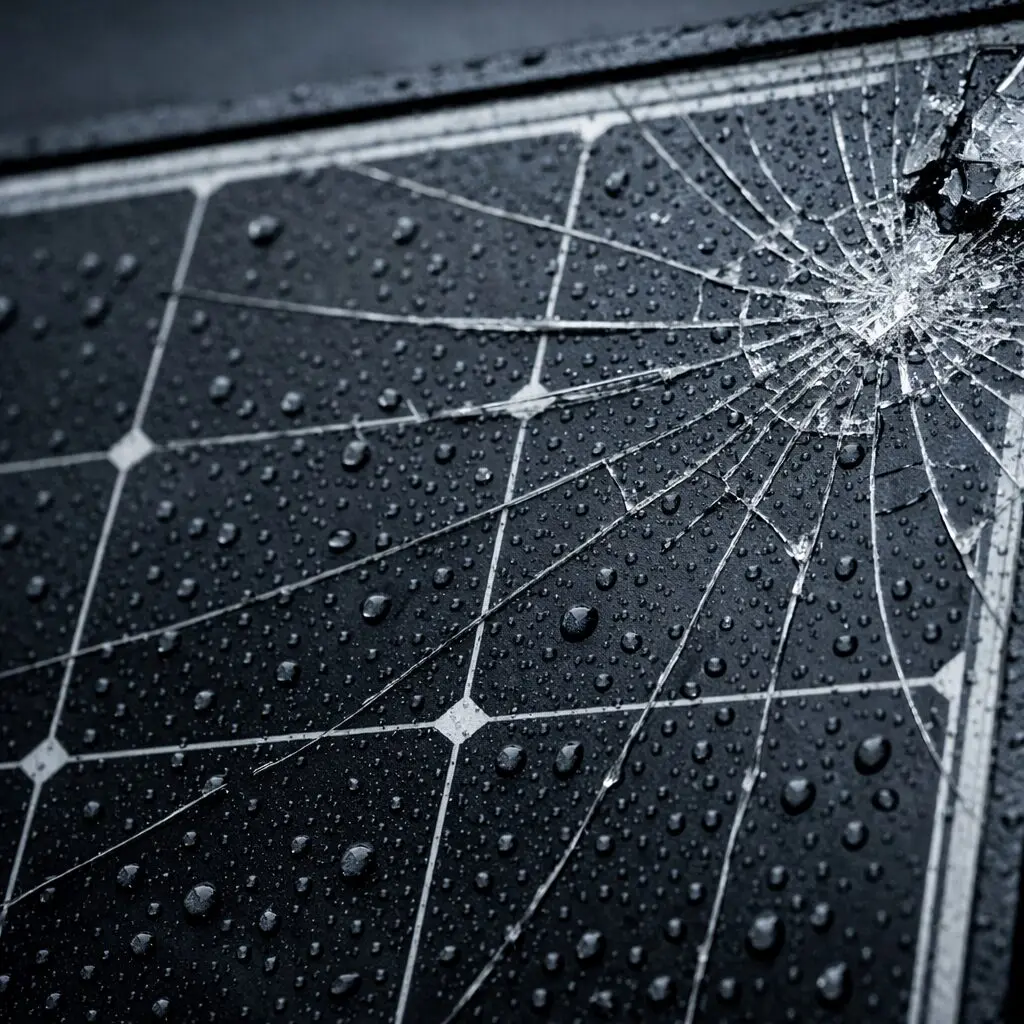
| Binoculars from the yard | Spiderweb cracks, shattered glass, bent frames, dislodged wiring | You |
| Gutters, siding, cars, soft metals | Dents that indicate hail size | You |
| Close-up inspection | Glass, frames, connectors, racking, roof around the array | Licensed solar installer |
| Electrical testing | Insulation faults, hidden cell damage, production loss | Licensed solar installer |
A cracked panel can let water reach the cells and wiring, so do not wait for it to fail outright. If an inverter reports a ground fault after a storm, leave it off and call us. If your app simply stopped reporting, check our offline monitoring guide first.
Photograph everything with dates before repairs, and have your installer document the system's condition for the adjuster. Be wary of storm-chasing crews that knock the day after a hailstorm, push you to sign a contract on the spot, or offer to “handle the insurance” for you.
Hail and commercial or farm arrays
Hail is a bigger financial issue as systems get larger. An AXIS insurance report on five years of renewable energy claims found that hail accounted for more than half of weather-related solar claims in the U.S. and Canada and about 55 percent of the gross claim dollars for solar natural-catastrophe and extreme-weather losses in North America. Those figures come mostly from larger projects, but the lesson carries over to a barn roof or a ground mount on the back forty.
- Ask your commercial or farm insurer how the array is scheduled, what deductible applies, and whether lost production during repairs is covered.
- Keep a few spare panels of the same model on larger systems. Exact replacements get harder to find as models change.
- Use monitoring with alerts, so a damaged string does not go unnoticed for a whole summer.
If you are planning a larger system, our farm ground-mount guide covers siting and design choices.
If the roof needs replacing: detach and reset
Hail claims in Minnesota often end with a new roof. If your roof has solar on it, the panels have to come off first and go back on after. That work is called detach and reset, and it is electrical work that needs a licensed electrician and typically an electrical permit.
- Make sure it is in the claim. The adjuster's estimate should include removing, storing and reinstalling the solar system, plus any damaged panels.
- Coordinate the schedule. The roofer and solar crew need to hand off cleanly so your system is not sitting on the lawn for weeks.
- Replace flashing and mounts with the roof. New shingles deserve new flashing at every attachment point.
Our storm damage and detach-reset guide walks through the full sequence, and our sister company Three Rivers Contracting handles roofing so one team can manage both sides.
Get a post-storm inspection
If hail hit your neighborhood, an inspection now is cheaper than chasing a slow leak or a failing panel later. We inspect and repair any brand of system and document damage for your insurer. Start with our detach and reset service if the roof is being replaced, or solar panel repair for a damage check. Call (651) 565-1140.
Sources
- U.S. Department of Energy (hosted paper) — Evaluation of hail grain production methods: round robin in Switzerland and Austria (IEC 61215 hail test parameters)
- PVEL — PV Module Reliability Scorecard: Hail Stress Sequence
- University of Minnesota Extension — Let's declare May as hail month
- Insurance Business — Hail causes more than half of solar panel weather claims (AXIS report)
- Minnesota Department of Commerce via pctribune.com — Homeowners should check insurance coverage for wind, hail limits
Frequently asked.
Can hail damage solar panels?
Yes, but it takes large hail. Most certified panels are tested against one-inch ice balls at about 51 mph, and they rarely break at that size. Golf ball hail and larger can crack the glass or the cells inside.
What size hail can solar panels withstand?
The IEC 61215 baseline test uses 25 mm (1 inch) hail at 23 m/s. Many panels survive larger stones, and some are independently tested with 50 mm (2 inch) hail. Check the spec sheet and any third-party test results for the model you are buying.
Does homeowners insurance cover hail damage to solar panels?
Usually, if the system is part of your dwelling coverage. Watch for a separate wind/hail deductible, which can be a percentage of your home's value, and for cosmetic damage exclusions. Tell your insurer when you install solar and confirm coverage in writing.
Does the solar panel warranty cover hail?
Generally no. Manufacturer warranties cover defects in materials and workmanship, and hail is an outside event. Hail damage is normally an insurance claim.
How do I know if hail damaged my solar panels?
Compare your monitoring data on the next sunny day with neighboring panels or the same period last year, and look for cracks or shattered glass with binoculars from the ground. Hidden cell cracks need a professional inspection and electrical testing.
Do solar panels protect my roof from hail?
The roof directly under the panels is shielded by the glass, which is often tougher than shingles. The exposed roof around the array still takes the hit, so a hail-damaged roof often needs replacing with the panels detached and reset.


Have a question we haven't covered?
Talk to a local iSolar expert — free, no pressure. Call (651) 565-1140.