
Squirrels Under Solar Panels: Signs, Risks and How to Keep Them Out
That scratching on the roof may be a squirrel nest under your solar array. Here is why it matters, what chewed wiring can do, and the fix that actually lasts.
Reviewed by John Ihle, MN Master Electrician (AM005101) · NABCEP-credentialed · iSolar, Saint Paul Park, MN · Last reviewed October 2026
The short answer: Squirrels nest under solar panels because the gap is sheltered and warm, and they chew the wiring. That can cut production, trigger ground faults and, rarely, create a fire risk. The lasting fix is to remove the animals and nest, repair any chewed wiring, and install perimeter critter guard mesh clipped to the panel frames, with no roof penetrations.
Why squirrels move in under Minnesota solar panels
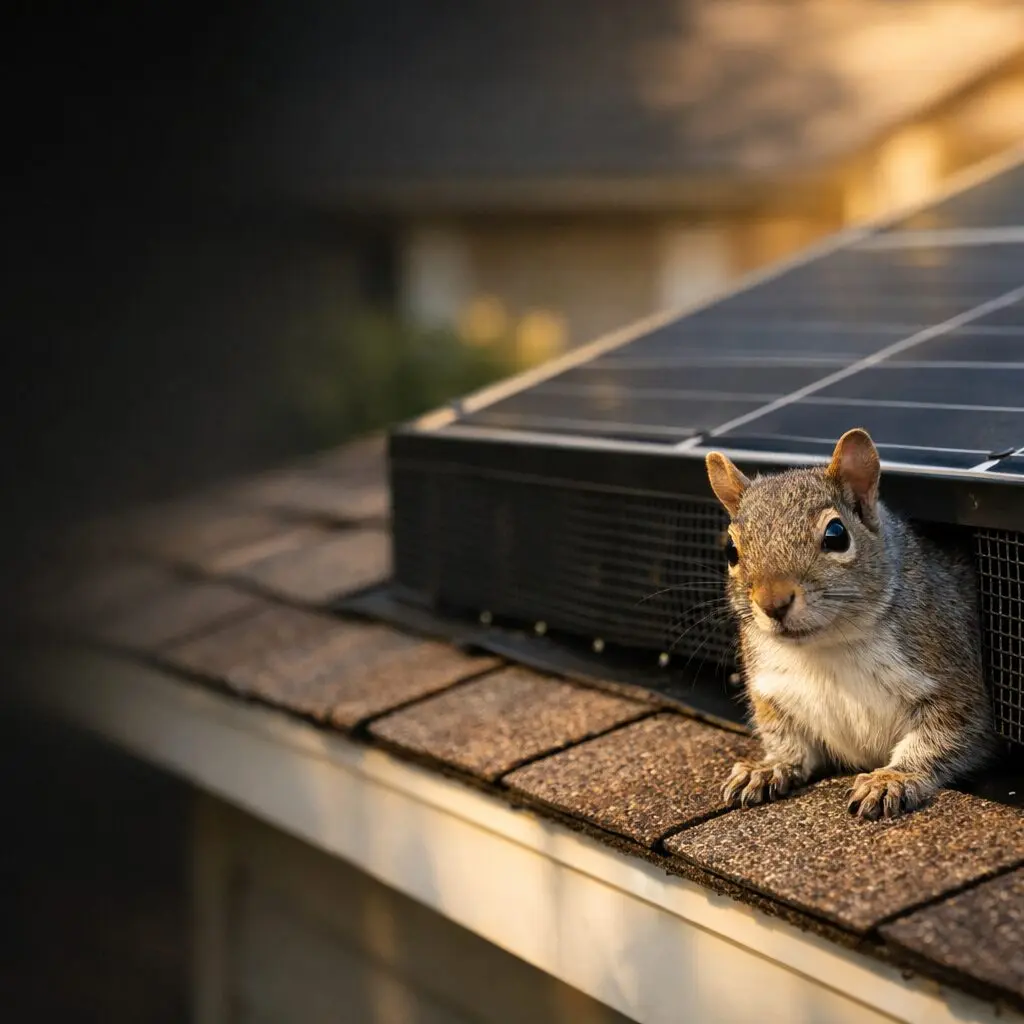
To a gray or red squirrel, a rooftop solar array is prime real estate. The gap between the panels and the shingles is only a few inches tall, it is shaded in summer, it stays a few degrees warmer than open air in winter, and hawks cannot reach it. Add a mature oak or maple over the roof, and you have a ready-made nest site with a food source next door.
Most homeowners never think about this until they hear scratching on the roof deck, or their monitoring app shows one panel (or a whole string) quietly dropping out. By then the animals have often been living there for weeks.
Nests under panels are not universal. Plenty of arrays never see a squirrel. But in the wooded suburbs we work in every week, from Woodbury and Cottage Grove to Minnetonka and Shoreview, it is one of the most common service calls we get.
Signs you have squirrels (or birds) under your array
You do not need to climb the roof to spot most of the warning signs. Look from the ground with binoculars and check your monitoring app.
- Nest material sticking out from under the panel edges: leaves, twigs, grass, insulation fluff.
- Debris piling up in the gutter below the array faster than leaf fall would explain.
- Scratching or thumping overhead in the early morning or at dusk.
- Squirrels running in and out at the same corner of the array again and again.
- Chewed bits of black wire jacket or plastic clips on the roof, deck or driveway.
- A panel or string reading zero in your app while its neighbors produce normally, or an inverter that keeps reporting a ground fault or isolation fault.
Birds (especially pigeons and starlings) cause the same problems with nesting debris and droppings, and the same fixes work for them.
Why it matters: chewed wiring, ground faults and fire risk
The real problem is not the nest. It is the wiring. Rodent teeth never stop growing, so squirrels gnaw constantly, and the soft jacket on solar wiring is an easy target. Installers and suppliers see it often enough that it is a recognized cause of PV faults: chewed conductors and nest debris can lead to ground faults that take part of an array offline until modules are removed and the nest is cleared.
Here is what chewed wiring can do, in rough order of how often we see it:
- Lost production. A cut conductor opens the circuit. On a microinverter system you lose one or two panels; on a string system you can lose the whole string.
- Ground faults. When the copper is exposed and touches the metal racking, the inverter detects current leaking to ground and shuts down for safety. That protects you, but your system makes nothing until it is fixed.
- Arcing and heat. Solar panels make direct current whenever light hits them. A damaged, partially severed conductor can arc. Modern inverters include arc-fault detection to shut things down, but a dry nest of leaves sitting under a hot panel is exactly the fuel you do not want near a fault.
- Roof damage. Nests hold moisture against shingles, plug gutters and can lead squirrels to chew into soffits and attics once they are established.
The fire scenario is rare. But it is a real, preventable risk, and it is the reason we treat squirrel activity under an array as a repair call, not a cosmetic one. For more on how arrays fail and how good installers prevent it, see our look at whether solar panels are a fire risk.
Critter guard mesh: how it works and what to compare
The fix that actually lasts is exclusion: closing off the gap around the array so animals cannot get underneath. The standard method is a critter guard, a roll of coated, galvanized wire mesh fastened to the panel frames around the full perimeter of the array with clips designed for that purpose. Done right, it requires no drilling into the panels or the roof.
A few details separate a good guard from a bad one:
- It runs continuously around every exposed edge, including the gaps between separate panel groups.
- It is cut to sit against the roof surface without being fastened through the shingles.
- The clips are rated for the panel frame so they do not void the module warranty or loosen in our freeze-thaw cycles.
- The wiring underneath is cleaned up and secured before the guard goes on, so you are not sealing in a problem.
Mesh does have one trade-off: it can catch some leaves along its edge, which is one reason we include critter checks in routine maintenance.
| Option | How well it works | Notes |
|---|---|---|
| Perimeter critter guard (mesh) | Best long-term fix | Physical barrier; no roof penetrations; inspect occasionally for leaves |
| Tight wire management | Reduces chewing targets | Should be standard on every install; does not stop nesting by itself |
| Spikes, deterrent sprays, noise devices | Short-lived at best | Animals adapt; sprays wash off; some chemicals can harm panel glass or coatings |
| Trapping only | Temporary | New squirrels move into the same open gap unless it is sealed |
| Trimming overhanging branches | Helpful supplement | Reduces jumping access and shading; keep limbs well back from the roof |
Our critter guard installation service covers the clean-out, wiring check and mesh in one visit.
Removing nests and animals the right way
Do not reach under your panels. Even with the inverter shut off, the panels themselves stay energized any time the sun is up, and the gap under an array is full of conductors you cannot see. Working on a pitched roof without fall protection is its own hazard.
The order of operations matters:
- Get the animals out first. In Minnesota, a landowner or occupant can take a squirrel that is damaging property without a permit, and squirrels do not need to be reported to a conservation officer, according to the Minnesota DNR. Poison is not allowed, and city ordinances may limit you to live trapping. Many homeowners hire a wildlife control company for this step, especially if there may be young in the nest.
- Remove nest material and debris from under the array and out of the gutters.
- Inspect every conductor and connector that was exposed to the animals. Chewed wire gets replaced, not taped.
- Test the system and confirm every panel is reporting in the monitoring app.
- Install the critter guard so the problem does not come back next season.
If you skip straight to mesh without the clean-out and wiring check, you can trap damage (or an animal) inside the array.
What squirrel-proofing typically costs
We do not publish a flat price because jobs vary too much. What you can expect from any reputable installer:
- Critter guard is typically quoted by the linear foot of array perimeter, or as a per-system price for a standard residential array. More separate panel groups mean more edge and more cost.
- Roof access matters. A steep two-story roof needs more fall-protection setup than a single-story ranch.
- Wiring repair, if needed, is usually billed as time and materials on top of the guard.
- Animal removal is often a separate bill from a wildlife control company.
Ask whether the quote includes the clean-out and a system test, not just the mesh. Also check your paperwork: animal damage is often treated as an outside cause rather than a product defect, so read how your coverage handles it. Our guide to solar warranties explains the difference between equipment, workmanship and third-party coverage.
Prevention at install time
If you are still planning your system, this is the cheapest moment to deal with squirrels:
- Ask how the installer manages wiring. Conductors should be clipped tight to the rails and frames, with no loose loops hanging toward the roof, and transition into conduit at the junction box.
- If you have large trees within jumping distance of the roof, consider adding critter guard at install. It goes on faster with the crew already on the roof.
- Trim overhanging limbs before installation day.
- Use monitoring that shows panel-level production, so a single dead panel stands out right away. If your app is blank, our offline monitoring troubleshooting guide walks through the usual causes.
Get a squirrel check or repair
If you see nest material, chewed wire or a panel reading zero, call us before the damage spreads. Our master electrician-led crews handle the clean-out, wiring repair and critter guard in one trip, on systems we installed and on systems other companies installed. Start with our solar panel repair service or call (651) 565-1140.
Sources
Frequently asked.
How do I know if squirrels are under my solar panels?
Look for leaves or twigs sticking out from under the panel edges, debris collecting in the gutter below the array, scratching sounds at dawn or dusk, and chewed bits of wire on the ground. A panel or string that suddenly reads zero in your monitoring app is another strong clue.
Can squirrels damage solar panels?
They rarely hurt the glass, but they do chew the wiring underneath. Chewed conductors can cut production, cause ground faults that shut the inverter down, and in rare cases lead to arcing. Nests also trap leaves and moisture against the roof.
Does critter guard void my solar panel warranty?
A properly installed critter guard uses clips designed for solar panel frames and does not drill into the modules or the roof, so it should not affect the panel warranty. Ask your installer which clip system they use and confirm it is compatible with your panel model.
How much does it cost to squirrel-proof solar panels?
Critter guard is typically quoted by the linear foot of array perimeter or as a per-system price, with wiring repairs billed separately as time and materials. Roof height, pitch and the number of separate panel groups all affect the price, so get an itemized quote that includes clean-out and a system test.
Can I remove a squirrel nest from under my solar panels myself?
We do not recommend it. Solar panels are energized whenever the sun is up, even with the inverter off, and you would be reaching into a space full of conductors on a pitched roof. Have the animals removed first, then let a licensed solar electrician clear the nest and check the wiring.
Do squirrel repellents work on solar panels?
Sprays, spikes and noise devices usually work for a short time at best because squirrels adapt and sprays wash off. Some chemicals can also harm panel glass or coatings. A physical mesh barrier around the array is the only reliable long-term solution.


Have a question we haven't covered?
Talk to a local iSolar expert — free, no pressure. Call (651) 565-1140.