
Tesla Powerwall 3 in Minnesota: An Electrician's Read of the Spec Sheet
The Powerwall 3 packs a battery and a solar inverter in one box. Here's what its numbers mean in a Minnesota garage, on a 200-amp panel, during a January outage.
Reviewed by John Ihle, MN Master Electrician (AM005101) · NABCEP-credentialed · iSolar, Saint Paul Park, MN · Last reviewed October 2026
The short answer: The Tesla Powerwall 3 stores 13.5 kWh, delivers 11.5 kW continuous, and includes a solar inverter that accepts up to 20 kW of panels. Its rated operating range bottoms out at -4°F, so in Minnesota it belongs in an attached garage or other sheltered spot. Xcel customers can get $175/kWh toward it, capped at $5,000.
Tesla Powerwall 3 specs that matter in Minnesota
The Tesla Powerwall 3 is different from earlier Powerwalls in one big way: it's a battery and a hybrid solar inverter in a single cabinet. Solar panels can wire straight into it, and it can run your home's backup loads. Here are the numbers from Tesla's North American installation manual that we pay the most attention to, with what each means for a Minnesota home.
| Spec (Tesla) | Powerwall 3 | What it means here |
|---|---|---|
| Energy capacity | 13.5 kWh | Roughly a day of essential loads, less in a January outage |
| Continuous power | 11.5 kW | Enough to run most of a home at once, including a well pump or AC |
| Motor start | 185 A LRA (1 second) | Helps start compressors and pumps; confirm against your equipment |
| Solar input | Up to 20 kW STC, 6 MPPTs, 60–550 V DC | Can be the only inverter for a typical home array |
| Operating temperature | -4°F to 122°F (-20°C to 50°C) | Outdoor walls in Minnesota fall below this range in cold snaps |
| Enclosure | NEMA 3R, indoor and outdoor rated | Rain-tight, but rating isn't the same as cold tolerance |
| Weight and size | 287 lb; 43.25 × 24 × 7.6 in | Needs solid wall framing or floor mounting |
| Expansion | Up to 4 units (3 in some configurations) | Room to grow if your critical loads grow |
| Warranty | 10 years | Read Tesla's terms for throughput limits |
Garage vs. outdoor siting below 0°F
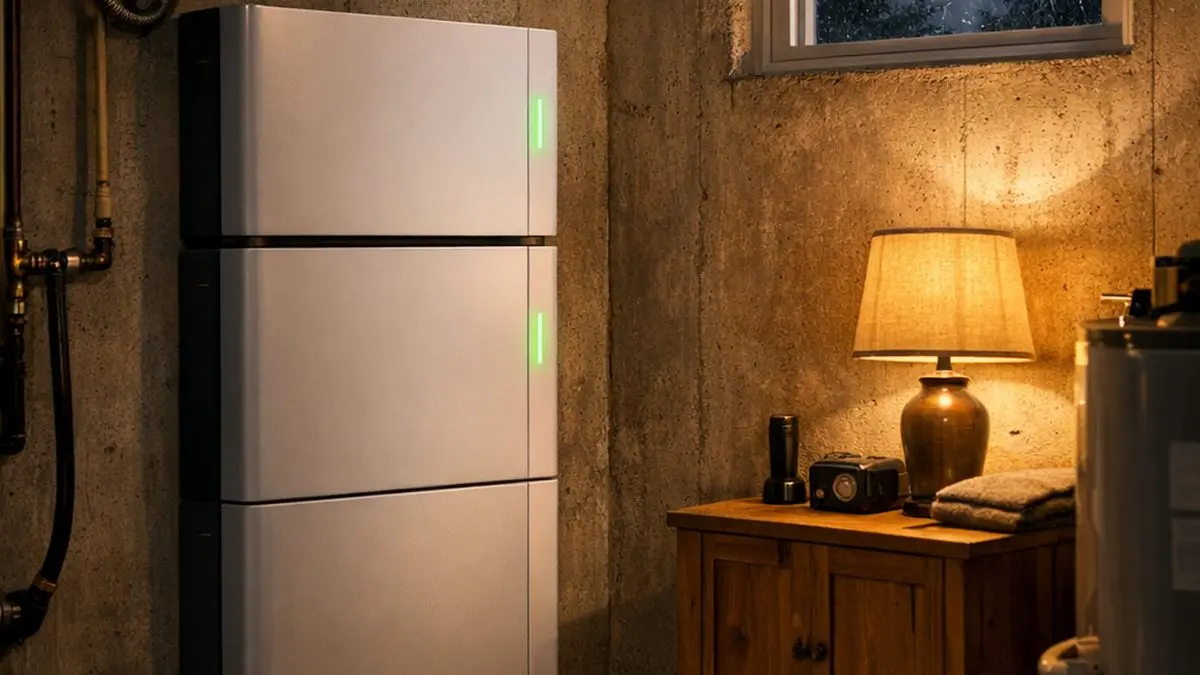
The spec we flag first for Minnesota buyers is temperature. Tesla rates the Powerwall 3 to operate from -4°F up to 122°F, and to be stored between -4°F and 86°F. Twin Cities winters routinely bring subzero nights, and an outdoor wall on the north side of a house can sit well below -4°F for days in a hard cold snap. That's exactly when you'd want backup power.
For that reason, our default advice for any battery in Minnesota is an attached garage or other sheltered, code-compliant location. An attached garage usually stays well above the outdoor low because it shares walls with heated space. Things to plan for:
- Vehicle impact protection. Fire and electrical codes generally require protection where a vehicle could hit the unit. Bollards or a recessed location are common.
- Clearances and fire separation. Indoor battery rules cover where in the home a battery can go and how much capacity is allowed in each space. Our plain-English guide to indoor battery code explains them.
- Detached garages and sheds. Tesla's manual allows up to four units, but limits outdoor wall-mount and most indoor installs to three; detached garages and storage sheds are the exception. An unheated detached garage also brings trenching and the same cold-weather question as an outdoor wall.
- Heat matters too. Tesla notes performance may be derated above 104°F, so avoid a south-facing wall in full sun.
Tying a Powerwall 3 into a 200-amp panel
Because the Powerwall 3 is also an inverter, it connects to your electrical system like a solar inverter does, and the same panel math applies. A quick electrician's example:
- 11.5 kW at 240 V is about 48 amps of continuous output.
- Code sizes the breaker or overcurrent device at 125% of continuous current, so that's a 60-amp circuit.
- Under the NEC's 120% busbar rule (705.12 in the 2023 edition), a 200 A panel with a 200 A main breaker can accept only up to 40 amps of backfed breakers.
So on many 200-amp homes, a full-output Powerwall 3 doesn't fit as a simple backfed breaker. The common solutions are a line-side (supply-side) connection, a main breaker derate where loads allow it, or a panel upgrade. On 100-amp services, the conversation usually starts with a service upgrade. Our guide to an electrical panel upgrade for solar covers when each option makes sense, and our free panel capacity check gives you a first read.
Minnesota adopted the 2026 NEC for electrical permits filed on or after August 17, 2026, so section numbers on your permit may differ from older references, but the busbar logic is the same.
Xcel interconnection and incentives
A Powerwall 3 paired with solar is interconnected generation, so it goes through Xcel's interconnection process. Xcel's storage program requires, along with the one-line diagram and site plan, a signed Declaration of Energy Storage Operation for the configuration you're using. Missing declarations get applications rejected at completeness review, which delays your interconnection agreement.
The incentive side, as of October 2026:
- Xcel customers: $175 per kWh of capacity, or $370 per kWh for income-qualified customers, capped at $5,000. One Powerwall 3 (13.5 kWh) works out to about $2,363 at the standard rate, or $4,995 income-qualified. The battery must be charged by solar and be 50 kWh or less, and Xcel pays within 30 business days of permission to operate.
- Outside Xcel territory: Minnesota Commerce offers $250 per kWh up to $7,000, first come, first served. Commerce listed about $1.40 million remaining as of October 7, 2026.
- Federal: the residential 25D credit, which covered batteries, ended for systems placed in service after December 31, 2025.
What it will (and won't) back up
An 11.5 kW inverter is strong enough to start and run most household loads, which is why the Powerwall 3 is often sold as whole-home backup. Capacity is the limit, not power. A few Minnesota realities:
- Gas furnaces back up well. The blower and controls draw a few hundred watts, so a furnace, fridge, freezer, sump pump, lights and internet can run a long time on 13.5 kWh.
- Electric heat doesn't. Electric baseboard, a heat pump in deep cold, or an electric water heater can drain one battery in hours.
- Winter recharge is weak. Short December days and snow on panels mean little solar refill during a winter outage.
- Bill savings are modest under Xcel's monthly net metering. The value is mostly backup, unless you move to Xcel's optional time-of-use plan, where shifting evening use (summer peak around 21¢/kWh from 6 to 9 p.m.) can pay. See our post on Xcel time-of-use rates and solar.
Size from your loads, not from the box. Our battery sizing tool lists common Minnesota loads and how long a given battery covers them.
Installer's notes before you buy
- Ask for a load list with your quote: which circuits are backed up and roughly how many hours 13.5 kWh covers in summer and in January.
- Ask whether your existing inverter stays, or whether the Powerwall 3 becomes the solar inverter. Retrofits onto microinverter systems are configured differently from new installs.
- Get the backup configuration in writing: whole-home or partial, and which circuits.
- Confirm who handles Xcel paperwork, the storage declaration and the incentive application.
- Compare against other batteries on cold rating, expansion and warranty. Our Minnesota home battery guide lays out the field.
Plan your backup with iSolar
We'll look at your panel, loads and garage before recommending any battery. Start with our battery backup page or request a quote, and we'll call back the same business day. We install several battery brands and will tell you plainly if a different battery, or a smaller one, fits your home better.
Sources
Frequently asked.
How much does a Tesla Powerwall 3 hold?
Tesla lists the Powerwall 3 at 13.5 kWh of usable energy at 25°C at the beginning of life, with 11.5 kW of continuous power. Up to four units can be combined in some configurations.
Can a Powerwall 3 be installed outside in Minnesota?
It's indoor and outdoor rated (NEMA 3R), but Tesla's operating range only goes down to -4°F. Minnesota cold snaps regularly go below that, so we recommend an attached garage or other sheltered, code-compliant location.
Does the Powerwall 3 work with an existing solar system?
Yes, in most cases. It can act as the solar inverter for new panels, or be added to an existing array. The configuration, paperwork and backup wiring differ between those approaches, so ask your installer which applies.
Can a Powerwall 3 run my whole house?
Its 11.5 kW output can run most household loads at once, but 13.5 kWh is a limited amount of energy. Gas-heated homes can ride out long outages on essentials; homes with electric heat will drain it quickly in winter.
What incentives are there for a Powerwall 3 in Minnesota?
Xcel pays $175 per kWh, or $370 per kWh for income-qualified customers, capped at $5,000, for solar-charged batteries up to 50 kWh. Outside Xcel territory, the state offers $250 per kWh up to $7,000 while funds last. The federal 25D credit is no longer available for new installs.
Do I need a panel upgrade for a Powerwall 3?
Often not a full upgrade, but a 60-amp output circuit usually exceeds the 40 amps of backfeed a 200 A panel with a 200 A main allows. A line-side connection, a main breaker derate or a panel upgrade solves it, depending on your service.


Have a question we haven't covered?
Talk to a local iSolar expert — free, no pressure. Call (651) 565-1140.