
Ground Mount vs. Roof Mount Solar in Minnesota: Cost, Production and Zoning
Roof mounts usually cost less. Ground mounts often produce more and shed snow better. Frost depth, trench length and your city's setbacks decide which one wins.
Reviewed by John Ihle, MN Master Electrician (AM005101) · NABCEP-credentialed · iSolar, Saint Paul Park, MN · Last reviewed October 2026
The short answer: For most Minnesota homes with a south, east or west roof, a roof mount costs less per watt. A ground mount costs more because of frost-depth foundations (42 inches in the metro, 60 up north), trenching and extra steel, but it can face due south at a steeper tilt, sheds snow better, suits bifacial panels and never touches your roof.
The quick verdict
For most suburban Minnesota homes with a decent south, east or west roof, a roof mount is the lower-cost, simpler choice. A ground mount earns its higher price when the roof is shaded, faces north, is due for replacement soon, or is too small for the system you need, and when you have open land with good sun.
The rest of this guide covers where the extra ground-mount cost comes from, what you get for it in production and snow performance, and the zoning rules that decide whether you can build one at all.
| Factor | Roof mount | Ground mount |
|---|---|---|
| Structure | Rails attached to rafters with flashed mounts | Steel or aluminum racking on posts, piles or piers |
| Foundations | None; uses the house | Must resist frost heave: below frost depth, or driven/helical piles |
| Wiring run | Short, mostly on the house | Trench from the array to the house or an outbuilding |
| Tilt and direction | Set by the roof | Chosen for production, usually due south |
| Snow | Slides on steep, smooth roofs; can dump on walkways | Steep tilt sheds well; snow piles at the low edge need clearance |
| Roof leaks and reroofing | Attachments to maintain; detach and reset at reroof time | No roof involvement |
| Space and zoning | Roof area and fire setbacks | Yard setbacks, height limits, sometimes screening |
| Maintenance access | Ladder or lift | Standing on the ground |
What makes a ground mount cost more
On a roof mount, your house is the structure. On a ground mount, you build the structure, then wire it to the house. Three things drive the difference.
Foundations and frost depth
Minnesota frost is the big one. The state building code sets minimum footing depth for frost protection at 42 inches in southern Minnesota, including Hennepin, Ramsey, Dakota, Washington and Anoka counties, and 60 inches in the northern zone, including St. Louis, Itasca, Crow Wing and Otter Tail counties (Minnesota Rules 1303.1600). Unless an engineer shows otherwise, posts need to get below that line or they'll heave and twist the racking over a few winters.
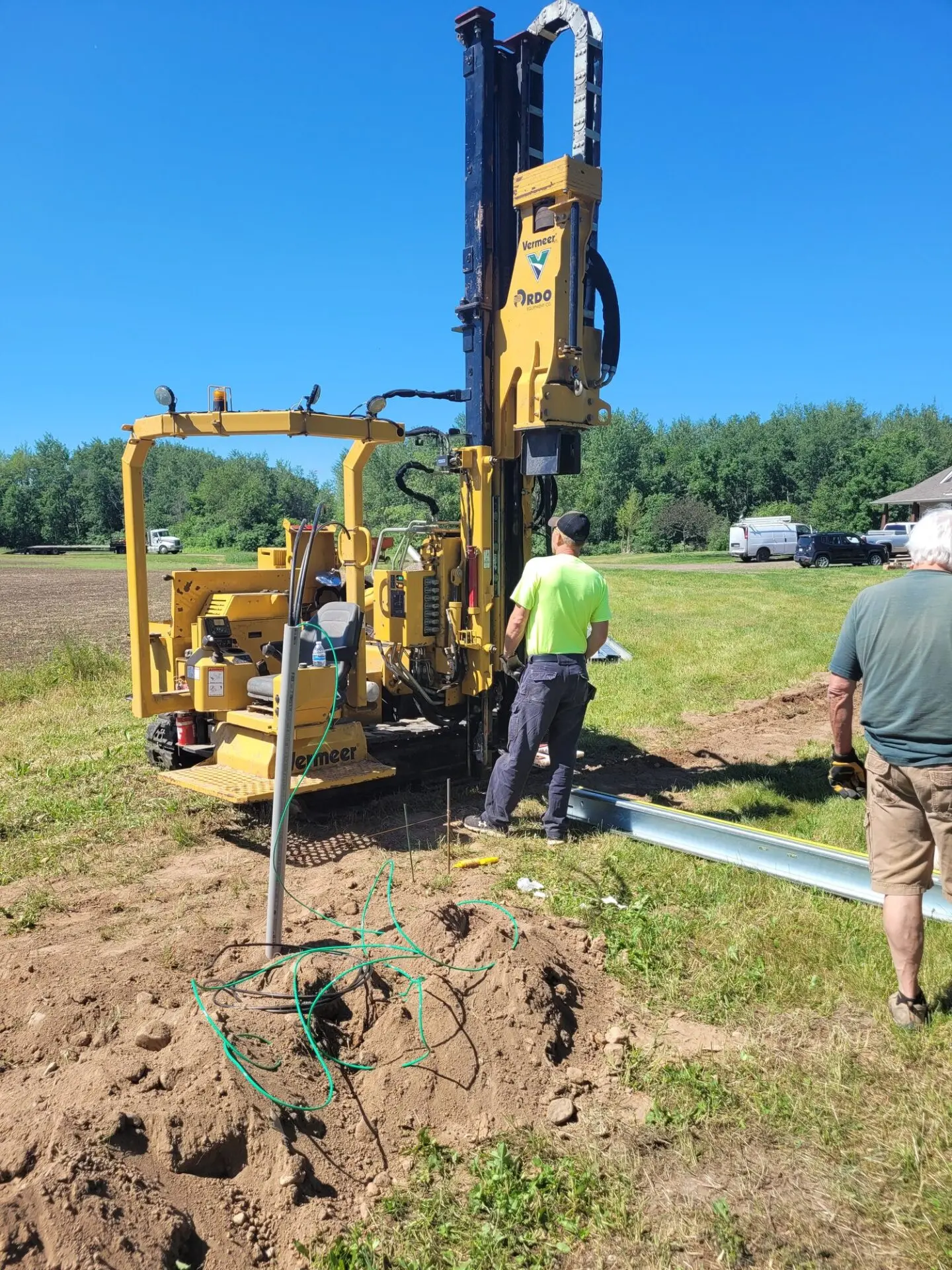
That's done one of three ways: concrete piers poured below frost depth, driven steel piles, or helical piles screwed in with a machine. Which one fits depends on soil, rock, wind and snow loads, and the racking manufacturer's engineering. Rocky ground and high water tables add cost fast.
Trenching and wire
The array has to connect to your electrical system, usually by an underground run. The National Electrical Code sets minimum cover depths for that run. Under NEC Table 300.5, common residential depths are 24 inches for direct-burial cable, 18 inches for PVC conduit, and 6 inches for rigid metal conduit. Longer runs also need bigger wire to keep voltage drop in check, and copper isn't cheap. A 250-foot run to a back pasture costs real money in both labor and conductor.
Racking steel and site work
Ground racking uses more steel than roof rails, and the site may need grading, a path for equipment, and restoration of the lawn afterward. Larger systems spread these fixed costs over more panels, which is why the per-watt gap shrinks as the system grows. That's one reason ground mounts are popular on farms; see our guide to ground-mount solar for Minnesota farms.
Production: where ground mounts win
A Twin Cities array produces roughly 1,150 to 1,300 kWh per kW of panels per year, with south-facing, unshaded arrays near the top of that range. East- and west-facing roofs typically produce about 10–20% less than south. A ground mount lets you pick the best spot on the property and face it due south, so homes stuck with an east/west or partly shaded roof often gain the most.
Tilt matters too. A common rule of thumb puts the best fixed tilt for annual production a bit below your latitude, which in the Twin Cities lands in the high 30s. Most roofs are flatter than that (a 6/12 pitch is about 27 degrees), so the roof gives up a little production. For a well-oriented roof the gap is modest. The bigger production wins come from orientation, shade and snow.
Snow shedding
Snow is where ground mounts shine in Minnesota. A steeper tilt sheds snow sooner, and you can brush off the low edge with a soft roof rake from the ground. Leave enough clearance under the low edge for snow to pile up without burying the bottom row; we design for that. Read more about winter output in how solar panels perform in a Minnesota winter.
Bifacial panels
Ground mounts also make bifacial panels worthwhile. These capture light on the back side too, and fresh Minnesota snow is highly reflective. On a roof, the back of the panel faces dark shingles a few inches away, so bifacial gains are small. On a raised ground rack over a snowy yard, they can add meaningful winter production. Our post on bifacial panels in Minnesota snow explains how.
Space, setbacks and zoning
A ground mount needs open, sunny land and city approval. Rules vary by city and township, so check yours before falling in love with a spot. As an example, Rosemount's solar ordinance (published in the Metropolitan Council's local planning handbook) treats ground-mounted solar as an accessory use in residential districts, requires it to meet accessory structure setbacks, caps height at 15 feet, and limits its area to the district's lot coverage standard.
Common restrictions you'll run into across the metro:
- No ground mounts in the front yard; side or rear yard only.
- Setbacks from property lines similar to a shed or detached garage.
- Height limits, which matter for steep tilts and tall racks.
- Lot coverage or impervious surface limits.
- Screening from the street "where practical."
- Shoreland and floodplain rules on lake lots.
Rough space math: a typical modern residential panel covers about 20 square feet. A 10 kW system of 400-plus-watt panels needs roughly 500 square feet of panel area, plus row spacing so rows don't shade each other in winter, plus clearance to mow and walk. Rooftop arrays face their own limits from fire-code pathways and ridge setbacks.
When a roof mount is the better call
- Your roof faces south, east or west with little shade.
- Your shingles have plenty of life left. If they don't, replace first; see how to time a reroof and solar once.
- You have a small or shaded yard, or strict setbacks.
- You want the lowest installed cost per watt.
When a ground mount is worth the premium
- The roof is north-facing, heavily shaded, small, or cut up by dormers and vents.
- You have acreage with full sun and a short, practical trench path.
- You want maximum winter production and easy snow clearing.
- You'd rather never think about roof leaks or removing panels at reroof time.
- You're planning a larger system, where fixed site costs spread out.
There's also a third option: a solar carport or pergola over a driveway or patio. It's a structure you use anyway, with the array on top. We build ground mounts and carports across Minnesota and western Wisconsin; see our solar carports and ground mounts page for examples.
Get both options priced
The honest answer depends on your roof, your yard, your soil and your city's rules. If you're on the fence, ask us to price both. We'll show the production estimate, the per-watt cost and the site work for each side by side. Start with our free roof solar estimator, or request a quote and mention you want a ground-mount comparison.
Sources
Frequently asked.
Is ground mount solar more expensive than roof mount?
Usually yes for residential systems, because a ground mount needs foundations below frost depth, a trench to the house and more racking steel. The per-watt gap narrows on larger systems where those fixed site costs are spread over more panels.
How deep do ground mount solar posts go in Minnesota?
Minnesota's building code sets frost-protection footing depth at 42 inches in the southern zone, including the Twin Cities, and 60 inches in northern counties, unless an engineer approves otherwise. Driven and helical piles are designed to the racking manufacturer's engineering for your soil.
Do ground mounted solar panels produce more than roof panels?
Often, because you can face them due south, set a steeper tilt and avoid roof shade. The gain is small for a well-oriented, unshaded roof and larger for east/west, shaded or north-facing roofs.
How far can a ground mount be from my house?
There's no fixed limit, but longer runs need deeper and longer trenches and larger wire to control voltage drop, which adds cost. Many residential ground mounts sit within a few hundred feet of the house or an outbuilding with electrical service.
Do I need a permit for a ground mount solar system in Minnesota?
Yes. Expect an electrical permit and inspection, usually a building or zoning permit from your city, and utility interconnection approval. Cities commonly limit ground mounts to side or rear yards with setback and height limits.
Are bifacial panels worth it on a ground mount?
They can be in Minnesota because snow reflects a lot of light onto the back of a raised panel. On a roof the back side faces shingles, so the benefit is much smaller.


Have a question we haven't covered?
Talk to a local iSolar expert — free, no pressure. Call (651) 565-1140.