
Solar for Apartment Buildings in Minnesota: A Guide for Multifamily Owners
On an apartment building, the meter decides more than the roof does. Here's how Minnesota owners size solar, claim the credit and help tenants save.
Reviewed by John Ihle, MN Master Electrician (AM005101) · NABCEP-credentialed · iSolar, Saint Paul Park, MN · Last reviewed October 2026
The short answer: For most Minnesota apartment buildings, solar works best on the owner's common-area (house) meter, because Xcel net metering credits only the meter the array is connected to. Systems of 40 kW or less can join Solar*Rewards, owners can usually claim the 30% Section 48E credit, and tenants can save through community solar subscriptions.
Start with the meters, not the roof
On an apartment building, the first question isn't how many panels fit. It's whose meter the solar will offset. Most Minnesota multifamily buildings have two kinds of electric service:
- The house (common-area) meter, in the owner's name. It runs hallway and exterior lighting, elevators, laundry, garage exhaust fans, boiler and pump motors, security systems and sometimes EV chargers.
- Tenant meters, one per unit, each in the tenant's name and billed to the tenant.
Some older or affordable buildings are master-metered instead: one big meter, and the owner pays for everything. That changes the math in the owner's favor, because solar can offset the entire building's use.
Xcel net metering works per meter and per account. A solar array wired to the house meter offsets the house meter's usage. It can't spread credits across 24 tenant accounts. Minnesota's net metering statute does let a customer aggregate several meters for billing, but only meters owned by the customer requesting it on contiguous property they own (Minn. Stat. 216B.164, subd. 4a). Tenant-held accounts don't fit that.
Four ways to put solar to work on a multifamily property
| Approach | Who saves | Best fit | Watch out for |
|---|---|---|---|
| Array on the house meter | Owner (lower common-area bills) | Most market-rate buildings | House meter usage may be small, which caps system size |
| Array on a master meter | Owner, who pays all electricity | Master-metered buildings | Larger systems face utility review and the 120% sizing limit |
| Separate small arrays per unit meter | Each tenant | Townhome-style rows with separate roofs | Multiple systems, interconnections and permits; rarely practical in stacked buildings |
| Community solar subscriptions | Tenants (or the owner) | Buildings with no usable roof, or to reach tenant bills | Savings depend on the garden's subscription terms |
For most owners, the practical move is solar on the house meter, sized to the common-area load, plus pointing tenants to community solar if you want them to benefit too.
Sizing to the house meter: net metering and Solar*Rewards
System size limits come from your usage, so pull 12 months of house meter bills first. Our utility bill extractor can turn PDF bills into usable numbers.
- Under 40 kW: Xcel net metering credits surplus energy at the average retail utility energy rate, and credits carry forward. See net metering in Minnesota.
- Xcel Solar*Rewards: Pays a 10-year production incentive for systems of 40 kW or less, sized to no more than 120% of annual usage. Capacity is limited and opens in rounds, and Xcel sets the rate each program year; we confirm the current rate in your quote. Details: Xcel Solar*Rewards in 2026.
- 40 kW to under 1 MW: Still eligible for net metering with Xcel, but state law lets the utility cap annual production at 120% of the customer's on-site annual consumption (subd. 4c).
Example (illustrative): a 24-unit walk-up's house meter uses an assumed 36,000 kWh a year. At roughly 1,200 kWh per kW in the Twin Cities, a 30 kW system covers about 100% of that. The 120% cap allows up to about 43,200 kWh, or roughly 36 kW. That fits under the 40 kW Solar*Rewards limit. Your actual production depends on roof orientation, tilt and shade.
Note that Xcel's Income-Qualified Solar*Rewards program is built for income-qualified households who own and live in their home. It isn't designed for rental apartment buildings.
The federal credit for building owners
Homeowners lost the federal residential credit after 2025, but an apartment building is business property. Owners can generally look to the commercial Section 48E credit:
- 30% for systems under 1 MW AC, which covers nearly every apartment roof.
- Projects that begin construction after July 4, 2026 must be placed in service by Dec. 31, 2027.
- Possible +10 point adders for energy community locations or domestic content.
- Depreciation on top of the credit, with basis reduced by half the credit.
Residential rental property has some special tax rules, and passive-activity limits often apply to real estate owners. Have your CPA confirm eligibility and timing before you sign. Our explainer on the Section 48E credit and the 2027 deadline covers the rules in detail.
Community solar: how tenants can benefit
Tenants can't put panels on your roof for their own meters, but they can subscribe to a community solar garden and receive bill credits on their own Xcel accounts.
Minnesota's newer community solar program, created by 2023 legislation and administered by the Department of Commerce, launched in January 2024. According to Commerce's January 2026 report, each garden must have at least 30% of its capacity subscribed by low- and moderate-income households, and at least 55% by low- and moderate-income, public interest or affordable housing subscribers. Gardens approved under the program totaled about 179 MW by mid-December 2025.
For affordable housing owners, that's worth a call: affordable housing is a named subscriber category. For market-rate buildings, sharing community solar information with tenants is a low-cost amenity. Compare the options in community solar vs. rooftop solar in Minnesota.
Roof space math for apartment roofs
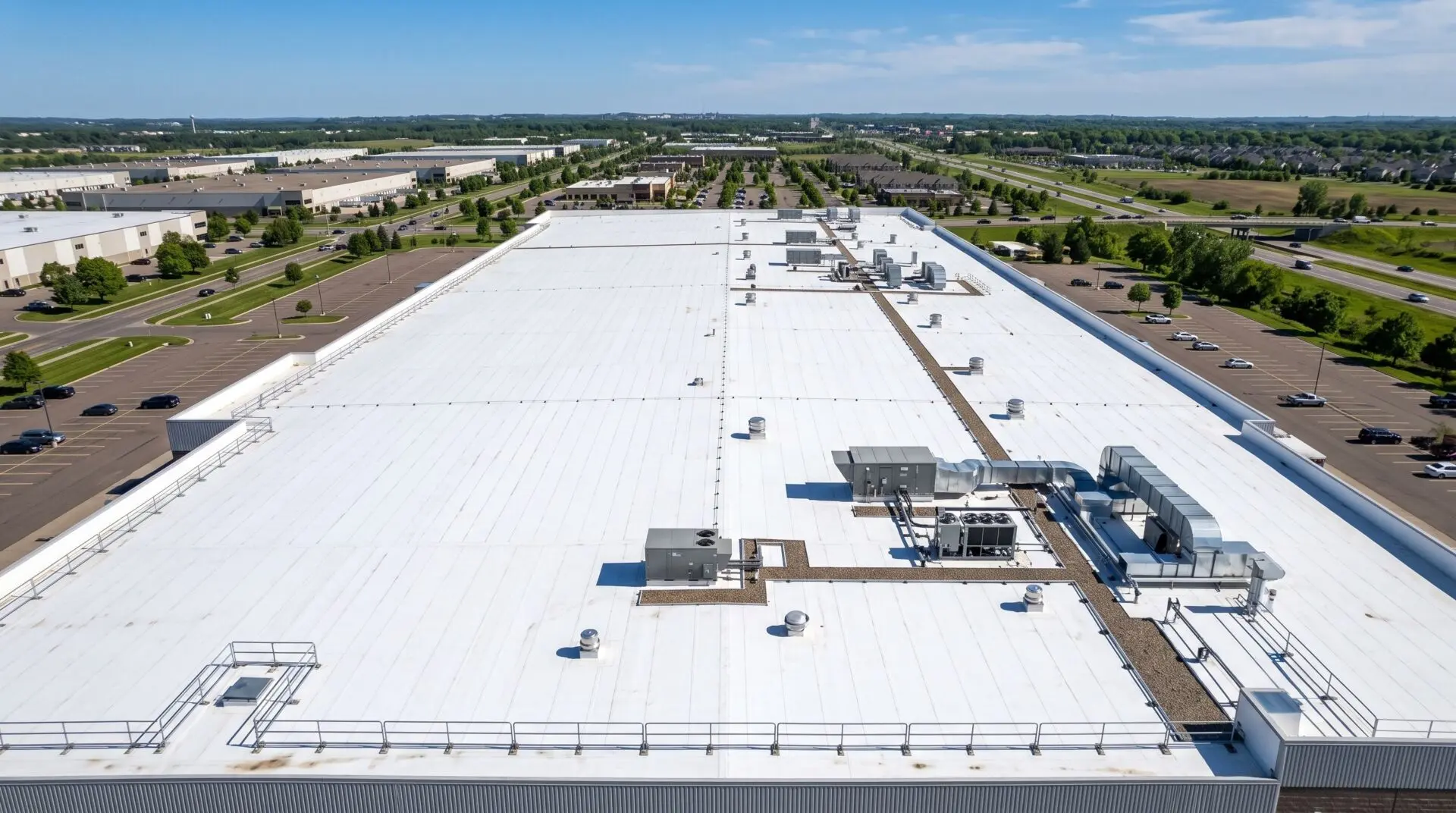
Most mid-size apartment buildings have flat or low-slope roofs crowded with HVAC units, vents and hatches. Here's quick planning math before anyone climbs up:
- Gross roof area. Measure it or take it from drawings.
- Subtract the unusable parts. Fire-code pathways and edge setbacks, HVAC units and their service clearances, hatches, vents, drains and shaded areas near parapets or taller walls. On a busy roof, half to two-thirds of the area may remain usable.
- Apply panel density. A typical 430-watt panel covers about 21 square feet, roughly 20 watts per square foot. Low-tilt rows need spacing so they don't shade each other, which drops it to roughly 12–15 watts per square foot of usable roof.
Example: a 10,000 sq ft roof with 60% usable area (6,000 sq ft) supports roughly 72–90 kW. That's more than most house meters can use, so the meter, not the roof, usually sets the final size. Flat roofs also need a structural review for ballast weight and wind; see flat-roof commercial solar and ballasted racking. And if the membrane has fewer than about 10 years left, replace it first.
Practical issues owners ask about
- Roof access and leases. Plan for technician access, and check whether any rooftop leases (such as cell antennas) limit space.
- Condos and townhome associations. Shared roofs belong to the association, so the board decides. Minnesota limits how far associations can restrict solar, but reasonable rules still apply.
- Electrical room. Older buildings may need switchgear work to connect solar at the house service.
- Tenant communication. Let residents know about installation days and roof work in advance.
- Utility bill-backs. If you divide a shared meter's costs among tenants, Minnesota landlord-tenant law regulates how that's done, so check current rules with your attorney. Lower shared-meter bills from solar then flow through to residents.
- EV charging. If you're adding chargers to the garage or lot, plan them with solar so the house meter sizing accounts for them.
Get a building-specific answer
We'll review your meter setup, 12 months of house meter bills, roof condition and tax timing, then show you what size makes sense and what it pays back. Learn more on our commercial solar page, or request a quote and note that it's a multifamily property.
Sources
- Minnesota Revisor of Statutes — Minn. Stat. 216B.164, Cogeneration and small power production (net metering)
- Minnesota Department of Commerce — Low- and Moderate-Income Accessible Community Solar Garden Program 2026 Annual Report
- Minnesota Reformer — Minnesota solar industry avoided legislative defeat, but future uncertain (June 2025)
Frequently asked.
Can apartment buildings get solar panels in Minnesota?
Yes. Most owners connect solar to the common-area house meter, which offsets hallway lighting, elevators, laundry and other shared loads. Master-metered buildings can offset the whole building's use.
Can solar on my apartment building lower my tenants' electric bills?
Not directly when tenants have their own meters, because Xcel net metering credits only the meter the array is connected to. Tenants can lower their bills by subscribing to a community solar garden, and owners can pass along savings through lower common-area costs.
Do apartment building owners qualify for the solar tax credit?
Generally, owners can look to the commercial Section 48E credit, typically 30% for systems under 1 MW AC. Projects beginning construction after July 4, 2026 must be placed in service by December 31, 2027. Confirm eligibility with your CPA, since rental property has special rules.
Can a multifamily building join Xcel Solar*Rewards?
A system of 40 kW or less on an Xcel account, sized to no more than 120% of that meter's annual use, can apply. Capacity is limited each year and Xcel sets the incentive rate annually.
How much solar can fit on an apartment roof?
As planning math, low-tilt flat-roof layouts fit roughly 12 to 15 watts per square foot of usable roof after pathways and equipment. A 10,000 square foot roof with 60% usable space supports about 72 to 90 kW, though the house meter usually limits the final size.
Can renters sign up for community solar in Minnesota?
Yes, renters with their own utility accounts can subscribe. Minnesota's newer program requires each garden to reserve at least 30% of its capacity for low- and moderate-income households.


Have a question we haven't covered?
Talk to a local iSolar expert — free, no pressure. Call (651) 565-1140.