
Solar Panels on a Metal Roof in Minnesota: Clamps, Snow and Grounding
Standing seam metal is the easiest roof to put solar on: no holes, and a roof that outlasts the panels. Corrugated metal is a different job. Here's how each one works in a Minnesota winter.
Reviewed by John Ihle, MN Master Electrician (AM005101) · NABCEP-credentialed · iSolar, Saint Paul Park, MN · Last reviewed October 2026
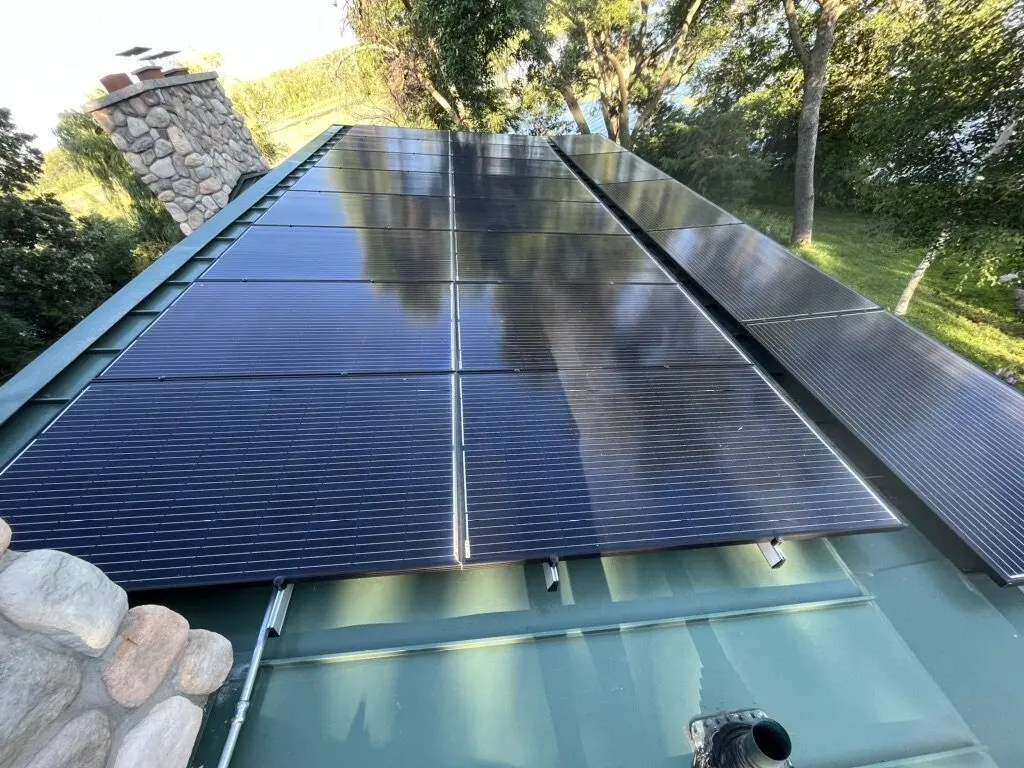
The short answer: Yes, metal roofs are excellent for solar. On standing seam roofs, clamps grip the seams so no holes are drilled, and the roof can last as long as or longer than the 25- to 30-year panels. Exposed-fastener roofs use sealed rib-mounted brackets. In Minnesota, plan clamp spacing for 50 to 60 psf ground snow loads and add snow guards over walkways.
Why metal roofs and solar get along
If you have a standing seam metal roof, you have the easiest roof in Minnesota to put solar on. That is not marketing. It comes down to three practical facts.
- No holes. On standing seam, the racking clamps onto the raised seams. Nothing goes through the roof, so there is nothing to flash and nothing to leak.
- The roof outlasts the panels. Quality panels carry 25 to 30 year warranties. A white paper series from S-5! and the Metal Construction Association, published in pv magazine USA, notes most metal roofs carry 40-year warranties and cites earlier research finding metal roofs can reach a 70-year life in most non-coastal U.S. environments. With an asphalt roof, you often plan a panel removal for a reroof partway through the system's life. With metal, you usually don't.
- Fast install. With no penetrations to seal, the attachment work goes quicker than on shingles.
Not every metal roof is standing seam, though. The type of metal roof you have decides how we mount the panels, and that is where homeowners get confused.
Standing seam vs. exposed-fastener metal: two different jobs
| Roof type | How you recognize it | How panels attach | Roof penetrations |
|---|---|---|---|
| Standing seam | Smooth flat pans separated by evenly spaced raised vertical seams; no visible screws | Seam clamps tightened onto the seam; rails or rail-less mounts ride on the clamps | None |
| Exposed-fastener (corrugated, R-panel, ag panel) | Rows of screws with rubber washers across the whole roof; ribs instead of seams | Rib-mounted brackets fastened through the metal into the purlins or deck with sealing gaskets | Yes, but sealed and spread across the ribs |
| Metal shingles / stone-coated steel | Looks like shingle, tile or shake but is steel | Product-specific flashed mounts | Yes, and the details vary by manufacturer |
Standing seam clamps
Seam clamps are machined aluminum blocks shaped to grip a specific seam profile. S-5!, the best-known maker, describes its S-5-TH clamp as a non-penetrating clamp that rolls over the seam and is tightened with a bolt to a set torque, and warrants it for the life of the roof. The key detail is profile matching. Mechanically seamed, snap-lock and T-seam roofs each need the right clamp. We confirm the seam profile and spacing on site before ordering hardware, because the wrong clamp is the one way to get a standing seam install wrong.
Standing seam panels are held down with clips that let the metal slide as it heats and cools. Clamping the racking to the seam lets the array move with the roof instead of fighting it. That matters in a state where a dark roof bakes in July sun and contracts on below-zero January nights.
Exposed-fastener roofs
Corrugated and R-panel roofs, common on pole barns, garages and some cabins, have no seam to clamp. Here we use brackets that sit on top of a rib (the high point, where water doesn't run) and fasten through the metal into the structure underneath, with gasketed fasteners that seal the hole. Done right, this is a durable, weathertight attachment. Done wrong, with fasteners in the flat valleys or missing the purlins, it is a leak waiting for the first thaw. Ask any installer exactly where the fasteners will land.
Snow load and snow slides: the Minnesota part
Structural snow load
Minnesota's building code sets the design ground snow load at 50 pounds per square foot in most counties and 60 psf in 29 northern counties, including Crow Wing, Cass, Itasca and St. Louis (Minn. R. 1303.1700). Most certified panels are tested to about 5,400 Pa of front-side load, which is roughly 113 psf. The panel is rarely the weak link. The attachment layout is. On metal roofs, the engineer sets clamp spacing based on the snow load, wind exposure and how strong each clamp is on that seam. In heavy-snow counties, that often means more clamps per rail.
Snow sliding off panels and metal
Here's the trade-off nobody mentions: glass panels and metal roofing are both slick. Snow sheds off a metal roof with panels faster and in bigger sheets than off shingles. That is great for winter production (see what to do about snow on solar panels), but a sheet sliding off a second-story roof onto a deck, walkway or gas meter is dangerous.
The fix is planning, not luck:
- Keep the array back from eaves above doors, decks and walkways.
- Add snow guards on the metal below the array where people walk. Standing seam snow guards clamp to the seams the same way the racking does, with no holes.
- Protect gas meters, AC condensers and the electrical service mast from falling snow.
Grounding and bonding on a metal roof
This is the electrician's part, and it is where details matter. A metal roof is a large conductive surface, but it is not part of the PV grounding system. The National Electrical Code requires the module frames, rails and other exposed metal parts of the PV system to be bonded together and connected to the equipment grounding conductor that runs back to your panel. We use listed bonding hardware (bonding clamps or mid-clamps with bonding pins) so every frame and rail has a reliable path to ground.
What we don't do is count on the roof panels to carry fault current. Roof panels are held by sliding clips and painted surfaces, so they aren't a dependable conductor. All rooftop PV also needs NEC 690.12 rapid shutdown, so firefighters can de-energize conductors on the roof. With Enphase microinverters, that is built in. With SolarEdge, optimizers handle it.
Watch for mixed metals
Aluminum clamps on Galvalume or painted steel are a standard, proven pairing. Copper is the problem. Bare copper grounding wire or copper-bearing runoff touching Galvalume can corrode the coating. Keep copper off the roof surface and route conductors in the rail channels or in conduit.
Wiring, penetrations and the roof warranty
Even on a no-penetration standing seam install, the wiring still has to get from the roof to your electrical panel. We usually run it in conduit down an exterior wall or through a single flashed roof entry using a jack or boot rated for metal. That one entry is planned, flashed and documented. If your metal roof has a manufacturer or installer warranty, check its terms on rooftop attachments before work starts. Many roofing manufacturers accept seam clamps because nothing penetrates the panel, but the paperwork is worth reading.
Our installs carry the SolarInsure 30-year warranty, which includes roof penetrations, so the one place we do enter the roof is covered.
Thinking about a new metal roof before solar?
If your shingles have five to ten years left and you plan to stay, it is worth pricing a metal roof and solar together. You avoid paying for a detach and reset later, and the roof should outlive the array. Our sister company, Three Rivers Contracting, installs roofing, and we coordinate the sequence so the roof goes on first and the array follows. For timing advice on any roof type, read re-roofing and solar: time it once, pay once.
| Question to ask your installer | Good answer |
|---|---|
| Which clamp, for which seam profile? | A named clamp matched to your measured seam |
| How is clamp spacing set? | By engineering for your county's snow load and wind exposure |
| Where do wires enter the house? | Conduit on the wall or one flashed, metal-rated entry |
| How is the array bonded? | Listed bonding hardware to the equipment grounding conductor; not through the roof panels |
| What about falling snow? | Setbacks over walkways plus snow guards where needed |
Get a metal-roof solar layout
Start with our free roof solar estimator for a quick size and production range, then request a quote. We'll confirm the seam profile, snow exposure and wiring route on a site visit and design the clamp layout for your roof, not a generic one.
Sources
Frequently asked.
Do solar panels on a standing seam metal roof need holes?
No. Seam clamps grip the raised seams, so the racking attaches without penetrating the roof. The wiring still needs a route to your electrical panel, usually conduit down a wall or one flashed, metal-rated roof entry.
Can you put solar panels on a corrugated metal roof?
Yes. Corrugated and R-panel roofs use brackets that sit on the ribs and fasten through the metal into the purlins or deck with sealing gaskets. The fasteners must hit structure and stay on the high ribs, not in the valleys where water runs.
Will snow slide off solar panels on a metal roof?
Yes, and faster than off shingles. That helps winter production, but sliding sheets can hit decks, walkways and meters. Setbacks and snow guards below the array manage the risk.
Does solar void my metal roof warranty?
It depends on the roof manufacturer's terms. Many accept non-penetrating seam clamps, but read the warranty before installation. The roof penetration for wiring on iSolar installs is covered under our SolarInsure 30-year warranty.
Is a metal roof worth it before going solar?
If your shingles are near the end of their life and you plan to stay, often yes. A metal roof can outlast the array, so you avoid paying to remove and reinstall panels for a reroof later.
Do solar panels on a metal roof attract lightning or need extra grounding?
Panels don't attract lightning. The PV frames and rails must be bonded to the equipment grounding conductor per the National Electrical Code, using listed bonding hardware, and the roof panels themselves are not used as a grounding path.


Have a question we haven't covered?
Talk to a local iSolar expert — free, no pressure. Call (651) 565-1140.