
EV Charger Installation Cost in Minnesota: 2026 Price Ranges
Your panel and your garage set the price more than the charger does. Here's how Level 2 installs break down in Minnesota homes and how to avoid paying for capacity you don't need.
Reviewed by John Ihle, MN Master Electrician (AM005101) · NABCEP-credentialed · iSolar, Saint Paul Park, MN · Last reviewed October 2026
The short answer: Nationally, Level 2 EV charger installation labor runs about $400 to $1,200 plus a $700 to $2,000 charger and $100 to $200 in permits, per HomeAdvisor. Twin Cities homes with the panel near the garage land at the low end; detached garages and full 100A panels cost more, sometimes adding an $800 to $2,000-plus panel upgrade.
EV charger installation cost: the ranges
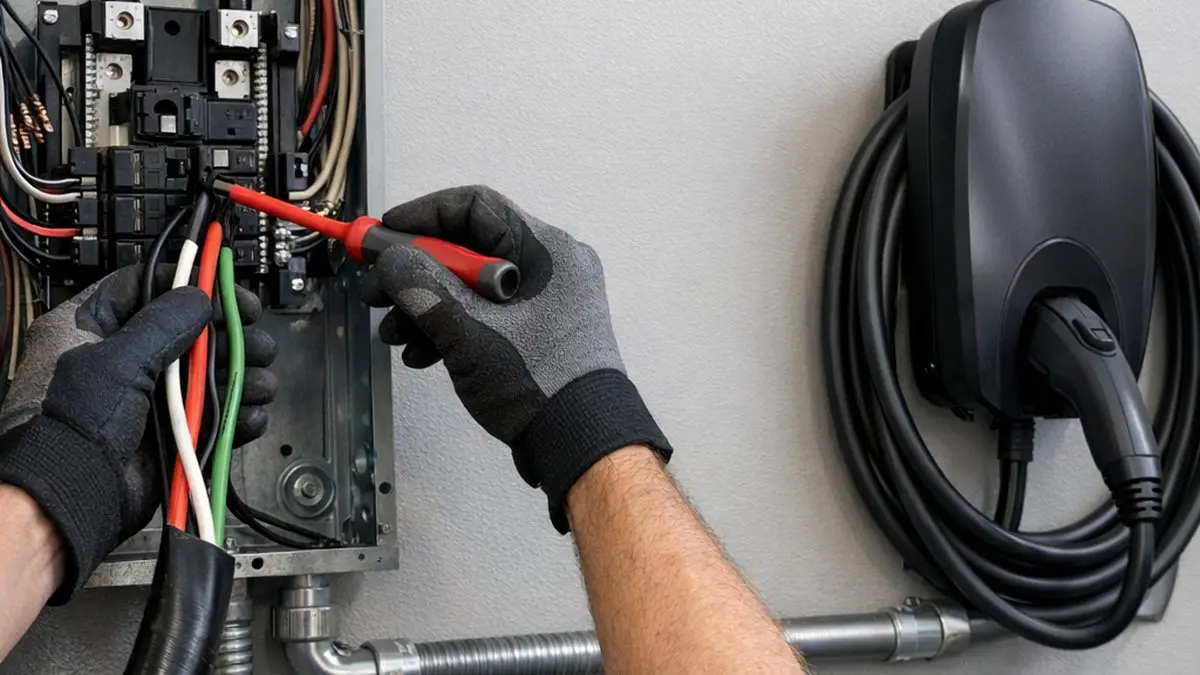
EV charger installation cost depends far more on your house than on the charger. The same 48-amp charger can be a half-day job in an attached garage next to the panel, or a multi-day project when the garage is detached and the panel is full. National cost guides give a useful starting point. HomeAdvisor's 2026 figures list:
- Level 2 charger unit: about $700 to $2,000
- Electrician labor: about $400 to $1,200
- Permits: about $100 to $200
- Rewiring a garage circuit: about $500 to $1,500
- Panel upgrade: about $800 to $2,000
Those are national numbers, not Minnesota quotes. Twin Cities pricing varies with the route the wire takes, the panel you have and whether trenching or a service upgrade is involved, so we price on site. What follows is how to figure out which bucket your home falls in.
Level 2 charger installation cost by home situation
| Your situation | What the job involves | Cost drivers |
|---|---|---|
| Attached garage, panel in or next to the garage, open breaker spaces | New 240V circuit, short run, receptacle or hardwired charger | Lowest cost: labor and permit, plus the charger |
| Attached garage, panel across a finished basement | Longer run, fishing wire through finished walls or ceilings | More labor; heavier copper for a long 60A circuit adds material cost |
| Detached garage | Trenching or using an existing feeder, often a subpanel in the garage | Trench length, conduit, feeder size and frost-depth burial |
| Full panel or 100A service | Load calculation, then load management, a panel replacement or a service upgrade | Adds the panel upgrade range above, sometimes utility coordination |
| Outdoor or driveway charging post | Weather-rated equipment, a pedestal or wall mount outside | Mounting, trenching and protection from plows and vehicles |
Minnesota adds a few line items warmer states don't. Detached-garage trenches have to reach proper burial depth, and nobody wants to trench in January. Outdoor equipment has to handle snow, ice and plow spray. If you're planning a detached garage install, book it before the ground freezes.
Worked example: two garages, same car
Take two homeowners with the same Model Y all-wheel drive, which charges at up to 32A.
- House A in Woodbury has an attached garage with the 200A panel on the shared wall. A 40A circuit runs a few feet. Using the national ranges, that's roughly $500 to $1,400 for labor and permit, plus the charger.
- House B in Saint Paul has a 100A service and a detached garage about 80 feet away. Add the garage rewiring range ($500 to $1,500) and, if the load calculation fails, a panel upgrade ($800 to $2,000 or more). The same charger can cost several times as much to install.
These are illustrations built from national averages, not quotes, but they show why two neighbors can get very different numbers.
Amps, breaker size and why bigger isn't always better
EV charging is treated as a continuous load under the electrical code, so the circuit is sized at 125% of the charger's output. Tesla's own Wall Connector table shows the pattern:
| Breaker | Max charging current | Power at 240V | Approx. Model 3 range added per hour |
|---|---|---|---|
| 60A | 48A | 11.5 kW | 44 miles |
| 50A | 40A | 9.6 kW | 37 miles |
| 40A | 32A | 7.7 kW | 30 miles |
Here's the money-saving detail. Tesla notes that Model 3 and Model Y rear-wheel-drive versions and the Model Y all-wheel drive are limited to 32A. For those cars, a 40A circuit delivers full charging speed. Running a 60A circuit costs more in wire and panel capacity for no faster charging. Most people plug in overnight; even 30 miles of range per hour refills a typical metro commute in an hour or two.
Check your car's onboard charger rating before you pick a circuit size. If your panel is tight, a smaller circuit can be the difference between a simple install and a service upgrade.
When the panel decides the price
Older Twin Cities homes with 100A services are where EV charger quotes jump. Before adding a 40A to 60A continuous load, a licensed electrician should run a load calculation on your home. The outcomes, from cheapest to most expensive:
- It fits. There's capacity and breaker space. Straightforward install.
- It fits at a lower setting. Many chargers can be set to a lower current, matching a smaller circuit.
- It fits with load management. A charger or energy management device that reduces EV charging when the house is busy can avoid an upgrade where the code and inspector allow it.
- Panel or service upgrade. Needed when there's no capacity or no space. This is the $800 to $2,000-plus line in national guides, and more if the utility service or meter base must change.
Our free panel capacity check gives you a first read on which outcome you're likely in. If you're also considering solar, the same panel questions apply; see our guide to planning solar and EV charging together.
Permits, inspection and who can do the work
A new 240V circuit for an EV charger is electrical work that needs a permit and inspection in Minnesota, through the Department of Labor and Industry or your city's electrical inspector. The permit fee is a small part of the total. The inspection is worth it: it confirms wire size, breaker, grounding and GFCI protection where required, and it's what your insurer will expect if something goes wrong.
Be wary of quotes that skip the permit. A charger running near its full rating every night for years is exactly the load that exposes undersized wire or a loose lug.
Rebates and the federal credit
The federal Section 30C charger credit ended for property placed in service after June 30, 2026, so don't count on it for a new install. Utility programs change year to year; our Minnesota EV charger rebates guide tracks what's available from Xcel and others. Check eligibility before you buy, since some programs require specific chargers or enrollment first.
How to keep the cost down
- Match the circuit to your car's onboard charger instead of defaulting to 60A.
- Mount the charger as close to the panel as practical.
- Pick a charger that's on your utility's eligible list if you want a rebate. Our reviews of the Emporia charger and the ChargePoint Home Flex cover installer-side details.
- Bundle work: if you need a panel upgrade for a heat pump or solar later, plan it once.
- Schedule detached-garage trenching before freeze-up.
Get a firm number for your home
A photo of your panel, the distance to where you park and your car model are usually enough for a ballpark; a short site visit gets you a firm price. iSolar's licensed electricians install Level 2 chargers across the Twin Cities. See our EV charger installation services or request a quote for a same-business-day callback.
Sources
- HomeAdvisor — How much does an electric car charging station cost to install? (2026)
- Tesla — Wall Connector support: circuit breaker sizes and charging speed
- U.S. DOE Alternative Fuels Data Center — Charging electric vehicles at home
- Minnesota Department of Labor and Industry — Electrical permits for homeowners
Frequently asked.
How much does it cost to install a Level 2 charger at home?
National cost guides put electrician labor around $400 to $1,200, plus the charger and about $100 to $200 for permits. Long wire runs, detached garages and panel upgrades push the total higher, so get an on-site quote.
Do I need a 60 amp breaker for an EV charger?
Only if your car can actually charge at 48 amps. Many vehicles, including several Tesla models, top out at 32 amps, which needs just a 40-amp circuit for full speed. Check your car's onboard charger rating first.
Do I need a permit to install an EV charger in Minnesota?
Yes. A new 240-volt circuit is electrical work that requires a permit and inspection through the Minnesota Department of Labor and Industry or your city's electrical inspector.
Will I need a panel upgrade for an EV charger?
Not always. A load calculation shows whether your service can handle the added load. Options like a lower charger setting or load management can sometimes avoid an upgrade, especially on 100-amp services.
Is there still a federal tax credit for home EV chargers?
No. The Section 30C credit ended for charging equipment placed in service after June 30, 2026. Some utility rebates may still apply, so check before you buy.
How long does EV charger installation take?
A simple install in an attached garage near the panel often takes a few hours. Detached garages with trenching, or jobs that need a panel upgrade, can take a day or more plus inspection scheduling.


Have a question we haven't covered?
Talk to a local iSolar expert — free, no pressure. Call (651) 565-1140.