
Pros and Cons of Solar Panels in Minnesota (No Sales Spin)
Minnesota solar has real advantages and real drawbacks, and the 2026 loss of the federal credit shifted the balance. Here's an honest scorecard with the numbers behind it.
Reviewed by John Ihle, MN Master Electrician (AM005101) · NABCEP-credentialed · iSolar, Saint Paul Park, MN · Last reviewed October 2026
The short answer: In Minnesota, the main pros of solar panels are monthly net metering at retail-level credit with Xcel, Solar*Rewards at $0.05/kWh for 10 years, tax exemptions and weather-tough panels. The main cons are no federal homeowner credit after 2025, 10- to 16-year cash payback, weak winter output and the need for a battery to get outage backup.
The pros and cons of solar panels, scored for Minnesota
Most lists of the pros and cons of solar panels are written for Arizona or California. Minnesota is different: long winters, a strong net metering law, and, since the start of 2026, no federal tax credit for homeowners who buy. Here's the honest scorecard from people who install solar here, with the numbers behind each point.
| Pros | Cons |
|---|---|
| Xcel's monthly net metering credits surplus at about the retail energy rate | The 30% federal homeowner credit is gone for systems placed in service after 2025 |
| Xcel Solar*Rewards pays $0.05/kWh for 10 years on systems up to 40 kW | Payback for cash buyers is commonly 10 to 16 years |
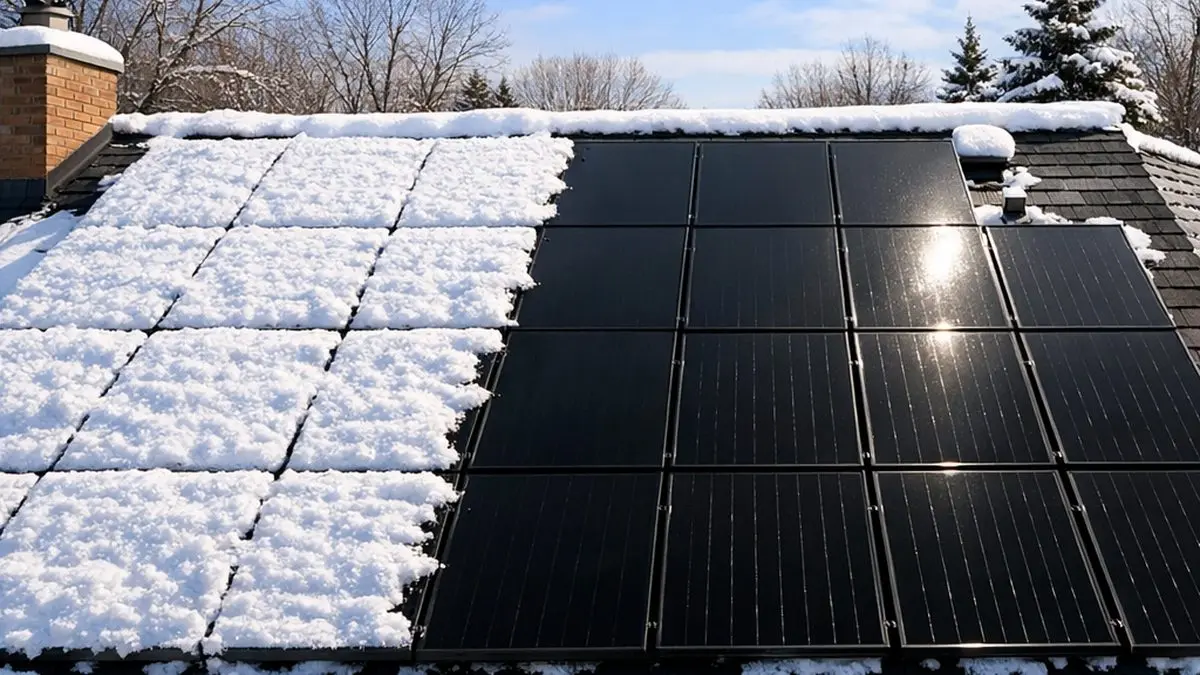
| No Minnesota sales tax on equipment; added value exempt from property tax | December and January production is low, especially under snow |
| Panels are tested for heavy snow loads and 1-inch hail | Your roof needs to outlast the panels, or you'll pay to remove and reinstall them |
| Protection against future rate increases | Grid-tied solar shuts off in an outage unless you add a battery |
| Minnesota HOAs generally can't ban rooftop solar | Co-op and municipal customers may be paid less for surplus |
Advantages of solar panels in Minnesota
1. Net metering here is still good
For Xcel customers with systems up to 40 kW, net metering is monthly. Surplus energy is credited at the average retail utility energy rate, credits roll forward and Xcel pays out by check when the balance passes a threshold. There's no year-end forfeiture. That's more generous than many states that have cut export credits. A summer surplus pays your winter bills.
2. Solar*Rewards and the tax exemptions
Xcel's Solar*Rewards currently pays $0.05 per kWh produced for 10 years on systems sized to 120% of your usage or less. On a 7 kW system making about 8,750 kWh a year, that's roughly $440 a year, about $4,400 over the term, if you're accepted into the limited capacity. Minnesota also exempts solar equipment from sales tax and the system's added value from property tax.
3. A hedge against rising rates
Xcel asked regulators for roughly $353 million in its latest Minnesota rate case. The PUC's June 24, 2026 order approved far less: about 2.3% for 2025 and another 3.4% for 2026. Rates still went up. Every kWh your roof makes is a kWh you don't buy at whatever the next rate case sets.
4. Built for Minnesota weather
Most certified panels are tested to withstand 1-inch (25 mm) ice balls at about 23 meters per second. Qcells' Q.TRON BLK M-G2+ datasheet, for example, lists a 5,400 Pa push test load for snow. Quality panels degrade roughly 0.25% to 0.5% a year and carry 25- to 30-year warranties.
5. Your HOA can't simply say no
Minnesota Statutes 500.216 generally prevents homeowners associations from prohibiting rooftop solar, while allowing reasonable restrictions.
Disadvantages of solar panels in Minnesota
1. No federal credit for buyers
The IRS states the residential clean energy credit isn't available for property placed in service after Dec. 31, 2025. The timing rule is installation completion, not when you paid. A 7 kW system at $3.00 to $3.25 per watt is about $21,000 to $22,750, and today you pay all of it. Leases and PPAs can still use the commercial credit and may pass some savings through, but you don't own the system.
2. Longer payback
Cash payback commonly lands around 10 to 16 years in Minnesota, depending on usage, roof direction and rates. That's a long-term investment, not a quick win. A quick worked example: a 7 kW system on a good Twin Cities roof costs about $21,000 to $22,750 and makes about 8,750 kWh a year. At an all-in 14 to 16 cents per kWh, that's roughly $1,225 to $1,400 a year in bill savings, plus about $440 from Solar*Rewards. Divide the price by $1,660 to $1,840 a year and simple payback lands around 11.5 to 13.5 years, before any rate increases.Run your own numbers with our solar payback calculator.
3. Winter is weak
Twin Cities systems produce about 1,150 to 1,300 kWh per kW a year, but most of it from spring through early fall. Snow-covered panels in December make close to nothing. Net metering smooths that out financially, but don't expect a winter bill near zero. Our guide to solar in Minnesota winters shows what to expect month by month.
4. Roof timing
Panels last decades. If your shingles have less than about 10 years left, replacing the roof first usually costs less than removing and reinstalling the array later. See how to time reroofing and solar.
5. No power in an outage without a battery
Grid-tied solar shuts down when the grid goes down, for line-worker safety. Backup requires a battery, and under monthly net metering batteries save little on your bill; their value is resilience. Read why solar shuts off in an outage.
6. Your utility matters
Co-ops and municipal utilities can pay year-end surplus at a lower avoided-cost rate and have more variation in rules. If you're with Connexus, Dakota Electric or a city utility, read the tariff first or see our co-op net metering guide.
Who should go solar now
- Xcel customers with a south, east or west roof that has 15-plus years of life left and little shade.
- Households using roughly 9,000 kWh a year or more, especially with an EV or heat pump.
- Owners planning to stay long enough to see payback, or who value predictable bills.
- Income-qualified Xcel customers: the Income-Qualified Solar*Rewards program offers $3.00 per watt up front, and 2027 sign-ups close Dec. 31, 2026. Details are on our income-qualified program page.
Who should wait
- Your roof needs replacing in the next few years. Do the roof first.
- Your roof is heavily shaded and a ground mount isn't practical.
- Your utility pays little for surplus and your daytime use is low.
- The only way to afford it is a loan with a large dealer fee buried in the price.
- You're likely to move soon and don't want to manage a system through a sale.
One more con that isn't about the technology: sales pressure. Door-knockers and out-of-state call centers sometimes still pitch a "federal tax credit" that no longer applies to homeowners who buy, or quote savings based on an inflated rate forecast. If someone promises you'll eliminate your bill, ask to see the production estimate, the rate assumption and the cash price in writing.
Get the pros and cons for your house
General lists only go so far. Your roof, usage and utility decide which column wins. If you want the bigger picture first, start with is solar worth it in Minnesota. When you're ready for numbers specific to your home, request a free quote and we'll tell you straight if it doesn't pencil.
Sources
Frequently asked.
What are the disadvantages of solar panels in Minnesota?
The biggest are no federal homeowner tax credit for systems placed in service after 2025, cash payback of roughly 10 to 16 years, low winter production and no backup power during outages without a battery. Co-op customers may also be paid less for surplus energy.
Is solar still worth it in Minnesota without the tax credit?
It can be, especially for Xcel customers with a good roof and higher usage. Monthly net metering, Solar*Rewards and the state tax exemptions still help, but payback is longer than it was in 2025.
Do solar panels work in Minnesota winters?
Yes, but production is low in December and January and near zero under snow. Most annual output comes from spring through early fall, and net metering credits carry that surplus into winter.
Can my HOA stop me from installing solar panels in Minnesota?
Generally no. Minnesota Statutes 500.216 limits HOAs from prohibiting rooftop solar, though they can apply reasonable restrictions.
Should I replace my roof before getting solar?
If your roof has less than about 10 years of life left, usually yes. Removing and reinstalling panels later adds cost that's easy to avoid by reroofing first.
Do solar panels increase electricity bills in winter?
No, but they won't erase winter bills either. Low December output means you'll draw more from the grid, offset by credits banked during sunny months under Xcel's net metering.


Have a question we haven't covered?
Talk to a local iSolar expert — free, no pressure. Call (651) 565-1140.