
Do Solar Panels Need Direct Sunlight, or Just Light?
Panels make the most power in full sun, but they never stop using scattered skylight. What actually hurts output in Minnesota is hard shade, not gray skies.
Reviewed by John Ihle, MN Master Electrician (AM005101) · NABCEP-credentialed · iSolar, Saint Paul Park, MN · Last reviewed October 2026
The short answer: No. Solar panels work best in direct sun but also convert diffuse light scattered by clouds and haze, plus light reflected off snow and nearby surfaces. In the Twin Cities a well-placed, unshaded array typically produces about 1,150 to 1,300 kWh per kW each year, and that figure already includes cloudy days. Hard shade from trees or chimneys costs more than overcast skies.
Do solar panels need direct sunlight? The short answer
Do solar panels need direct sunlight? No. They need light, and they produce the most when that light arrives as direct sun hitting the glass squarely. But a solar cell does not care whether a photon came straight from the sun or bounced off a cloud first. Scattered skylight, which engineers call diffuse light, still makes electricity. It just makes less of it.
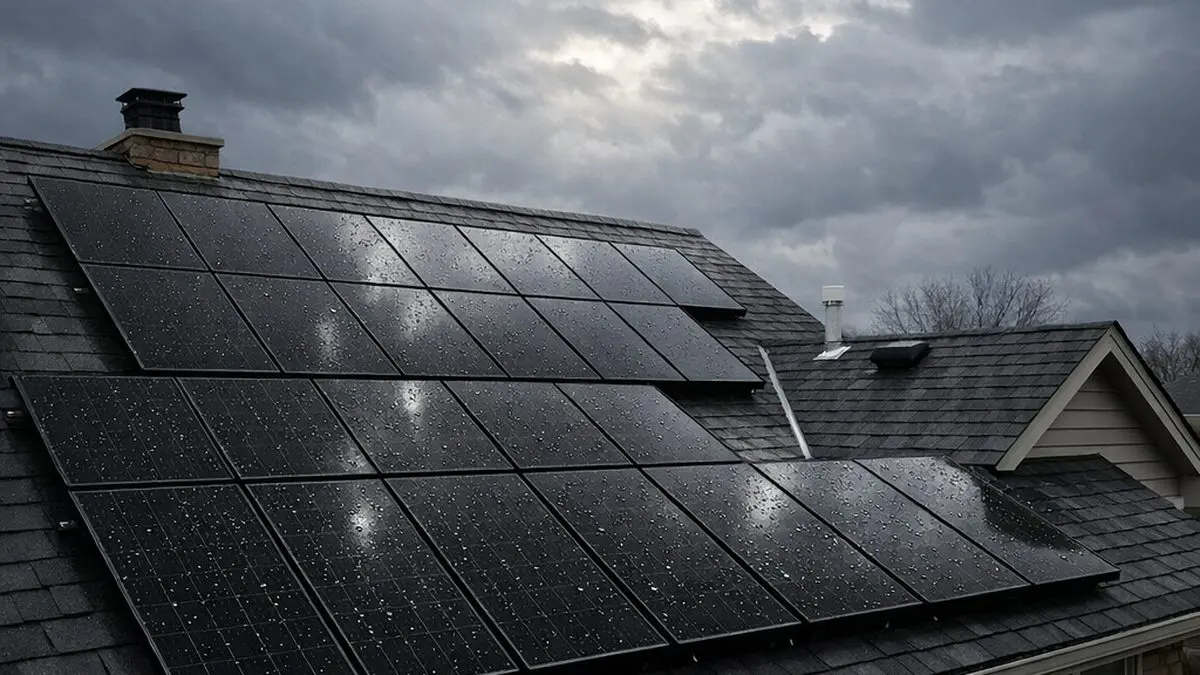
That matters in Minnesota, where November and December are gray for weeks at a time. The useful question is not whether your panels work without direct sun. It is how much of your yearly production depends on it, and what on your property blocks it. This guide covers both, from an installer's side of the ladder.
Direct, diffuse and reflected light: what your roof actually sees
The U.S. Department of Energy describes sunlight at the ground in two parts. Direct beam radiation reaches the surface without being scattered. Diffuse radiation is the share that air molecules, water vapor, clouds, dust and pollutants scatter across the sky. DOE notes that clouds can cut the direct beam by 100% on thick, overcast days and by about 10% on clear, dry days.
Solar modeling tools add a third piece. Sandia National Laboratories' PV modeling group breaks the light landing on a tilted panel, called plane-of-array irradiance, into three components:
- Beam: direct sun. This is the big one on clear days and the reason south-facing roofs win.
- Sky diffuse: light from the whole dome of the sky. On a thick overcast day, it is essentially all you get.
- Ground-reflected: light bouncing off the ground and nearby surfaces. It depends on albedo, which is why fresh Minnesota snow gives panels a small bonus, and why bifacial panels over snow can pick up extra energy from their back side.
So the honest answer to "direct sunlight or just light" is: both count, but they do not count equally.
How each kind of light shows up in Minnesota production
Here is the part most articles skip. The yearly production estimate in a good solar quote is not a sunny-day number. NREL's PVWatts calculator, which most installers and Xcel's Solar*Rewards review rely on, runs your system through a typical year of local weather, cloudy weeks included. When we say a Twin Cities array makes about 1,150 to 1,300 kWh per kW-DC per year, the gray days are already baked in.
| Situation | Light reaching the panels | What it means for output |
|---|---|---|
| Clear summer day, south roof, no shade | Mostly direct beam plus some diffuse | Near peak output for several midday hours |
| Thin haze or high clouds | Direct beam weakened, more diffuse | Noticeably lower, still useful production |
| Thick overcast (common in November) | Direct beam blocked, diffuse only | A small fraction of a sunny day, but not zero |
| Snow on the ground, panels clear | Direct plus diffuse plus strong ground reflection | Small boost from reflected light |
| Panels in hard shade from a tree or dormer | Diffuse only on the shaded cells | Can drag down more than the shaded area alone (see below) |
The seasonal swing is real. Minnesota State Climatology Office figures reported by MPR put the Twin Cities at about 39% of possible sunshine in November and 42% in December, the two cloudiest months of the year. Combine gray skies with short days and a low sun angle, and late fall is your weakest stretch. Our peak sun hours by month guide shows the full curve.
A worked example: a 10 kW, south-facing, unshaded system in the metro typically produces about 12,000 to 12,900 kWh a year. Most of that comes from April through September, when days are long and skies are clearer. With Xcel's monthly net metering, surplus summer credits roll forward to cover part of those dim winter bills, which is why you size for the year, not for December.
Partial shade vs. full shade: the problem that actually costs you
Overcast skies dim the whole array evenly. Shade is different, because it hits some cells hard and leaves others in full sun. That unevenness is what hurts.
A panel is a chain of cells wired in series, divided into sections that each have a bypass diode. When a few cells are shaded, the diode lets current route around that section instead of forcing it through the weak cells. You lose that section's output, but not the whole panel's. Without bypass diodes, a single shaded cell could throttle everything wired with it.
The inverter design sets how far the damage spreads:
- String inverter, no optimizers: panels in a string share one current. A shaded panel can pull down its neighbors.
- Microinverters (such as Enphase IQ8): each panel is managed on its own, so a shaded panel mostly costs only its own output.
- String inverter with optimizers (such as SolarEdge): panel-level tracking that also limits the spread.
We install both microinverter and optimizer systems. Our microinverter vs. string inverter comparison explains why we lean toward panel-level electronics on shaded Minnesota roofs.
On Twin Cities site visits, the shade we see most is not a neighbor's house. It is mature oaks, maples and spruce on the south or west side of the lot, plus chimneys, plumbing vents and dormers on the roof itself. A tree that shades the array from 3 p.m. on costs real production in summer. A tree that only shades it at 8 a.m. in December barely matters, because there was little energy to collect at that hour anyway.
Indirect sunlight myths we hear
"A north-facing roof gets indirect light, so it should be fine." In Minnesota, a north slope sees mostly diffuse light, and at our latitude that usually is not enough to pay back the panels. East and west faces are different: they typically make about 10 to 20% less than south, which can still work. See which roof directions work here.
"Panels behind a window will charge from indirect sun." Glass, screens and indoor angles cut light sharply. A small panel on a sill is a gadget, not a power source.
"Cloudy states can't do solar." Diffuse light keeps systems producing on gray days, and the annual estimate already accounts for them. For a closer look at rain and overcast weather, read how panels perform on cloudy days in Minnesota. And for the one time output truly drops to zero, see whether solar panels work at night.
A five-minute direct-sun check for your roof
- Find your best plane. South is ideal. East or west is workable. North usually is not.
- Watch it from 10 a.m. to 3 p.m. on a sunny day. Those hours carry most of the yearly energy.
- Note what casts shadows and when. Trees, chimneys, dormers, a neighbor's addition.
- Look at the trees in summer, not winter. Bare branches in March hide the July shade problem.
- Ask about tree growth. A spruce that clears the array today may not in eight years. Panels last 25 to 30 years.
- Get a measured shade report. A real installer quote should state annual production per kW and the shade loss assumed.
If your best roof plane loses a lot of direct sun to trees, a ground mount in a sunnier part of the yard can beat trimming or removing a tree you love.
See how much direct sun your roof gets
Start with our free roof solar estimator for a quick production read on your address. When you want a measured shade analysis and a design that matches the inverter to your shade pattern, request a quote and one of our designers will walk the numbers with you.
Sources
Frequently asked.
Do solar panels work in indirect sunlight?
Yes. Panels convert diffuse light scattered by clouds and haze, plus light reflected off snow and nearby surfaces. Output is lower than in direct sun, but it is not zero, and annual production estimates already include those hours.
Do solar panels need direct sunlight to charge a battery?
No. Any production can charge a battery, including on overcast days, but the charge rate drops with the light. In a long gray stretch, a home battery may not refill fully from solar alone and will draw from the grid if it is set up to do so.
How much power do solar panels make on a cloudy day?
It depends on how thick the clouds are. Thin haze costs a modest amount, while heavy overcast blocks the direct beam entirely and leaves only diffuse light, which is a small fraction of a sunny day. Over a full Minnesota year, the cloudy days are averaged into the 1,150 to 1,300 kWh per kW estimate.
Is partial shade worse than clouds for solar panels?
Often, yes. Clouds dim the whole array evenly, while hard shade on part of a panel forces bypass diodes to skip sections and, on a basic string inverter, can drag down unshaded panels too. Microinverters or optimizers limit that spread.
Can solar panels work on a north-facing roof in Minnesota?
They will produce some power from diffuse light, but at Minnesota's latitude a north slope usually does not produce enough to justify the cost. East and west roofs typically make about 10 to 20% less than south and can still pencil out.
Do solar panels work through windows?
Only weakly. Window glass, screens and the steep indoor angle cut the light reaching the cells, so a panel behind glass is best treated as a novelty, not a power source for your home.
Have a question we haven't covered?
Talk to a local iSolar expert — free, no pressure. Call (651) 565-1140.