
Dual Axis Solar Tracker in Minnesota: Worth the Moving Parts?
A tracker catches about a third more Minnesota sunlight than a fixed array, mostly in summer. Whether that beats more panels on a simple rack depends on your land and loads.

Reviewed by John Ihle, MN Master Electrician (AM005101) · NABCEP-credentialed · iSolar, Saint Paul Park, MN · Last reviewed October 2026
The short answer: In Minneapolis, NREL data shows a dual axis solar tracker receives about 35% more sunlight per year than a fixed south-facing array at latitude tilt, and a tilted single-axis tracker gets about 30%. Most of the gain comes in summer. Trackers pay off only if their installed price per annual kWh beats a fixed array's, after counting maintenance and extra land.
What a dual axis solar tracker does
A dual axis solar tracker is a pole- or pedestal-mounted rack that turns panels on two axes: east to west through the day, and up and down as the sun's height changes with the seasons. The goal is to keep the panels facing the sun almost all day. A single-axis tracker only follows one of those motions, usually east to west. A fixed ground mount does neither; it's set at one tilt, facing south, and stays there for 30 years.
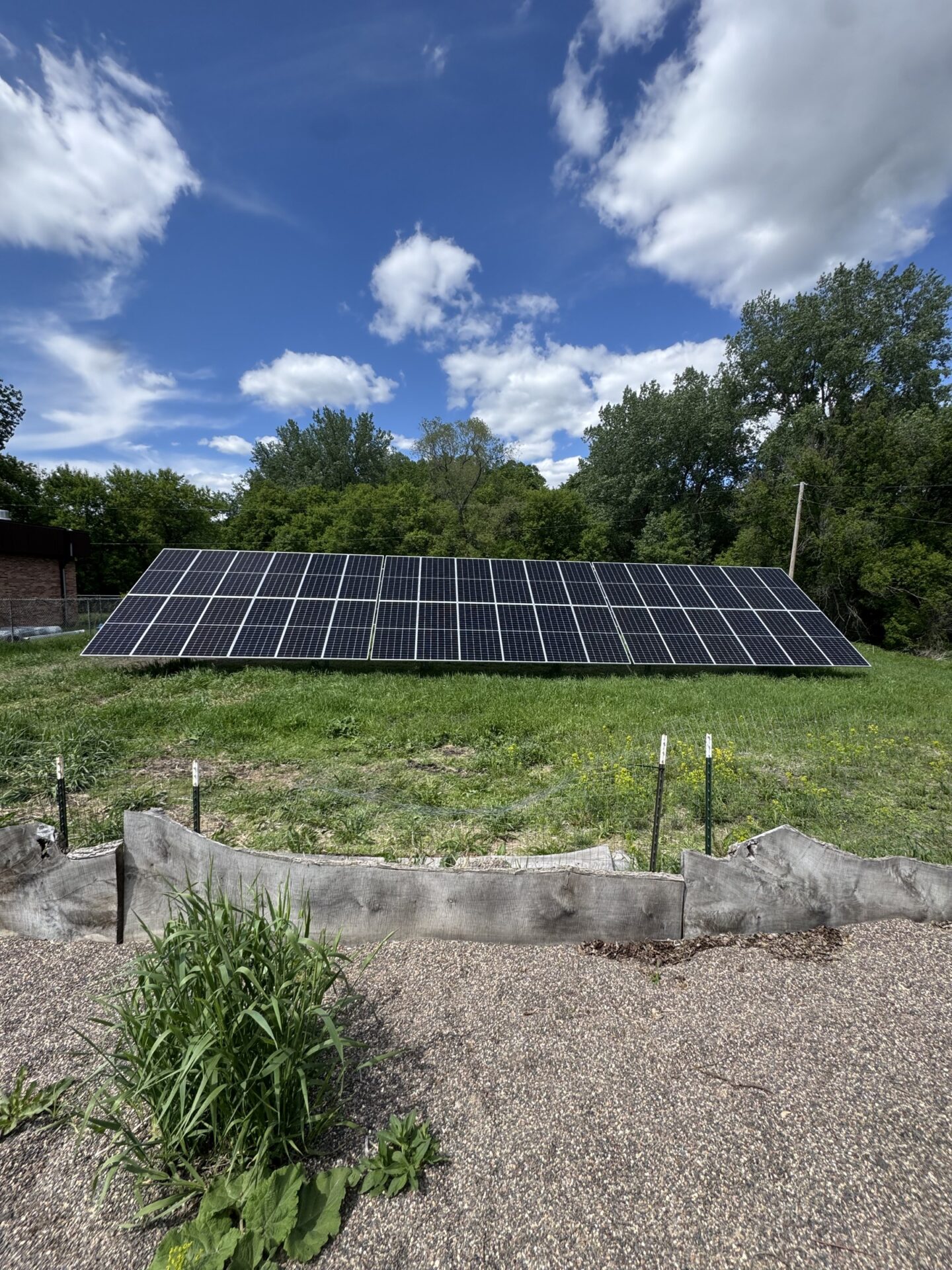
In Minnesota, a dual-axis tracker is mostly a farm and acreage product. You'll see them as one or two big panel "tables" on a steel post in a pasture or yard, sometimes in rows. The question every buyer should ask is simple: does the extra energy pay for the motors, controls, heavier foundation and extra land?
How much more a tracker produces at 45°N
NREL's Solar Radiation Data Manual is still one of the clearest apples-to-apples comparisons, because it lists the sunlight each collector type receives at the same weather station. For Minneapolis, it reports these annual averages (1961–1990 data, ±9% uncertainty), in kWh of sunlight per square meter per day:
| Mounting (Minneapolis) | Annual average | Versus fixed tilt | December | July |
|---|---|---|---|---|
| Fixed, facing south, tilted at latitude (~45°) | 4.6 | baseline | 2.7 | 5.9 |
| Single-axis, horizontal north-south axis | 5.3 | +15% | 2.0 | 8.5 |
| Single-axis, axis tilted at latitude | 6.0 | +30% | 3.0 | 8.4 |
| Dual-axis tracker | 6.2 | +35% | 3.2 | 8.9 |
Three things jump out from an installer's point of view:
- The gain is real, about a third more sunlight on the panels. Actual electricity gains usually come in a bit lower than the sunlight gain, because hotter panels lose some efficiency and closely spaced trackers can shade each other at low sun angles.
- Most of the gain arrives in summer. In July a dual-axis tracker gets about 51% more sunlight than a fixed array; in December it's about 19% more. Minnesota winter production stays small no matter how the panels move.
- The second axis adds little. A single-axis tracker with a tilted axis gets 6.0 versus 6.2 for full dual-axis. Most of the benefit comes from following the sun east to west.
What that means for a 10 kW array
A well-placed fixed array in the Twin Cities typically makes about 1,150 to 1,300 kWh per kW each year. Take 12,500 kWh for a 10 kW fixed ground mount. Applying the 35% sunlight gain as an upper bound, the same panels on dual-axis trackers might reach roughly 16,000 to 16,900 kWh. Flip it around and you'd need only about 7.4 kW of panels on trackers to match the fixed array. That's the trade: fewer panels, more machinery.
Solar tracker cost: the breakeven test
We don't publish a tracker price, because small dual-axis tracker pricing varies widely by brand, foundation and site, and there's no reliable public benchmark for farm-size units. What you can do is compare quotes on the one number that matters: installed price divided by expected first-year kWh.
Here's the benchmark to beat. Minnesota systems commonly run $3.00 to $3.25 per watt installed, so a 10 kW fixed array is about $30,000 to $32,500. At 12,500 kWh a year, that's roughly $2.40 to $2.60 per annual kWh. A tracker quote has to land below that on the same math, using a production estimate you trust, before it's the better buy. Then account for the differences that don't show up on day one:
- Motors, slew drives, controllers and sensors that will need service during the system's life
- Larger concrete or driven foundations for the wind load of a big panel table on one post
- Monitoring for tracker faults, since a tracker stuck facing east quietly loses production
- Extra trenching if trackers are spread out to avoid shading each other
Our system size estimator gives you a fixed-array baseline to compare against, and you can model tracking yourself in NREL's free PVWatts calculator by changing the array type.
Wind, snow and ice: the Minnesota durability questions
Moving parts in a climate with derechos, ice storms and -25°F nights deserve hard questions before you sign. Ask any tracker vendor or installer:
- What's the wind stow behavior? Trackers are designed to move to a protective position in high wind. Find out the trigger speed, whether it works on battery or needs grid power, and what happens if the controller is offline when a storm arrives.
- How does it handle snow? A tracker that can tip panels steeply can shed snow faster than a fixed rack. Ask whether it does this automatically and whether it can park in a snow-shedding position overnight.
- What's the cold-weather rating of the drive and controls? Lubricants, actuators and electronics all have temperature limits. Get them in writing.
- Who services it, and how fast? A fixed rack needs almost nothing. A tracker needs someone who can diagnose a motor or controller fault, often years from now.
- What's the warranty on the moving parts versus the steel and the panels? They're usually different.
Our field note from ground-mount work: the panels and the electrical side of a tracker system are the same as on a fixed array. What changes is the mechanical maintenance plan, and that's the part buyers most often skip.
Land, spacing and shading
Trackers need more room. Lawrence Berkeley National Laboratory found that utility-scale single-axis tracking projects used a median of about 4.2 acres per MW-DC versus 2.8 for fixed tilt. Dual-axis units need generous spacing in every direction, because Minnesota's winter sun is low: at the winter solstice, the noon sun in the Twin Cities sits only about 22° above the horizon, so a tilted panel table casts a long shadow. On a farm with open pasture, that's rarely a problem. On a two-acre lot with tree lines, it can erase the gain.
Are solar trackers worth it on a Minnesota farm or home?
Here's how we'd frame it after looking at a site:
| Tracker can make sense | Fixed mount usually wins |
|---|---|
| Open land with no roof option and plenty of room | A good south roof or a simple fixed ground mount is available |
| Summer-heavy loads, such as irrigation, cooling or grain handling | Usage is spread evenly or peaks in winter |
| Limited fenced or permitted area where more kWh per panel matters | The budget is tight and long-term simplicity matters most |
| A business owner claiming the commercial Section 48E credit, which still applies to qualifying farm projects (confirm with your tax advisor) | A homeowner with no federal credit available for systems placed in service after 2025 |
One more Minnesota wrinkle: if you're an Xcel customer using Solar*Rewards, the system must be sized at or below 120% of your annual usage. A tracker doesn't let you produce more than that cap; it just gets you there with fewer panels. Because tracker gains are concentrated in summer, they also deepen the summer surplus that net metering carries into fall. For farm-specific layouts, see our guides to solar farms in Minnesota and solar for irrigation.
Get a fixed-versus-tracker comparison for your site
The fair way to decide is two production estimates and two prices for the same site, compared per annual kWh, with the maintenance plan spelled out. iSolar designs ground mounts and agricultural solar across Minnesota. Request a quote and tell us you'd like the tracker comparison.
Sources
Frequently asked.
How much more energy does a dual axis tracker produce in Minnesota?
NREL's solar radiation data for Minneapolis shows about 35% more sunlight on a dual-axis tracker than on a fixed array tilted at latitude. Real electricity gains are usually somewhat lower because of heat and shading between units. Expect most of the gain from May through August.
Is a single-axis tracker almost as good as dual-axis?
For Minneapolis, a single-axis tracker with its axis tilted at latitude receives about 6.0 kWh per square meter per day versus 6.2 for dual-axis. That small difference is why most large solar farms use single-axis tracking. A horizontal single-axis tracker gains less in Minnesota, about 15%.
Do solar trackers work in Minnesota winters?
They can, but winter gains are small because the sun is low and days are short. The bigger winter questions are snow shedding, ice on moving parts and the cold-weather rating of motors and controllers. Get those specs in writing before you buy.
How much does a solar tracker cost?
Prices for small dual-axis trackers vary widely by brand, foundation and site, and there's no reliable public benchmark for farm-size units. Compare quotes by installed price divided by expected annual kWh. A fixed Minnesota array at $3.00 to $3.25 per watt works out to roughly $2.40 to $2.60 per annual kWh, which is the number to beat.
Do solar trackers need maintenance?
Yes. Motors, drives, controllers and sensors can fail, and a tracker stuck in one position quietly loses production. Ask who services the tracker, how fast, and what the warranty covers on the moving parts versus the steel and panels.
Can I put a solar tracker on my roof?
No. Trackers are ground-mounted on posts or pedestals and need open space around them. For rooftops, a fixed array is the only practical option.

Have a question we haven't covered?
Talk to a local iSolar expert — free, no pressure. Call (651) 565-1140.