
How Do Solar Farms Work in Minnesota? Farm, Community and Utility Scale
"Solar farm" can mean a 40 kW array behind a dairy barn or 1.7 million panels near Becker. The size decides who owns it, who permits it, and who gets the power.
Reviewed by John Ihle, MN Master Electrician (AM005101) · NABCEP-credentialed · iSolar, Saint Paul Park, MN · Last reviewed October 2026
The short answer: A solar farm is any ground-mounted array built to produce power at scale. In Minnesota they range from farm-owned systems around 40 kW that offset one operation's bill, to community solar gardens that credit subscribers, to utility plants like Xcel's 710 MW Sherco Solar. Utility-scale arrays use roughly 3 to 4 acres per megawatt, and projects under 50 MW are permitted locally.
What a solar farm is, in plain terms
A solar farm is a ground-mounted solar array built to produce electricity at a scale larger than one home's roof. Rows of panels sit on steel racking, either fixed at an angle facing south or on trackers that follow the sun. Inverters convert the DC power to AC, and the power flows either into the owner's own buildings or straight onto the utility grid.
In Minnesota the term covers three very different things, and mixing them up causes a lot of confusion at county board meetings and kitchen tables alike. The difference is who uses the power.
The three kinds of solar farms in Minnesota
| Farm or business scale | Community solar garden | Utility scale | |
|---|---|---|---|
| Typical size | About 20 to 100 kW | Mid-size, between farm and utility scale | Tens to hundreds of MW |
| Who uses the power | The farm or business it's wired to | Subscribers who get bill credits | The utility's customers |
| Who owns it | The farm or business | A developer or other owner | A utility or independent power producer |
| Permitted by | City or county, plus electrical permit and utility interconnection | Local government | Local government under 50 MW; state PUC at larger sizes |
| Minnesota example | Barn-side ground mounts on dairy and grain farms | Gardens throughout Xcel territory | Sherco Solar near Becker, 710 MW |
Farm-scale arrays: power for the operation
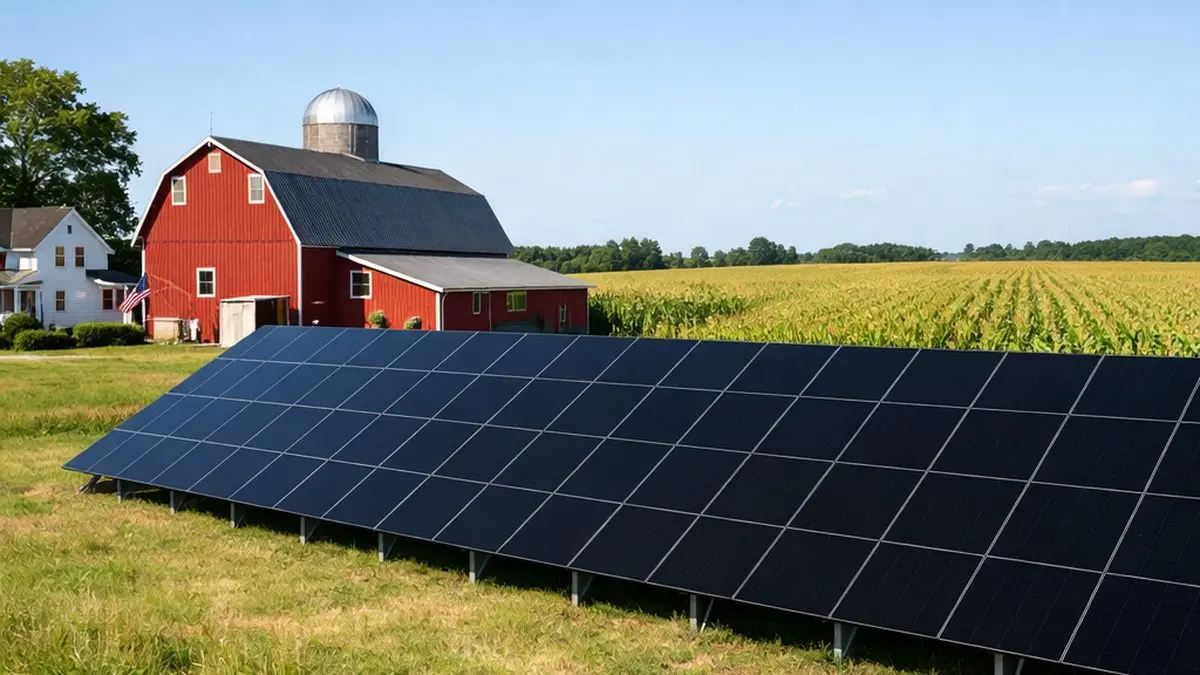
This is the kind of solar farm iSolar builds. A farm or rural business puts a ground mount near its main meter or a high-use building and offsets its own bill. For Xcel customers, net metering applies to systems up to 40 kW, which makes that a natural ceiling for many projects; co-op members have their own rules.
A worked example: a 40 kW ground mount in southern Minnesota making about 1,150 to 1,300 kWh per kW per year produces roughly 46,000 to 52,000 kWh annually. Using Lawrence Berkeley National Laboratory's density figure for fixed-tilt arrays of about 2.8 acres per MW-DC, the array itself occupies around a tenth of an acre. That's a corner of a yard site, not a field.
Farm-owned commercial systems can still use the federal Section 48E credit under its 2026 and 2027 deadlines, and USDA REAP grants remain available for agricultural producers and rural small businesses. See our guides to the 48E credit deadline and REAP grants. Our agricultural solar projects page shows ground mounts we've built from Hastings to Felton.
Community solar gardens: shared solar farms
Community solar gardens are mid-size solar farms whose output is divided among subscribers. A subscriber, who might be a renter, a homeowner with a shaded roof or a school district, gets credits on their utility bill for their share of production. Minnesota's legacy garden program was run through Xcel Energy.
That legacy program closed to new applications at the end of 2023. The Legislature replaced it with a Low and Moderate-Income Accessible Community Solar Garden program administered by the Minnesota Department of Commerce. As of Sept. 1, 2026, Commerce reported 30.5 MW of 2026 project capacity approved, with another 1.5 MW under review.
Should you subscribe or build your own? Our comparison of community solar vs. rooftop solar runs the numbers.
Utility-scale solar farms
Utility-scale projects are the ones you notice from the highway. The largest in Minnesota is Xcel Energy's Sherco Solar in Sherburne County, built near the retiring Sherco coal plant. MPR News reported in July 2026 that its third phase began delivering power at the end of June, bringing the project to 710 MW from nearly 1.7 million panels, enough for about 150,000 homes. Phase 3 alone covers about 1,500 acres. Xcel has said it plans to propose a fourth, 200 MW phase.
Across all sizes, the Solar Energy Industries Association's Minnesota page, updated September 2026, lists about 3,618 MW-DC of installed solar supplying roughly 6.45% of the state's electricity.
Federal support is shifting. The 2025 federal budget law phased out tax credits for utility-scale solar on a timeline tied to construction start and in-service dates, and MPR notes tariffs on imported components have raised construction costs. Expect fewer, more carefully sited projects than the last few years.
Who actually benefits from a solar farm?
The answer changes with the scale, which is why neighbors and owners often talk past each other.
- Farm-scale: the owner benefits directly through lower electric bills, and the power is used on site or credited through net metering. Payback depends on usage, incentives and how the system is financed.
- Community gardens: subscribers benefit through bill credits without putting anything on their own roof, and the garden owner earns a return on the project. Under the newer program, access for low- and moderate-income households is a stated goal.
- Utility-scale: the utility adds generation to replace retiring plants, landowners typically receive lease payments, and all ratepayers share the cost and the output through the rate base.
Grid capacity is the hidden constraint at every size. A farm array needs an interconnection review from the local utility, and larger projects often wait in a queue for substation or feeder upgrades. Sherco Solar sits at a coal plant site where grid connections already exist, and Xcel plans to use those same connections for battery storage. For a farm, checking what the nearest line and transformer can accept is one of the first steps, before you fall in love with a site.
How much land does a solar farm use?
LBNL's empirical study of U.S. utility-scale plants found median 2019 power densities of about 2.8 acres per MW-DC for fixed-tilt arrays and 4.2 acres per MW-DC for single-axis tracking. Trackers produce more per panel but need wider row spacing.
| Project size | Fixed-tilt land (approx.) | Tracking land (approx.) |
|---|---|---|
| 40 kW farm array | about 0.1 acre | about 0.17 acre |
| 1 MW-DC community garden | about 2.8 acres | about 4.2 acres |
| 100 MW-DC utility project | about 280 acres | about 420 acres |
These are array footprints. Setbacks, access roads, fencing and stormwater features add to the total site. If you're thinking about grazing or crops alongside panels, see our post on agrivoltaics in Minnesota.
Permits, interconnection and who decides
Minnesota's siting law draws the lines by size. Under Minn. Stat. chapter 216I, a solar energy generating system of 50 MW AC or more falls under the Public Utilities Commission. Projects under 50 MW don't need a commission permit but must get local, state and federal approvals that apply. Between 50 and 80 MW a developer can choose local approval instead, and at 80 MW and above the PUC issues the permit.
For landowners approached by a developer, ask about the lease term, decommissioning and restoration bonds, drain tile protection, fencing, vegetation management, and how property taxes are handled.
Thinking about solar for your farm?
If you want a solar farm that lowers your own operation's bill rather than leasing land to a developer, start with a site visit. Our agricultural solar team sizes ground mounts to your meters and usage, and we'll walk through REAP and 48E timing with you and your tax advisor.
Sources
- MPR News — Xcel Energy's Sherco Solar project near Becker gets bigger (July 28, 2026)
- Lawrence Berkeley National Laboratory — Land Requirements for Utility-Scale PV: An Empirical Update on Power and Energy Density
- Minnesota Statutes chapter 216I — Energy infrastructure facility siting (Office of the Revisor of Statutes)
- Minnesota Department of Commerce — Community Solar Gardens for Developers
- Solar Energy Industries Association — Minnesota Solar
Frequently asked.
How many acres does a solar farm need per megawatt?
Lawrence Berkeley National Laboratory found median densities of about 2.8 acres per MW-DC for fixed-tilt arrays and 4.2 acres per MW-DC for single-axis trackers in 2019. Roads, setbacks and fencing add to the total site.
What is the largest solar farm in Minnesota?
Xcel Energy's Sherco Solar near Becker in Sherburne County. MPR News reported it reached 710 MW in mid-2026 after its third phase came online, with nearly 1.7 million panels.
Who permits solar farms in Minnesota?
Projects under 50 MW AC are approved locally by the city or county. From 50 to 80 MW a developer can choose local approval or a state permit, and at 80 MW and above the Minnesota Public Utilities Commission issues the permit.
Can I build a solar farm on my own farm in Minnesota?
Yes. Many farms install ground-mounted arrays sized to offset their own electric use, often up to 40 kW for Xcel net metering. They need a building or zoning permit, an electrical permit and utility interconnection approval.
How do community solar gardens work in Minnesota?
A mid-size solar farm's output is split among subscribers, who receive bill credits for their share. Xcel's legacy program closed to new applications at the end of 2023, and a new income-accessible program is run by the Minnesota Department of Commerce.
How much electricity does Minnesota get from solar?
The Solar Energy Industries Association's Minnesota page, updated September 2026, lists about 3,618 MW-DC installed and roughly 6.45% of the state's electricity from solar.


Have a question we haven't covered?
Talk to a local iSolar expert — free, no pressure. Call (651) 565-1140.