
FranklinWH aPower 2: An Installer's Notes for Minnesota Homeowners
A 15 kWh battery with a 10 kW inverter and a whole-home transfer switch. Here's what that means in a Minnesota garage, on a farm with a generator, and next to the solar you already own.
Reviewed by John Ihle, MN Master Electrician (AM005101) · NABCEP-credentialed · iSolar, Saint Paul Park, MN · Last reviewed October 2026
The short answer: The FranklinWH aPower 2 is a 15 kWh lithium iron phosphate battery with 10 kW of continuous output, paired with the aGate controller for whole-home backup. It's AC-coupled, so it can be added to most existing solar systems, and it can work alongside a standby generator. Its rated low temperature is -4°F, so in Minnesota it belongs in a garage or basement.
FranklinWH aPower 2 at a glance
The FranklinWH aPower 2 is the second-generation battery in FranklinWH's whole-home system, announced in September 2024. It pairs with the aGate, a controller that sits between the utility, your main panel, your solar, and optionally a generator. If you've read our Minnesota home battery guide, think of the Franklin system as the "whole house, with a generator option" approach.
Here are the specs FranklinWH publishes for the aPower 2:
| Spec | FranklinWH aPower 2 | Why it matters in Minnesota |
|---|---|---|
| Capacity | 15 kWh | Roughly a day of essential loads for many homes, longer with careful use |
| Continuous output | 10 kW | Enough to run a well pump, furnace blower and kitchen at the same time |
| Charge rate | 8 kW | Refills quickly on a sunny day or from a generator |
| Motor starting | 185 LRA | FranklinWH says it can start a 5-ton central air conditioner |
| Chemistry | Lithium iron phosphate (LFP) | Stable chemistry, long cycle life |
| Operating temperature | -4°F to 131°F, with automatic heating | Not rated for a Minnesota January outdoors |
| Enclosure | IP67, fanless, 30 dBA | Quiet enough for an attached garage or utility room |
| Stacking | Up to 15 units per aGate (225 kWh) | Room to grow for farms and large homes |
| Warranty | 15 years or 60 MWh throughput | Throughput cap matters if you cycle it daily |
Compared with the first-generation aPower, which FranklinWH's datasheet lists at 13.6 kWh usable and 5 kW continuous, the aPower 2 doubles the continuous output. That's the upgrade that matters most for whole-home backup.
The aGate: whole-home transfer in one box
The aGate is what makes a Franklin system a whole-home system rather than a critical-loads panel. When the grid drops, it isolates your house from the utility and switches you to battery power. FranklinWH's published aGate datasheet lists:
- Transfer time under 16 milliseconds from grid to backup, fast enough that most electronics ride through.
- Backup load port rated up to 200 amps, so the aGate can feed a typical 200-amp main panel.
- Solar input with up to 80 amps of overcurrent protection for AC-coupled solar circuits.
- Smart circuits (optional module): one 80-amp 240V circuit plus either two 50-amp 120V circuits or one 50-amp 240V circuit. These let the system shed big loads, like an EV charger or electric water heater, during an outage.
Whole-home backup doesn't mean unlimited backup. A 10 kW battery won't run an electric range, a dryer, an EV charger and central air at once. The smart circuits and some sensible load planning are what make 15 kWh last.
Generator integration for rural Minnesota
This is where the Franklin system stands apart for many of our greater Minnesota customers. The aGate accepts an optional generator module, and FranklinWH's datasheet lists generator input protection up to 200 amps. The idea:
- The battery carries the house through short outages silently, which covers most of them.
- In a multi-day ice storm, the generator runs to recharge the battery and carry heavy loads, then shuts down while the battery takes over.
- The generator runs fewer, more efficient hours, which stretches a propane tank on a farm or lake property.
Worked example: a three-day ice storm near Hinckley
Say a farmhouse's essential loads (well pump, furnace blower, fridge, freezer, lights, internet) average about 1.5 kW. One full aPower 2 at 15 kWh covers roughly 10 hours of that before counting conversion losses. Because the aPower 2 charges at up to 8 kW, a generator large enough to deliver that much spare power can refill an empty battery in about two hours. Instead of a generator running 72 hours straight, you might run it a couple of hours, two or three times a day, with the battery carrying the quiet hours in between. Actual run time depends on the generator's size, the loads you keep on and how cold it gets. Winter solar helps on clear days, but don't count on it under snow.
The details depend on your generator. Its size, whether it has a compatible two-wire start, and how it connects to the aGate all need to be checked against FranklinWH's installation requirements before you assume your existing unit will work. If you're still deciding between the two technologies, our generator vs. battery comparison lays out the trade-offs.
Adding the FranklinWH aPower 2 to solar you already have
The aPower 2 is AC-coupled. It doesn't take DC from your panels directly; your existing inverters keep converting solar to AC, and the battery charges from that AC. FranklinWH says the system works with all solar inverter brands. In practice:
- Enphase microinverter systems: the solar circuit lands on the aGate's solar input. In a properly configured system, the aGate forms a local grid during an outage and the microinverters can keep producing into it, which recharges the battery.
- String or optimizer systems (such as SolarEdge): the string inverter's AC output connects the same way.
- Solar*Rewards and net metering: adding a battery changes your interconnection, so the utility needs an updated application. If you're in Xcel's Solar*Rewards program, the production meter and incentive arrangements need to be preserved in the redesign.
Two cautions from the field. First, the array has to be sized so it can't overcharge the battery when the house is islanded; that's a design check, not an afterthought. Second, older inverters may need firmware or settings updates to behave correctly in backup mode. Get both confirmed in writing before you sign.
Where to put it in a Minnesota home
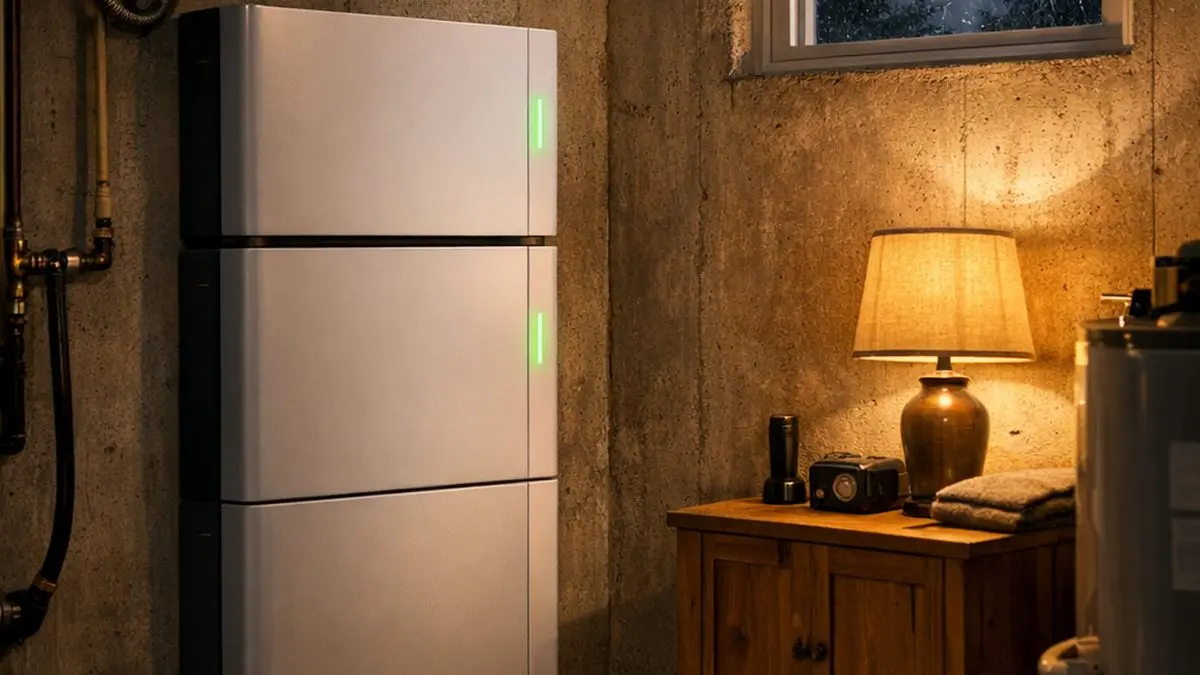
FranklinWH rates the aPower 2 for -4°F to 131°F, with built-in heating. That's fine for most attached garages, but not for an exterior wall in Bemidji in January. On Twin Cities installs we generally favor an attached garage or a basement utility area, both of which bring their own fire code rules on clearances and placement. Our plain-English guide to indoor battery code covers where a battery can live.
How it compares on paper
| FranklinWH aPower 2 | Tesla Powerwall 3 | |
|---|---|---|
| Capacity | 15 kWh | 13.5 kWh |
| Continuous output | 10 kW | 11.5 kW |
| Solar connection | AC-coupled (keeps your inverters) | Built-in solar inverter, up to 20 kW of panels |
| Generator integration | Optional aGate generator module | Check Tesla's current documentation |
| Low operating temperature | -4°F | -4°F |
For a new solar-plus-storage install, a hybrid design like the Powerwall 3 can simplify equipment. For an existing array or a home with a generator, AC coupling is often the cleaner retrofit.
Incentives and the real cost
There's no federal 25D credit for systems placed in service after 2025, so incentives come from Minnesota programs:
- Xcel customers: $175 per kWh up to $5,000, or $370 per kWh for income-qualified households. One 15 kWh aPower 2 works out to $2,625 at the standard rate; at the income-qualified rate it hits the $5,000 cap.
- Other Minnesota utilities: the state storage rebate pays $250 per kWh up to $7,000, but funds were running low as of August 2026.
Our Minnesota battery rebates guide covers eligibility and how to apply. Remember that under Xcel's monthly net metering a battery saves little on your bill; you're paying for backup, not payback.
Size it before you buy it
Whether you need one aPower 2, two, or a generator alongside, depends on what you want running during an outage and for how long. Try our battery sizing tool, then talk with us about battery backup options for your home. We'll design around your panel, your solar and your outage history.
Sources
- FranklinWH — aPower 2: The New Standard for Home Energy Management & Storage
- FranklinWH — aPower 2 product page
- FranklinWH — Announces new high-capacity 15 kWh home battery (Sept. 2024)
- FranklinWH — Franklin Home Power datasheet (aGate and aPower)
- Minnesota Department of Commerce — On-site energy storage systems incentive
Frequently asked.
How much does a FranklinWH aPower 2 hold?
FranklinWH lists the aPower 2 at 15 kWh with 10 kW of continuous output. Up to 15 units can connect to one aGate, for 225 kWh total.
Can the FranklinWH battery back up my whole house?
With the aGate, yes, in the sense that it can feed your whole main panel through a backup port rated up to 200 amps. You still can't run every large appliance at once, so smart circuits and load planning decide how long the battery lasts.
Can I add a FranklinWH aPower 2 to my existing solar panels?
Usually. The aPower 2 is AC-coupled, so your existing inverters keep working and the battery charges from their AC output. Your installer should confirm inverter settings and file an updated interconnection application with your utility.
Does FranklinWH work with a generator?
Yes. The aGate accepts an optional generator module, so a standby generator can recharge the battery and carry heavy loads during long outages. Confirm your generator's compatibility with FranklinWH's requirements first.
Can a FranklinWH battery be installed outside in Minnesota?
Its rated range starts at -4°F, so an outdoor install would see temperatures below spec in a typical Minnesota winter. An attached garage or basement location that meets fire code is usually the better choice.
What is the FranklinWH aPower 2 warranty?
FranklinWH offers 15 years or 60 MWh of energy throughput on the aPower 2, whichever comes first. If you cycle the battery daily, check how quickly you'd approach the throughput limit.


Have a question we haven't covered?
Talk to a local iSolar expert — free, no pressure. Call (651) 565-1140.