
How to Test a Solar Panel With a Multimeter (and When Not To)
A single loose panel on a sawhorse is a fair DIY test. A wired rooftop array is not. Here's how to check voltage and current safely, and what your monitoring already tells you.
Reviewed by John Ihle, MN Master Electrician (AM005101) · NABCEP-credentialed · iSolar, Saint Paul Park, MN · Last reviewed October 2026
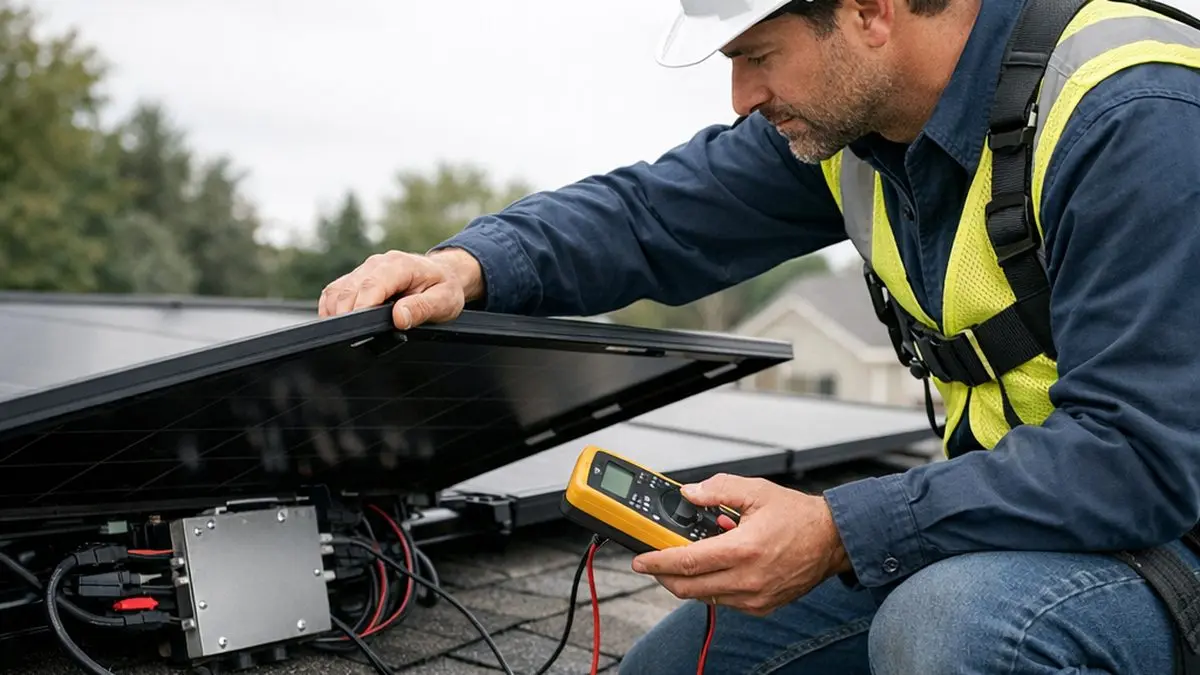
The short answer: To test a single, disconnected solar panel, measure open-circuit voltage (Voc) across its leads with a DC-rated meter in full sun and compare it to the datasheet; Fluke says a healthy module reads within about 10% of rated. Current needs a DC clamp meter or PV tester. Rooftop arrays carry hundreds of volts DC, so leave them to a licensed electrician.
First: is this a loose panel or a wired array?
Before you look up how to test a solar panel, decide which situation you're in, because the risk is completely different.
- A single loose module (a cabin panel, an RV panel, a spare from a past project) sitting on the ground and connected to nothing. Its open-circuit voltage is around 40 volts DC. You can check it with the right meter and some care.
- A panel that's part of a home system. On a string inverter system, modules are wired in series, and a string can easily run several hundred volts DC. Microinverter systems keep DC voltage low at each panel but put 240-volt AC on the roof. Either way, it's energized whenever the sun is up, and you can't turn the panels off.
In Minnesota, the installation of a solar PV system must be performed by a licensed electrical contractor, according to the Department of Labor and Industry. Opening connectors on a rooftop array is electrical work on a live system, on a roof. If you have a home system and suspect a bad panel, skip to the monitoring section below.
How to test a solar panel: what you need
- A DC-rated multimeter with a proper category rating. Fluke notes PV work falls in measurement Category III, and recommends CAT III 1000 V or 1500 V rated meters for solar.
- The module's datasheet or back label, which lists Voc, Isc, Vmp and Imp at standard test conditions (STC).
- MC4-compatible test leads or adapters, so you're not jamming probes into connectors.
- A DC clamp meter or PV tester if you want to check current.
- Clear sun. Readings on an overcast day mean little.
Step 1: Open-circuit voltage (Voc)
- Set the panel facing the sun, unshaded, tilted roughly toward the sun.
- Set your meter to DC volts, on a range above the panel's rated Voc.
- Connect red to the positive lead and black to the negative using MC4 test adapters.
- Read the voltage and compare it to the datasheet Voc.
Fluke's guidance is that voltage should be within about 10% of the module's rating; a reading well below that can indicate a problem. Voc is relatively insensitive to light level once the panel is in decent sun, which is why it's the easiest first check. A reading near zero usually means a broken connection, a failed junction box or a burned bypass path.
Why cold Minnesota panels read high
Voltage rises as cells get colder. Take Qcells' Q.TRON BLK M-G2+ 425 W as an example: its STC Voc is 38.67 V and its voltage temperature coefficient is −0.24% per °C. On a −20°C (−4°F) sunny January morning, that's 45 degrees below the 25°C test condition, so Voc climbs roughly 11% to about 42.8 V. A 10-panel series string would be near 430 V. This is exactly why the NEC requires a cold-temperature voltage correction when sizing strings, and why a high winter reading is not a fault.
Step 2: Short-circuit current (Isc), and why to be careful
Short-circuit current is the current the panel produces when its leads are connected together. It tracks sunlight closely, so it tells you more about cell health than voltage does, but it's the test people get wrong.
- Check your meter's current rating. Many handheld meters' current input is limited to 10 amps. The 425 W Qcells module above has an STC Isc of 13.49 A. Putting that through a 10 A input can blow the meter's fuse, or worse.
- Use a clamp or a PV tester. Fluke recommends a clamp meter for measuring module current. The clean way is to short the panel through a properly rated DC disconnect or test lead, clamp around one conductor, then open the switch, not the connector, to break the current.
- Never pull an MC4 connector under load. DC current doesn't pass through zero the way AC does, so it can draw a sustained arc.
Expect Isc to scale with sunlight. At the datasheet's NMOT condition of 800 W/m², the same panel's Isc is listed at 10.87 A, roughly 80% of STC. A reading of 6 A in hazy afternoon sun may be perfectly normal.
Reading the results
| What you see | Likely meaning | Next step |
|---|---|---|
| Voc within ~10% of datasheet, Isc reasonable for the light | Module is producing normally | Look elsewhere: wiring, charge controller, inverter |
| Voc above datasheet on a cold day | Normal temperature effect | None |
| Voc about one-third lower than expected | A bypass diode or cell substring may have failed | Inspect the junction box; likely replace the module |
| Voc near zero | Open circuit: broken lead, failed connector or junction box | Inspect leads and connectors |
| Normal Voc but very low Isc in full sun | Soiling, shading, cracked cells or degradation | Clean, re-test; consider an I-V curve test |
Common mistakes that fake a bad reading
- Testing at the end of a long cord. Voltage drop and a bad connector in an extension lead look like a weak panel. Test at the module's own leads first.
- Partial shade. A shadow across a few cells, even from a fence post or your own body, can drag current down sharply.
- Dirty or frosted glass. Light snow, frost or pollen film lowers current. Clean and re-test.
- Wrong meter setting. AC volts on a DC source gives nonsense. Double-check before you conclude anything.
A multimeter only gives you two points on the panel's curve. Fluke's I-V curve tracers plot the whole curve and compare it to the module's specifications, which is how installers spot subtle problems like cell cracks or mismatch. If a simple test is ambiguous, that's the next step.
For home systems, monitoring already tests your panels
If you have a grid-tied home system, you rarely need a meter to find a weak panel. Your monitoring app is already doing it.
- Microinverter systems (like Enphase IQ8) report production panel by panel. A module that consistently makes less than its neighbors on sunny days stands out on the array view. See our guide to the Enphase Envoy gateway if your data has gone blank.
- String systems with optimizers (like SolarEdge) also report per-panel data.
- Plain string inverters report only string totals, so a lower-than-expected string is the clue.
Compare your production to the same month last year rather than to a single day. Snow, haze and a short December day all look like faults if you're not careful. Our posts on fixing offline monitoring and what a solar inspection checks cover the rest. If you're weighing a hands-on approach generally, read DIY solar in Minnesota first.
When to call in an electrician
If your monitoring shows a panel or string underperforming, or you see scorch marks, melted connectors or cracked glass, iSolar's licensed electricians can test and diagnose it safely. Start on our solar panel repair page.
Sources
Frequently asked.
How do I test a solar panel with a multimeter?
On a single disconnected panel in full sun, set a DC-rated meter to volts and measure across the positive and negative leads. Compare the reading to the datasheet's open-circuit voltage; Fluke says a healthy module should read within about 10% of its rating.
Can I test solar panels on my roof myself?
We don't recommend it. Rooftop arrays are energized whenever there's daylight, string systems can run several hundred volts DC, and Minnesota requires PV installation work to be done by a licensed electrical contractor. Use your monitoring app first.
Why is my solar panel voltage higher than the rating?
Cold temperatures raise panel voltage. A panel with a −0.24% per °C voltage coefficient reads about 11% above its rated Voc at −20°C, which is normal on a Minnesota winter morning.
Can I measure solar panel current with a regular multimeter?
Be careful. Many meters' current inputs are limited to 10 amps, while modern residential panels can exceed 13 amps of short-circuit current. A DC clamp meter or PV tester is the safer tool.
How do I know if one of my solar panels is bad?
On microinverter or optimizer systems, look at per-panel production in the monitoring app on several sunny days. A panel that consistently lags its neighbors is worth having checked.
What does a low voltage reading on a solar panel mean?
A reading about one-third lower than expected often points to a failed bypass diode or cell section. A reading near zero usually means an open connection or failed junction box.

Have a question we haven't covered?
Talk to a local iSolar expert — free, no pressure. Call (651) 565-1140.