
Minnesota Power Outage: Who to Call, Outage Maps and How Long It Will Last
Your neighbor might be on a different utility. Here are the outage maps and numbers for Minnesota's major utilities, why some outages drag on, and how to back up your home.
Reviewed by John Ihle, MN Master Electrician (AM005101) · NABCEP-credentialed · iSolar, Saint Paul Park, MN · Last reviewed October 2026
The short answer: Report a Minnesota power outage to your own utility: Xcel at 1-800-895-1999 or text OUT to 98936; Dakota Electric at 651-463-6201; Connexus at 763-323-2660; Otter Tail at 800-257-4044. Each posts a live outage map. After big storms, crews fix safety hazards first, then repairs that restore the most customers, so single-home outages often come back last.
Minnesota power outage: first, figure out who your utility is
In a Minnesota power outage, the fastest path to a restoration estimate is your own utility's outage map, and Minnesota has a lot of utilities. Xcel Energy serves most of Minneapolis, Saint Paul and many suburbs, but large parts of the metro are served by cooperatives like Dakota Electric and Connexus, northern Minnesota by Minnesota Power, western and northwestern areas by Otter Tail Power, plus dozens of rural co-ops and city-owned utilities. Your neighbor across the road can be on a different system.
The quickest check: look at the logo on your electric bill or the name on your meter. Save that utility's outage number in your phone now, while it's charged.
Minnesota power outage map and phone numbers by utility
| Utility | Where it serves | Report an outage | Outage map |
|---|---|---|---|
| Xcel Energy | Minneapolis, Saint Paul, much of the metro and many outstate cities | 1-800-895-1999; text OUT to 98936; Xcel app; xcelenergy.com/out | Xcel outage map |
| Dakota Electric Association | Much of Dakota County and nearby areas | 651-463-6201 or 800-430-9722 (24 hours) | Dakota Electric outage map |
| Connexus Energy | Northern metro, including much of Anoka County | Outage line 763-323-2660; online report form | Connexus outage map |
| Minnesota Power | Duluth and much of northeastern and central Minnesota | Minnesota Power app; call center 800-228-4966 | Minnesota Power outage center |
| Otter Tail Power | Western and northwestern Minnesota | 800-257-4044 or 218-739-8877 (24/7) | Otter Tail outage map |
| Rural co-ops and municipal utilities | Much of greater Minnesota and some suburbs | Number printed on your bill | Most post a map on their own website |
Phone numbers and links are as listed on each utility's site in October 2026. A tip: if the outage map shows no outage at your address, report it anyway. Utilities build their picture from smart meters and customer reports, and an isolated problem at your service drop may not show up on its own.
Before you call: rule out your own panel
Plenty of calls that start as "the power is out" turn out to be a problem inside the house or at the service entrance. Check these first, with a flashlight, before you spend twenty minutes on hold:
- Look at the neighbors. Are their lights, porch lights or streetlights on?
- Check your main breaker. If the main is tripped, or half the house is dark, the problem may be yours. Partial power, where some lights glow dim or some rooms work and others don't, can mean a lost leg of service or a failing neutral. Turn off sensitive electronics and report it to the utility right away; it can damage appliances.
- Look at the service mast. After a storm, check where the overhead wires attach to your house. A tree limb that rips the mast or weatherhead off the house is a common Minnesota storm call. The utility owns the wires to the attachment point, but the mast and meter socket are usually the homeowner's, and an electrician has to repair them (with an inspection) before the utility will reconnect.
Stay away from any downed line, assume it's energized, and call 911 and your utility. That includes the service wire to your own house if it's sagging to the ground or lying across the driveway.
How long do power outages last in Minnesota?
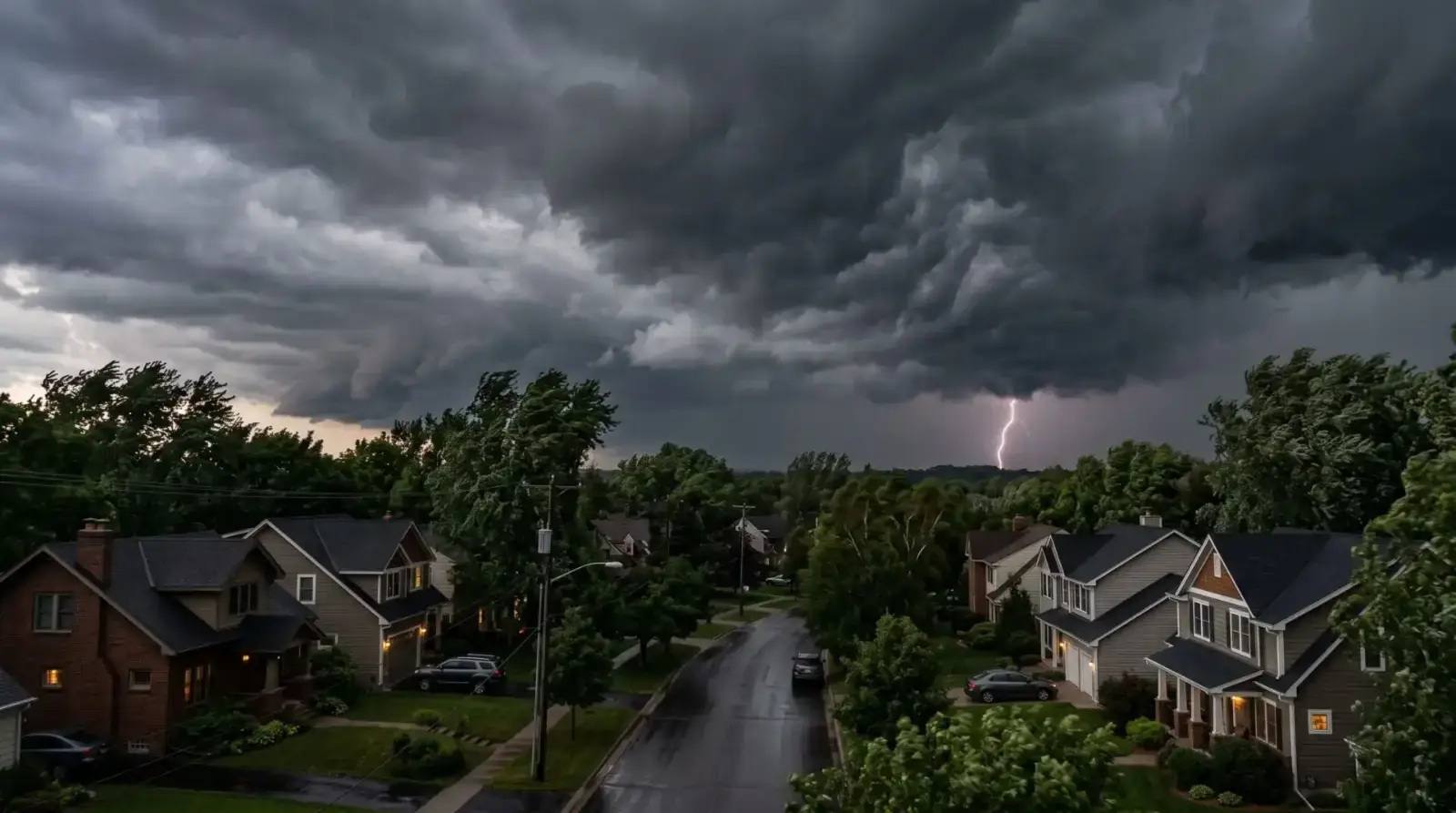
Most outages are short. The long ones come from storms that damage a lot of equipment at once, and the order of repairs decides when your lights come back. After the June 10, 2026 storms that left about 40,000 Xcel customers out, mostly in the east metro, Xcel described its approach: crews respond first to situations that threaten public safety, such as energized downed wires, then make the repairs that restore the most customers at once.
In practice that means repairs flow from big to small:
| Repair level | Customers restored per fix | Typical place in line |
|---|---|---|
| Transmission lines and substations | Thousands | First |
| Main distribution feeders | Hundreds to thousands | Early |
| Neighborhood taps and transformers | Dozens | Middle |
| Individual service drops to one home | One | Last |
That's why one dark house on a lit street can wait the longest after a big storm. If your neighbors come back and you don't, call again; you may have a separate problem the utility hasn't logged.
What causes long outages here
Minnesota's long outages tend to follow the seasons:
- Summer thunderstorms and straight-line winds. The biggest cause of widespread metro outages. Mature trees in older suburbs like Roseville, Saint Louis Park and Saint Paul neighborhoods come down on overhead lines.
- Ice storms and heavy, wet snow. Ice loading snaps branches and lines over wide areas, and crews work slowly in it. These are the outages that also take your heat.
- Spring wind on saturated ground. Trees uproot more easily when soils are soft from thaw.
- Long rural lines. Co-op feeders can run many miles through farmland and woods. A single fault far out can take longer to find and reach, especially in drifted snow.
- Equipment failure in extreme cold or heat. Transformers and underground cable faults spike on the hottest and coldest days of the year.
For a pre-season checklist covering sump pumps, furnace circuits and surge protection, see our winter storm electrical checklist.
Staying safe while the power is out
- Generators outside only. The CPSC says to run portable generators at least 20 feet from the house, never in a garage, porch or carport, and to keep battery-backed CO alarms on every level.
- Never backfeed. Plugging a generator into a dryer outlet can energize the lines crews are repairing. Use an inlet with an interlock or transfer switch.
- Protect pipes in winter. A gas furnace won't run without power. In a multi-day January outage, plan to keep the house above freezing or drain lines.
- Unplug sensitive electronics to protect them from surges when power returns, then plug back in gradually.
Backup power options for the next outage
| Option | Starts on its own? | Heat in winter? | Best for |
|---|---|---|---|
| Portable generator + inlet and interlock | No | Yes, with fuel on hand | Lowest cost, someone home to run it |
| Standby generator | Yes | Yes | Long outages, whole-home coverage |
| Home battery | Yes | Furnace blower for a limited time | Silent backup for essentials, short-to-medium outages |
| Solar + battery | Yes | Furnace blower, recharged by sun | Multi-day resilience when the sun is out |
Solar panels alone shut off in an outage for line-worker safety; our post on whether solar works in a power outage explains why. For a portable setup, start with our guide to choosing a portable generator for your house. For batteries, the battery sizing tool estimates how many kWh your essentials need.
Plan your backup before the next storm
Outages are a matter of when, not if. iSolar installs generator inlets and interlocks, standby generators and home batteries across the Twin Cities. See our battery backup and generator pages, or request a quote.
Sources
- Xcel Energy Newsroom — Xcel Energy working to restore power to customers after severe storms hit Minnesota (June 10, 2026)
- Dakota Electric Association — Report an outage
- Connexus Energy — Outage reports
- Minnesota Power — Outage and public safety center
- Otter Tail Power — Outages and safety
- U.S. CPSC — Winter storm may knock out power; CPSC warns of deadly carbon monoxide and fire risks (Feb. 19, 2026)
Frequently asked.
How do I report a power outage to Xcel Energy in Minnesota?
Call 1-800-895-1999 and follow the prompts, text OUT to 98936, use the Xcel Energy app, or go to xcelenergy.com/out. Xcel's outage map shows estimated restoration times when they're available.
Where is the Minnesota power outage map?
There isn't one statewide map. Each utility runs its own, so check the outage map for whoever sends your electric bill: Xcel, Dakota Electric, Connexus, Minnesota Power, Otter Tail Power or your local co-op or city utility.
Why is my power still out when my neighbors have power?
Utilities restore the largest groups first, so a problem with only your service drop or transformer may come last. Report it again, and check whether your main breaker tripped or your service mast was damaged.
How long do power outages last in Minnesota?
Most are short, but major storms can leave some customers out for days. Restoration time depends on how much equipment was damaged and where your home falls in the repair order.
Who fixes the wires attached to my house after a storm?
The utility owns the service wires up to the attachment point, but the mast, weatherhead and meter socket are usually the homeowner's. A licensed electrician must repair those before the utility reconnects.
Can I run my furnace on a generator during an outage?
Yes, if the generator is connected through an outdoor inlet with an interlock or transfer switch. A furnace blower typically needs a few hundred watts running and more to start.


Have a question we haven't covered?
Talk to a local iSolar expert — free, no pressure. Call (651) 565-1140.