
What Is a Solar Inverter? The Box That Actually Runs Your Solar System
Panels make the power, but the inverter decides how much of it you get, whether it's safe for line crews, and what your monitoring app shows.
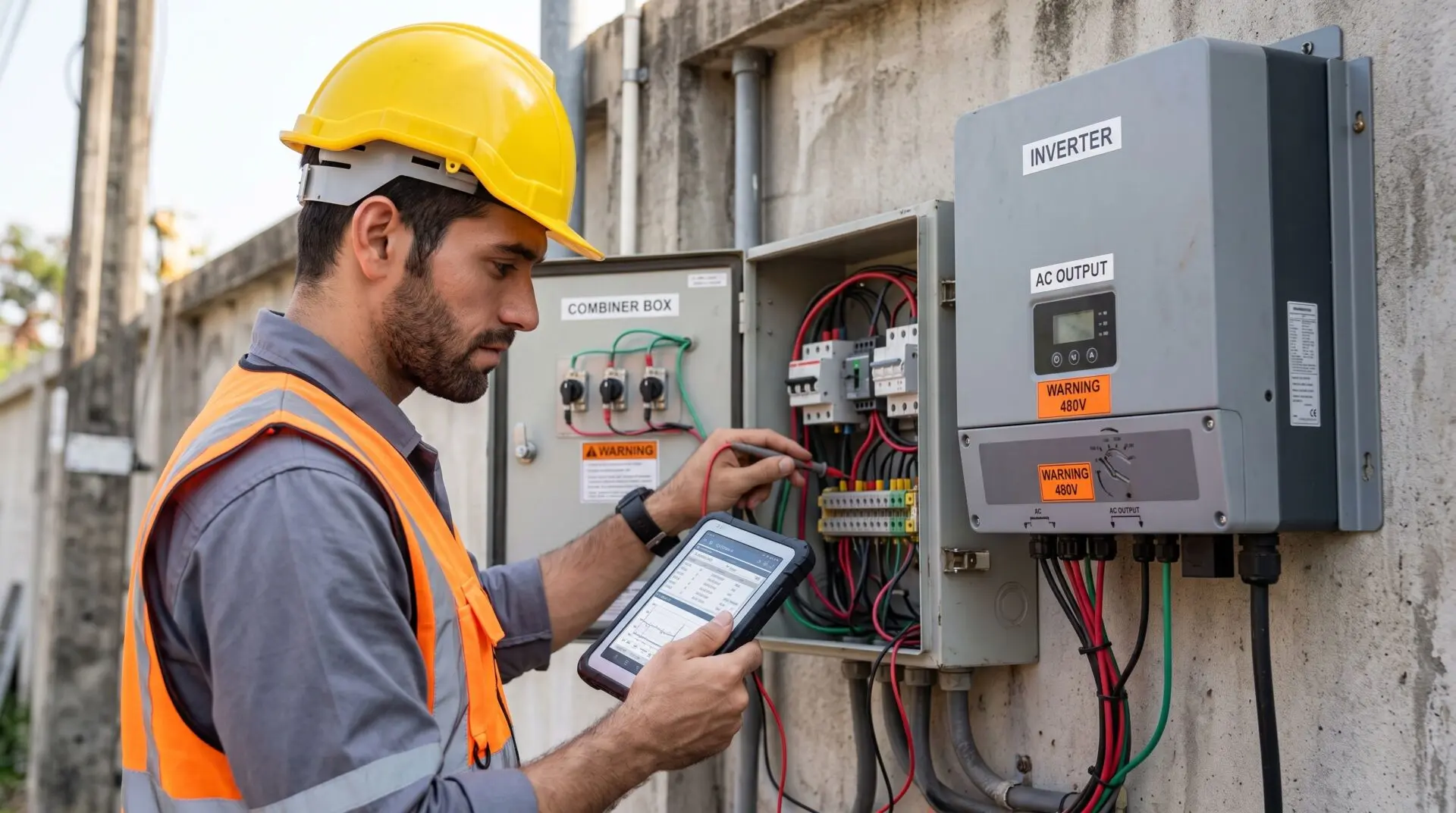
Reviewed by John Ihle, MN Master Electrician (AM005101) · NABCEP-credentialed · iSolar, Saint Paul Park, MN · Last reviewed October 2026
The short answer: A solar inverter converts the direct current (DC) your panels produce into the alternating current (AC) your home and the grid use. It also tracks each panel's best operating point, shuts down within 2 seconds when the grid fails, and reports production. Systems use string inverters, microinverters or hybrid inverters; microinverters like Enphase IQ8 carry 25-year warranties.
What is a solar inverter, in one paragraph?
What is a solar inverter? It's the power electronics that turn your panels' direct current (DC) into the 240-volt, 60-hertz alternating current (AC) your house and Xcel's grid run on. Solar cells only make DC. Your furnace blower, refrigerator and the utility's lines all run on AC. Without an inverter, a rooftop array is just expensive roofing.
But conversion is only one of its jobs. A modern inverter also squeezes the most power out of the panels minute by minute, keeps your system in step with the grid, shuts it off when the grid goes down, and feeds the data you see in your monitoring app. If you want the bigger picture of how the pieces fit, start with how solar power works; this page zooms in on the inverter.
How a solar inverter works, step by step
- Maximum power point tracking (MPPT). A panel's output depends on its voltage and current, and the sweet spot moves with sunlight and temperature. The inverter constantly adjusts the electrical load it puts on the panels to stay at that peak. On a cold, bright Minnesota morning, panel voltage runs high; on a hot July afternoon it sags. MPPT follows both.
- DC-to-AC conversion. Fast electronic switches chop the DC into pulses and shape them into a smooth AC sine wave.
- Synchronization. The inverter matches the grid's voltage, frequency and timing exactly before it pushes any power out. That's how solar power flows into your panel and, when you make more than you use, out through the meter.
- Protection and monitoring. It watches for ground faults, arc faults and grid problems, and logs production so you and your installer can spot trouble.
Think of how a solar inverter works this way: the panels are the engine, and the inverter is the transmission, the governor and the dashboard rolled into one.
String vs. micro vs. hybrid at a glance
Every grid-tied system uses one of three architectures. We cover the trade-offs in detail elsewhere, so here's the quick version:
| Type | Where it lives | How it handles shade | Battery-ready? | Deeper dive |
|---|---|---|---|---|
| String inverter | One box on a wall, panels wired in series strings | A shaded panel drags down its string unless optimizers are added | Needs an AC-coupled battery or a hybrid model | Power optimizers |
| Microinverters | Under each panel on the roof | Each panel works independently | AC-coupled batteries pair easily | Micro vs. string |
| Hybrid inverter | One box handling solar and battery | Depends on design; often paired with optimizers | Built for it (DC-coupled) | Hybrid inverters |
We install both microinverter systems (Enphase IQ8) and string-plus-optimizer systems (SolarEdge). On complex Twin Cities roofs with dormers, trees and several roof planes, panel-level electronics usually win. On large, simple, unshaded arrays, a string design can make sense.
The grid-safety jobs nobody sees
Your inverter is also a piece of grid equipment, and it has to follow the same rules as power plants many times its size.
Anti-islanding
If a storm takes down the line on your street, a solar system that kept pushing power onto those wires could shock a lineworker who assumes they're dead. That condition is called an island. Under IEEE Standard 1547, an inverter must detect it and stop energizing the grid within 2 seconds, and by default it waits 5 minutes after the grid returns before reconnecting. NREL's lab tests found real-world run-on times well under that 2-second limit. This is also why ordinary grid-tied solar goes dark in a blackout; our guide to solar during a power outage explains how batteries change that.
Ride-through and smart functions
The 2018 update to IEEE 1547 asks inverters to do more than just drop off. They're expected to ride through brief voltage and frequency dips instead of all tripping at once, and to support grid voltage with functions such as volt-var control. Minnesota was early here: the Public Utilities Commission adopted statewide Technical Interconnection and Interoperability Requirements built on IEEE 1547-2018 in November 2019. In practice, that's why your installer sets a specific grid profile at commissioning, and why an inverter bought online for another market may not be accepted for interconnection.
Sizing: why your inverter is smaller than your array
Look at a solar quote and you'll often see two numbers: the DC rating of the panels and a smaller AC rating of the inverters. That's deliberate. Panels rarely hit their nameplate output in the real world, especially at Minnesota's sun angles, so a modestly undersized inverter costs less and runs closer to its efficient range most of the day.
As an example from our own work, a 2026 Cottage Grove install pairs 10.56 kW of panels with 8.376 kW of Enphase IQ8A microinverter capacity, a DC-to-AC ratio of about 1.26. On a few cold, crystal-clear spring days the inverters may briefly cap output (called clipping), but the energy lost over a year is small. Ratios get pushed too far when a seller pairs large panels with undersized inverters to save on equipment. Ask for the ratio, and ask for the modeled clipping loss.
Where the inverter's output lands in your house
The AC side of the inverter has to connect to your electrical service somewhere, and that choice shapes the cost. The simple route is a backfed breaker in your main panel, but the NEC's 120% busbar rule (705.12 in the 2023 edition) limits how big that breaker can be: on a 200-amp panel with a 200-amp main, about 40 amps. Larger systems, or panels that can't take the breaker, connect with a line-side tap ahead of the main breaker instead. It's common on our jobs: in a review of roughly 370 of our recent residential plan sets, about three in four used a line-side tap. Either way, the inverter's AC rating, not the panel wattage, is what the electrical design is sized around.
How long does a solar inverter last?
The inverter is the hardest-working electronic part of the system, so plan for it. Some practical points:
- Warranty sets expectations. Enphase offers a 25-year limited warranty on IQ8 microinverters. Central string inverters typically carry shorter standard warranties, so check the spec sheet and whether an extension is included.
- Heat is the enemy, not cold. Wall-mounted inverters should be out of direct afternoon sun and have the clearances the manual requires. A shaded north or east garage wall is often ideal.
- Monitoring catches failures. A dead microinverter costs you one panel's output; a dead string inverter costs you everything until it's replaced. Keep the monitoring gateway online so problems show up in days, not months.
- Budget for one replacement over 25-plus years with a string inverter outside its warranty. That's normal, not a defect.
Problems with your inverter?
If your app shows zero production, the inverter is throwing a fault, or you inherited a system from an installer who's gone, our solar repair service can diagnose it. Planning a new system? Request a quote and we'll explain which inverter type fits your roof and why.
Sources
Frequently asked.
What does a solar inverter do?
It converts the DC electricity from your panels into AC power your home and the grid can use. It also tracks each panel's best operating point, synchronizes with the grid, shuts the system down if the grid fails and records production data.
Do all solar panels need an inverter?
Any system that powers normal household appliances or connects to the grid needs an inverter, because panels only produce DC. Small DC-only setups, like some RV or cabin systems charging batteries, can skip it for DC loads.
How long does a solar inverter last?
Microinverters like Enphase IQ8 carry 25-year limited warranties. Central string inverters typically have shorter standard warranties, so many owners should plan for one replacement over a system's 25-to-30-year life.
Why does my solar stop working during a power outage?
Grid-tied inverters must stop energizing the grid within 2 seconds of an outage to protect lineworkers. To keep power on during an outage you need a battery or other equipment that can safely isolate your home from the grid.
What is the difference between a string inverter and a microinverter?
A string inverter is one central box that converts power from panels wired in series. Microinverters sit under each panel and convert power individually, so shade or a fault on one panel doesn't drag down the others.
Should my inverter be smaller than my solar panels?
Usually slightly, yes. A DC-to-AC ratio modestly above 1.0 is common because panels rarely reach nameplate output. Very high ratios cause excessive clipping, so ask your installer for the modeled losses.


Have a question we haven't covered?
Talk to a local iSolar expert — free, no pressure. Call (651) 565-1140.