Are Solar Panels a Fire Risk? Real Causes and How Good Installs Prevent Them
Solar fires are rare, and when they happen the cause is usually a bad connection, not the panels. Here is where the risk lives and how code and good workmanship design it out.
Reviewed by John Ihle, MN Master Electrician (AM005101) · NABCEP-credentialed · iSolar, Saint Paul Park, MN · Last reviewed October 2026
The short answer: Solar panels are a low fire risk when installed correctly. A Fraunhofer ISE study of about 1.3 million German PV systems found about 120 PV-caused fires in 20 years, with serious damage in roughly 0.006 percent of systems, mostly from poor installation and bad connectors. Modern U.S. code adds DC arc-fault protection (NEC 690.11), rapid shutdown (690.12) and roof setbacks.
The short answer: rare, and mostly about workmanship
Solar panel fires make the news because they are unusual and dramatic. The data says they are rare, and that when they do happen, the cause is almost always how the system was installed rather than the panels themselves.
The best large data set comes from Germany, which put solar on rooftops years before the U.S. did. A Fraunhofer ISE study of roughly 1.3 million PV systems found about 350 fires over 20 years that involved a PV system. In only about 120 of those was the PV system the cause. Seventy-five caused serious damage, about 0.006 percent of systems, and in 10 cases a building burned down. Their headline finding was that poor installation and low-quality connectors were the main risk, and that qualified installers following existing rules are the best fire protection.
U.S. code has added several layers of protection since those German systems were built. Below is where the real risk lives and how a good installer designs it out.
Where solar fires actually start
Almost every PV fire traces back to a bad electrical connection somewhere in the DC wiring. The usual suspects:
- Mismatched connectors. Solar has no universal plug. Many brands sell “MC4-compatible” connectors, and while each may be listed on its own, the mated pair may not be. Small differences in dimensions and materials create resistance, heat and eventually failure. The NEC (690.33 in the 2020 and 2023 editions) requires mating connectors that are not the same type and brand to be listed and identified for intermatability.
- Poorly crimped or loose connections. A field-made connector crimped with the wrong tool, or a terminal not torqued to spec, heats up under load year after year.
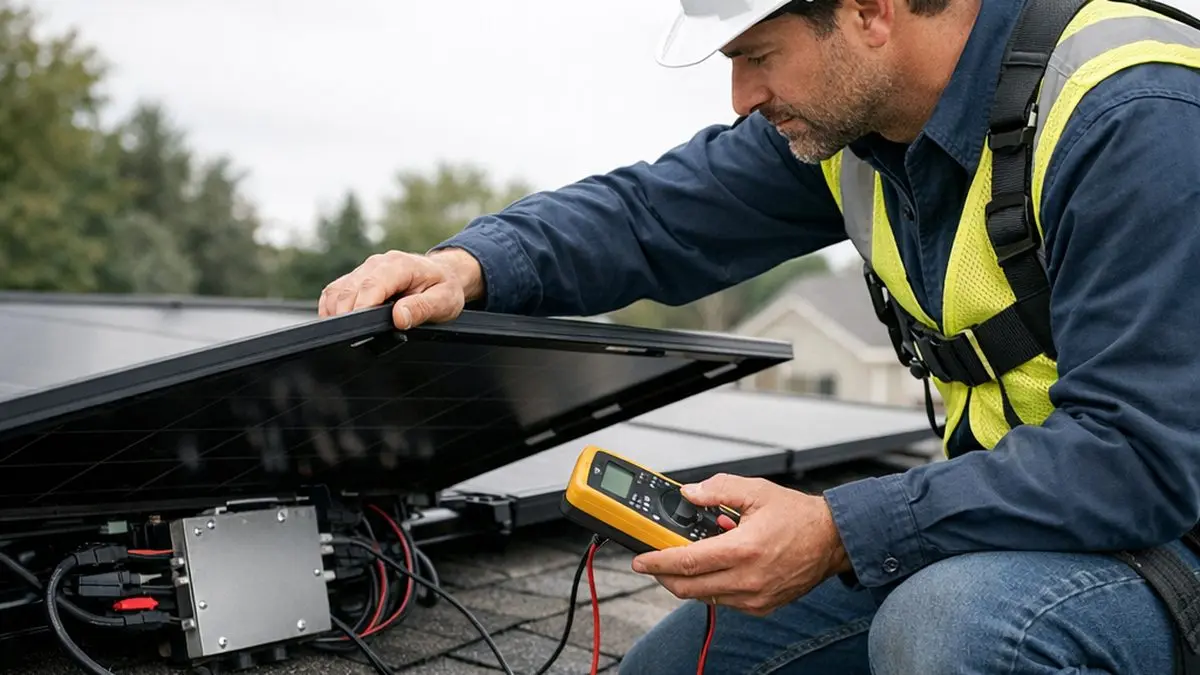
- Damaged wire. Conductors pinched under racking, rubbing on sharp roof edges, sagging onto shingles, or chewed by animals. (See what squirrels do to solar wiring.)
- Water in the wrong place. Junction boxes or conduit fittings that let water in, then freeze and crack in a Minnesota winter.
- Module defects. Less common with quality panels, but a damaged cell or failed bypass diode can create a hot spot.
Why does DC matter so much? Household AC current drops to zero 120 times a second, which helps an arc extinguish itself. DC from solar panels does not. Once a DC arc starts at a loose connection, it can sustain itself and get very hot. And panels keep producing DC whenever light hits them, even when the inverter is off.
Batteries are a separate topic with their own rules. If you are adding storage, read where a home battery can legally live.
The code safeguards built into modern systems
A permitted, inspected rooftop system in Minnesota is built to the National Electrical Code and the state fire code. Key protections:
| Safeguard | What it does | Where it comes from |
|---|---|---|
| DC arc-fault protection | Detects the signature of a series arc and shuts the circuit down | NEC 690.11, for PV circuits at 80 V DC or more |
| Rapid shutdown | Drops conductors outside the array boundary to 30 V within 30 seconds, and inside the array to 80 V within 30 seconds | NEC 690.12 (array boundary is 1 ft around the array) |
| Connector intermatability | Prevents mixing unlisted connector pairs | NEC 690.33 |
| Equipment grounding and bonding | Gives fault current a path so protection devices trip | NEC 690.43 and Article 250 |
| Roof pathways and ridge setbacks | Leaves room for firefighters to walk and ventilate the roof | Minnesota fire code, based on the International Fire Code |
| Labels and disconnect markings | Tells firefighters what is on the roof and how to shut it down | NEC 690 and fire code |
Section numbers above follow the 2020 and 2023 NEC. Minnesota moved to the 2026 NEC for permits filed on or after August 17, 2026, so a newer permit may cite slightly different numbers.
Microinverter systems such as Enphase IQ8 keep DC voltage at the module level, and string systems use module-level optimizers or other listed equipment to meet rapid shutdown. We install both, and our microinverter vs. string inverter comparison explains how they differ in practice.
Firefighter access and setbacks
Firefighters used to worry, with good reason, about cutting into a roof covered in energized panels. The industry and the fire service worked through that, and today's rules reflect it.
- Ridge setbacks. Firefighters typically ventilate at the peak. International Fire Code provisions developed from California fire service guidance keep modules back from the ridge on residential roofs, commonly 3 feet on each slope, with some exceptions.
- Access pathways. Clear paths from the eave to the ridge let crews move across the roof.
- Rapid shutdown initiation. A clearly labeled switch, typically at the service disconnect, de-energizes conductors leaving the array.
- Training. Fire departments now train on PV systems and know to look for the labels.
Exact setback dimensions depend on roof layout, the code edition and the local fire marshal, so your installer should design to them from the start rather than discover them at inspection.
How to pick an installer who builds it right
Since workmanship drives most of the risk, the installer you hire matters more than the panel brand. Ask every bidder:
- Are you a licensed Minnesota electrical contractor? Ask for the license number and check it on the Department of Labor and Industry lookup. Ask who the master electrician is.
- Who does the wiring? In-house electricians or a rotating cast of subcontractors?
- Do you use same-brand connectors on every mated pair? If not, are the pairs listed for intermatability?
- How do you manage wire on the roof? Look for wire clipped tight to the racking, nothing touching the shingles, and drip loops at entries.
- Do you torque-mark terminations and photograph the work? Good installers document it.
- Is it permitted and inspected? Every system should have an electrical permit and inspection.
- What does the workmanship warranty cover, and for how long?
Be cautious with door-knocker pitches that push a same-day signature or cannot name who will actually wire the system. Our solar bid checklist lists what should be in writing.
For context: iSolar is a Minnesota-licensed electrical contractor (EA761814), our master electrician John Ihle holds a NABCEP credential, and our residential crews are in-house.
Warning signs on a system you already own
Most problems give warnings before they become dangerous. Call a licensed solar electrician if you notice:
- Repeated arc-fault or ground-fault alerts from your inverter or app.
- A panel or string that drops out and comes back, or reads lower than its neighbors for no obvious reason.
- A hot plastic or burning smell near the inverter, disconnects or attic.
- Discoloration, scorching or melted spots on wiring, connectors or the back of a panel.
- Buzzing or crackling from equipment.
- Animal nests or loose wiring visible under the array.
If you see smoke or flame, get out and call 911. Tell the dispatcher the home has solar. Do not try to shut the system down by working on the roof or pulling connectors.
Annual checks catch most of these early. Our solar maintenance checklist shows what to look at from the ground and what to leave to a pro.
Get a safety inspection
If you have an older system, one installed by a company that is no longer around, or any of the warning signs above, a safety inspection is inexpensive peace of mind. Our electricians check connectors, terminations, grounding and rapid shutdown on any brand of system. Start with solar panel repair and inspection, or request a quote for a new system built to current code.
Sources
- Fraunhofer ISE — Fire protection in photovoltaic systems (press release, 2013)
- IAEI Magazine — NEC rapid shutdown requirements and UL 3741
- Advanced Energy — Mismatched connectors are a common cause of safety and reliability issues in solar installations
- IEA PVPS (hosted by NREL) — Photovoltaics and Firefighters' Operations: Best Practices in Selected Countries
- Minnesota Department of Labor and Industry — Electrical codes and standards
Frequently asked.
How common are solar panel fires?
Rare. In a Fraunhofer ISE study covering about 1.3 million German PV systems, PV systems caused about 120 fires over 20 years, and only 10 destroyed a building. Most were traced to installation errors and poor connectors rather than the panels.
What causes solar panels to catch fire?
Most solar fires start at a bad DC connection: mismatched or poorly crimped connectors, loose terminals, or damaged wire. Because DC current does not drop to zero like AC, an arc at a loose connection can sustain itself and generate heat.
Do solar panels make a house fire more dangerous for firefighters?
Modern code addresses this. Rapid shutdown de-energizes conductors outside the array within 30 seconds, roof setbacks and pathways give crews room to work and ventilate, and labels show where the system and disconnects are. Fire departments now train on PV systems.
Are microinverters safer than string inverters?
Microinverters keep DC voltage at the panel level, which limits high-voltage DC on the roof. Modern string systems meet the same rapid shutdown rules with module-level electronics. Both can be safe; workmanship matters more than the inverter type.
Can old solar panels become a fire hazard?
Any electrical system can develop problems with age, especially loose connections, weathered wiring or animal damage. Older systems may also predate arc-fault and rapid shutdown requirements, so a periodic inspection by a licensed solar electrician is worthwhile.
Will my insurance cover a fire caused by solar panels?
Standard homeowners policies generally cover fire regardless of cause, but tell your insurer you have solar and confirm the system is covered. Keep your permit, inspection and installer records, since they show the system was installed to code.


Have a question we haven't covered?
Talk to a local iSolar expert — free, no pressure. Call (651) 565-1140.