
How Much Do Solar Panels Weigh? Roof Load With Minnesota Snow
A residential solar panel weighs about as much as a bag of water-softener salt. Spread over your roof, it is a small load next to a Minnesota snowpack. Here is the math, and when an engineer should check it.
Reviewed by John Ihle, MN Master Electrician (AM005101) · NABCEP-credentialed · iSolar, Saint Paul Park, MN · Last reviewed October 2026
The short answer: A typical 400 to 430 watt residential panel weighs about 45 to 50 pounds, roughly 2.3 pounds per square foot. With rails and attachments, NREL puts a typical rooftop array at about 3 pounds per square foot, and ballasted flat-roof systems at 4 to 6. That is small next to the 50 psf ground snow load Minnesota uses in most counties.
How much do solar panels weigh? The per-panel number
So, how much do solar panels weigh? Today's common residential panels, in the 400 to 430 watt range with 108 half-cut cells, weigh about 45 to 50 pounds each. A real example: Qcells' Q.TRON BLK M-G2+ (405 to 425 watts) weighs 21.5 kg, or 47.4 pounds, and measures about 66.6 by 44.6 inches.
Most of that weight is the tempered glass front sheet and the aluminum frame. Larger commercial-format panels with more cells weigh more, and frameless glass-glass panels can be heavier for their size. Always check the specific model's datasheet; our guide to 400-watt solar panels compares common residential models.
Solar panel weight per square foot
Weight per panel is the number people ask about. Weight per square foot is the number that matters for your roof, because it tells an engineer how the load spreads across rafters or trusses.
| Component | Example | Approx. weight |
|---|---|---|
| Panel alone | 47.4 lb over about 20.6 sq ft | About 2.3 lb per sq ft |
| Racking rail | 14-ft aluminum rail at 10 lb | About 0.7 lb per linear ft |
| Typical flush-mounted array (panels plus racking) | NREL planning estimate | About 3 lb per sq ft |
| Ballasted flat-roof array | NREL planning estimate | 4 to 6 lb per sq ft |
On a pitched shingle roof, the array weight is carried to the rafters or truss top chords through lag-bolted attachments, typically every few feet along each rail. So the structure sees a series of point loads, not a perfectly even blanket. That is why attachment spacing on the permit plans comes from the racking manufacturer's engineering tables, not a guess.
Worked example: a 20-panel array on a Twin Cities roof
Let's run the numbers for a typical 8.5 kW system: 20 panels at 425 watts.
- Panel area: 20 x 20.6 sq ft = about 412 sq ft.
- Panel weight: 20 x 47.4 lb = about 950 lb.
- Panels plus racking at NREL's roughly 3 lb per sq ft: 412 x 3 = about 1,240 lb.
That sounds like a lot until you compare it with snow. Minnesota's building rules use a design ground snow load of 50 pounds per square foot in most counties, including the Twin Cities metro, and 60 pounds per square foot in 29 northern counties. Roof snow loads are derived from that ground value; a common starting point is 0.7 times the ground load, or 35 pounds per square foot, before adjustments for slope, exposure and drifting.
| Load on the same 412 sq ft of roof | Pounds per sq ft | Total |
|---|---|---|
| Solar array (panels plus racking) | About 3 | About 1,240 lb |
| Design roof snow load starting point (0.7 x 50 psf) | 35 | About 14,400 lb |
The array adds roughly a tenth of what the roof is already designed to carry in snow. For a roof in good condition that was built to code, that is usually comfortable. The question is whether your roof actually has the capacity it was supposed to have.
How snow and panels interact on a Minnesota roof
Weight is not the only structural question. Panels change how snow behaves.
- Panels shed snow. Smooth glass on a pitched roof lets snow slide off in sheets once the sun warms the array. That lightens the roof, but dumps a concentrated load at the eave, onto gutters, decks and walkways. Our guide to snow sliding off solar panels covers snow guards and layout.
- Drifts can form against the array edge on low-slope roofs, and NREL notes drift and runoff loads can be many times the array's own weight.
- Panels are rated for snow. The Qcells example above lists a 5,400 Pa test load and a 3,600 Pa design load on the front, which works out to about 113 and 75 pounds per square foot. Most certified panels are tested to similar levels, and the rear (uplift) rating matters for wind.
Weight on install day
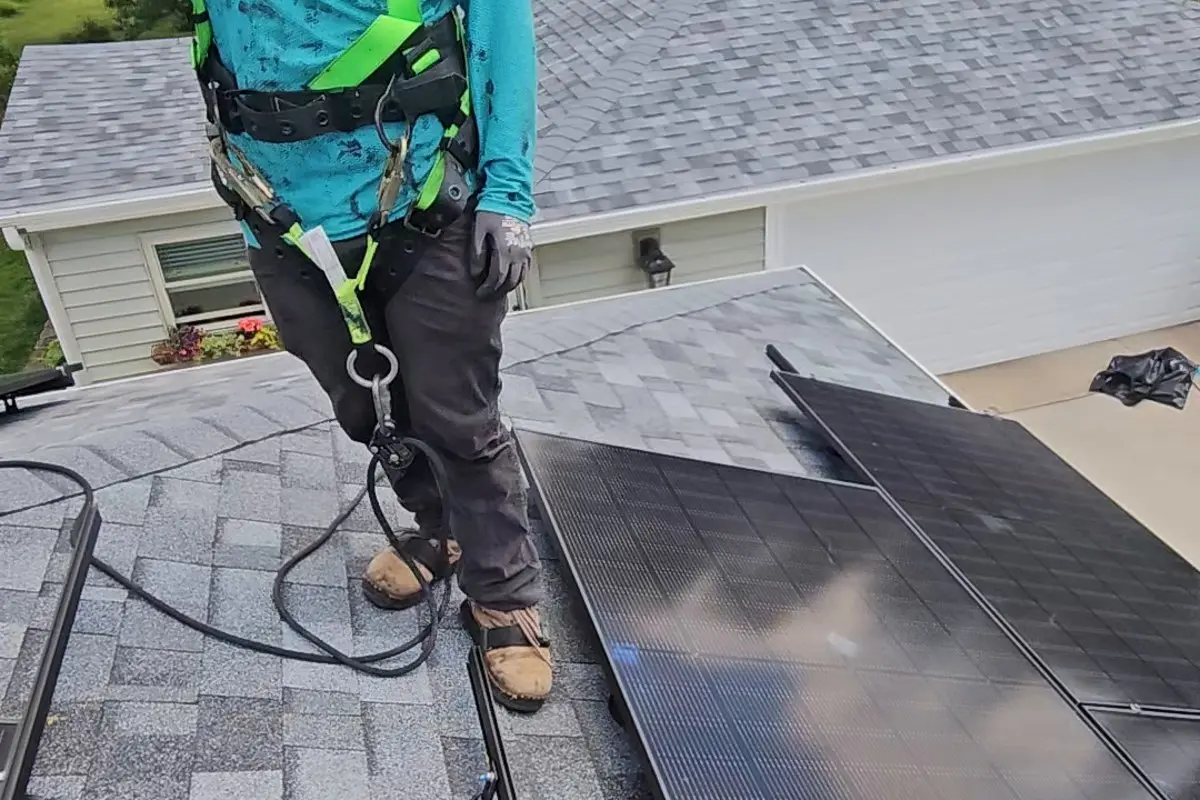
The heaviest moment for your roof is often not winter but installation morning, when a pallet's worth of panels could end up on one spot. On Twin Cities installs we lift panels with a ladder hoist or by hand one or two at a time, stage them across the roof rather than stacking them over a single rafter bay, and keep crew traffic off damaged or soft areas. A 47-pound panel is also a sail in the wind, which is why crews work tied off and avoid lifting in gusty conditions.
When you need an engineer letter
Many Minnesota building departments want structural documentation with a rooftop solar permit, and some require a letter or stamped calculation from a licensed engineer every time. Even where it is optional, we recommend one in these situations:
- Older framing. 2x4 rafters, long spans, or framing that predates modern codes, common in pre-1960 Minneapolis and Saint Paul homes.
- Visible sag or past damage. A wavy ridge, a dip between rafters, or a history of ice-dam leaks and rot.
- Modified trusses. Webs cut for attic storage or ductwork.
- Multiple shingle layers. Extra layers add dead load before the array even goes on. This is often the moment to reroof.
- Northern counties with the 60 psf ground snow load, or sites where drifting is likely.
- Low-slope and flat roofs, especially with ballasted racking. See our guide to solar on commercial roof types.
- Garages, porches and additions, which were sometimes framed lighter than the main house.
An engineer's review typically checks rafter or truss size, spacing and span against the combined dead, snow and wind loads, and confirms the attachment spacing. If a member is short on capacity, the fix is often a sister rafter or added blocking, which is far cheaper before the array goes up than after.
What to check on your own roof first
| Check | What you want to see |
|---|---|
| Roof line from the street | Straight ridge, flat planes, no dips |
| Attic framing | Dry wood, no cracked or notched rafters, no cut truss webs |
| Shingle age and layers | One layer with plenty of life left |
| Ice-dam history | No staining or rot at the eaves |
| Snow behavior | Where does snow slide today, and what is below it? |
Our house-readiness checklist walks through these in a few minutes, and the roof self-check covers orientation and shading.
Let us check the structure before we quote
On every rooftop job, we look at the framing in the attic, not just the shingles, and we include structural documentation in the permit set when the city or the roof calls for it. If the roof needs work, our sister company Three Rivers Contracting handles reroofing so solar goes onto a roof that will outlast it. Request a free quote to get started.
Sources
Frequently asked.
How much does a single solar panel weigh?
Most residential panels in the 400 to 430 watt range weigh about 45 to 50 pounds. For example, the Qcells Q.TRON BLK M-G2+ weighs 47.4 pounds. Larger commercial panels and glass-glass designs can weigh more.
What is the weight of solar panels per square foot?
A panel alone is roughly 2.3 pounds per square foot. NREL estimates a typical rooftop array, including racking, at about 3 pounds per square foot, and ballasted flat-roof systems at 4 to 6 pounds per square foot.
Can my roof hold solar panels and Minnesota snow?
Usually, if the roof was built to code and is in good condition. The array adds about 3 psf, while Minnesota designs for a 50 psf ground snow load in most counties. Older framing, sagging or damaged roofs, and flat roofs should be checked by an engineer.
Do I need a structural engineer for solar panels in Minnesota?
Some cities require structural documentation or a stamped letter with every solar permit. It is strongly recommended for older or undersized framing, roofs with visible sag, modified trusses, flat roofs and northern counties with higher snow loads.
How much do solar panels and racking weigh for a whole system?
A 20-panel, 8.5 kW array covers about 412 square feet and weighs roughly 1,200 to 1,300 pounds with racking, using NREL's 3 pounds per square foot estimate. That load is spread across many attachments into the roof framing.
Do solar panels add snow load to a roof?
On pitched roofs, panels usually shed snow faster than shingles, which can lighten the roof but concentrates sliding snow at the eaves. On low-slope roofs, arrays can cause drifts, which an engineer should account for.


Have a question we haven't covered?
Talk to a local iSolar expert — free, no pressure. Call (651) 565-1140.