
How to Connect Solar Panels: Series vs Parallel Wiring Explained
Series adds voltage, parallel adds current. On a real Minnesota roof, cold-weather voltage and the NEC decide how many panels can share a string.
Reviewed by John Ihle, MN Master Electrician (AM005101) · NABCEP-credentialed · iSolar, Saint Paul Park, MN · Last reviewed October 2026
The short answer: You connect solar panels in series (positive to negative, so voltages add) for string inverters, or each panel to its own microinverter on a parallel AC branch. In Minnesota, cold mornings raise panel voltage: a 425-watt panel with 38.7 V Voc reaches about 43 V at -25°C, so 13 panels, not 15, fit the NEC's 600-volt home limit.
How to connect solar panels: the two basic ways
How to connect solar panels comes down to two choices, series and parallel, and on a real rooftop system the inverter you pick decides which one you use. Wiring solar panels in series means connecting the positive lead of one panel to the negative lead of the next, like batteries in a flashlight. Voltages add; current stays the same. Wiring in parallel means connecting all the positives together and all the negatives together. Current adds; voltage stays the same.
Most homeowners asking how to wire solar panels have seen a diagram of four panels and a charge controller. That's a fine way to learn. But a grid-tied Minnesota house with 25 or 30 panels, a 200-amp service and an Xcel interconnection is a different job, governed by the National Electrical Code and done under a state electrical license. This guide explains how professionals do it and where the hard limits are, so you can read a design or a quote with confidence.
Series vs parallel at a glance
- Series strings raise voltage, which keeps current low and lets you use smaller wire over long runs. That's why string inverters use them. The catch is that voltage climbs in cold weather, and there are code limits on how high it can go.
- Parallel connections raise current. They're common in small 12- or 24-volt off-grid setups and when combining several strings. Higher current means bigger conductors and overcurrent protection on each string.
- Series-parallel combines both: several series strings joined in parallel at a combiner or at the inverter's multiple inputs.
A third approach sidesteps most of this: microinverters, which convert each panel to AC on the roof. More on that below.
Why cold Minnesota mornings set the maximum string length
A solar panel's open-circuit voltage (Voc) rises as the cells get colder. The highest voltage a string will ever see isn't on a hot July afternoon; it's at sunrise on a clear, subzero January morning, when the panels are frigid and the light hits them before any current flows.
The NEC handles this in section 690.7. As Mike Holt summarizes it in EC&M, for one- and two-family dwellings the maximum PV system DC voltage is limited to 600 volts. The designer must calculate maximum voltage from the module's Voc and, when the manufacturer provides one, its temperature coefficient, using the lowest expected ambient temperature. One accepted source for that temperature is the ASHRAE "extreme annual mean minimum design dry bulb" value for the nearest weather station.
Worked example: a 425-watt panel on a 600-volt limit
Take a Qcells Q.TRON 425-watt module. Its datasheet lists Voc of 38.67 volts at standard test conditions (25°C cell temperature) and a Voc temperature coefficient of −0.24% per degree C. For this example we'll assume a design low of −25°C (−13°F); your designer uses the ASHRAE value for your location.
- Temperature difference: 25°C to −25°C is 50 degrees.
- Voltage rise: 50 × 0.24% = 12%.
- Cold Voc per panel: 38.67 × 1.12 ≈ 43.3 volts.
| Panels in series | String Voc at 25°C | String Voc at −25°C | Within 600 V? |
|---|---|---|---|
| 10 | 387 V | 433 V | Yes |
| 12 | 464 V | 520 V | Yes |
| 13 | 503 V | 563 V | Yes |
| 14 | 541 V | 606 V | No |
| 15 | 580 V | 650 V | No |
Using the label voltage alone, you'd think 15 panels fit. The cold correction says 13. Two extra panels would push the string past the code limit on the coldest mornings and can exceed the inverter's maximum input rating, which is how inverters get damaged. The inverter's own minimum and maximum input voltages (and its operating window) narrow the choice further.
Current limits when you wire in parallel
Current has its own rule. Under NEC 690.8, maximum source-circuit current is the module's short-circuit current (Isc) times 125%. For the example panel, 13.49 amps × 1.25 ≈ 16.9 amps per string, and conductors are then sized at 125% of that before temperature and conduit-fill corrections. Put three strings in parallel and the combined circuit carries three times the current, which is why parallel strings typically need fuses and a combiner, and why a single wrong connection there is dangerous.
Polarity matters, too. A string connected backward to another in parallel can drive current backward through the weaker string. On DIY off-grid kits this shows up as melted connectors; on rooftop systems, it's caught at commissioning when an electrician checks each string's polarity and voltage before closing the disconnect. Our guide to testing a solar panel covers what those checks look like.
How microinverters change the wiring
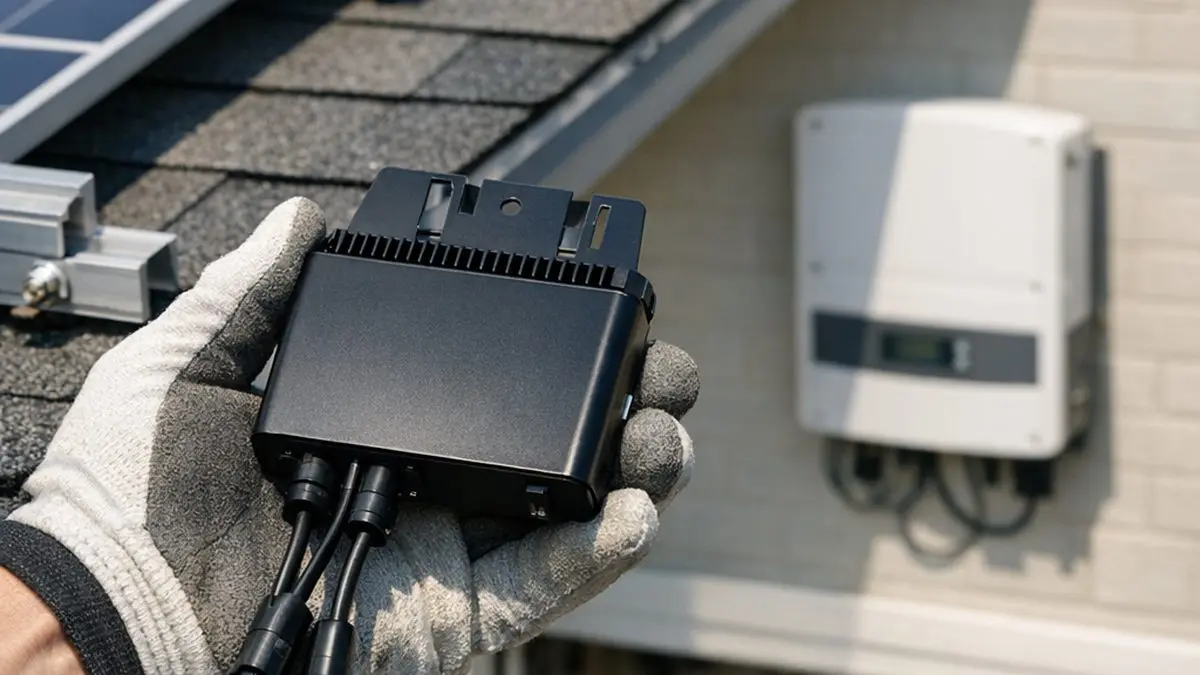
With microinverters, each panel plugs into its own small inverter mounted on the racking. Panel-level DC stays low, roughly the one panel's voltage, and the microinverters connect to an AC trunk cable in parallel, forming a 240-volt branch circuit back to a combiner panel.
The limit here is branch-circuit size, not string voltage. Enphase's IQ8 datasheet lists up to 13 IQ8PLUS units or 16 IQ8 units per 20-amp, 240-volt branch circuit. A 26-panel IQ8PLUS system therefore needs at least two branch circuits. The datasheet also caps DC input voltage (60 volts for IQ8PLUS), so the designer still checks the panel's cold Voc against it. A 43-volt cold Voc is well within that.
Power optimizers are a middle path: panels still wire in series to a string inverter, but each optimizer manages its panel, and the system's design rules set string lengths. See how solar optimizers work, or our broader explainer on what a solar inverter does.
DIY limits: where wiring solar panels becomes a licensed job
Small, portable 12-volt setups for a shed or ice house are a reasonable hobby. A grid-tied system on your house is not a DIY wiring project in Minnesota:
- Licensing. The Minnesota Department of Labor and Industry states that the actual installation of a solar PV system must be performed by a Minnesota-licensed electrical contractor.
- You can't turn panels off. In daylight, a string of a dozen panels can carry several hundred volts DC with no switch upstream. DC arcs don't self-extinguish the way AC arcs tend to.
- Code features you'd have to design in. Rapid shutdown, labeling, grounding, conduit routing and the interconnection at your panel all get inspected.
- Utility approval. Xcel and the co-ops require an interconnection application before you turn the system on.
Our DIY solar in Minnesota guide covers what homeowners can legally take on and where the risks are.
Get a design that's checked for Minnesota cold
Every iSolar system is laid out with string or branch-circuit calculations for Minnesota's design low temperatures, reviewed under master electrician John Ihle's license. If you'd like to see how your roof would be wired, request a quote and we'll walk you through the layout.
Sources
- EC&M (Mike Holt) — Article 690, Solar Photovoltaic Systems, Part 2 (690.7 maximum voltage, 690.8 current)
- Qcells — Q.TRON BLK M-G2+ datasheet (Voc, Isc, temperature coefficients)
- Enphase — IQ8 Series Microinverters data sheet (US, branch circuit limits)
- Minnesota Department of Labor and Industry — Solar installer licensing requirement
Frequently asked.
Is it better to wire solar panels in series or parallel?
For grid-tied string inverters, series is standard because higher voltage means lower current and smaller wire. Parallel is common in small low-voltage off-grid systems and for combining multiple strings.
How many solar panels can be connected in series?
It depends on the panel's cold-corrected open-circuit voltage and the limits of the inverter and code. On a home, the NEC caps DC voltage at 600 volts, which in our worked example allows 13 panels of a 425-watt model, not 15.
Why does panel voltage go up in cold weather?
Solar cell voltage rises as temperature drops. The datasheet's Voc temperature coefficient tells you how much; for a coefficient of -0.24% per degree C, a panel 50 degrees colder than test conditions reads about 12% higher.
How are microinverters wired?
Each panel connects to its own microinverter, and the microinverters connect in parallel on an AC trunk cable that forms a 240-volt branch circuit. Enphase lists up to 13 IQ8PLUS units per 20-amp branch.
Can I wire my own solar panels in Minnesota?
Small portable setups are fine, but Minnesota DLI says installing a solar PV system must be performed by a licensed electrical contractor. Grid-tied systems also need permits, inspection and utility interconnection approval.
What wire size do solar panels need?
Conductors are sized from the circuit's maximum current, which the NEC sets at 125% of the panel's short-circuit current, then sized again at 125% and corrected for heat and conduit fill. Your installer's design shows these calculations.


Have a question we haven't covered?
Talk to a local iSolar expert — free, no pressure. Call (651) 565-1140.