
Ice Dams and Solar Panels: Do Panels Make Them Worse?
Ice dams start in the attic, not on the panels. Here's how solar changes snow on your roof, and how to keep water out of the ceiling.
Reviewed by John Ihle, MN Master Electrician (AM005101) · NABCEP-credentialed · iSolar, Saint Paul Park, MN · Last reviewed October 2026
The short answer: Solar panels don't cause ice dams. Ice dams form when attic heat melts roof snow that refreezes at the cold eaves, so the fix is air sealing, insulation and ventilation. Panels can shed snow onto the eave and make ice under the bottom row harder to clear, so keep arrays off the eave and use snow guards where needed.
How ice dams form on a Minnesota roof
An ice dam is a ridge of ice along the eaves that traps meltwater behind it. That water can back up under shingles and leak into your attic, walls and ceilings. University of Minnesota Extension explains it simply: ice dams come from uneven roof temperatures. You need three things at once for a sustained stretch:
- Snow on the roof.
- Upper roof surfaces above 32°F, so snow melts from underneath.
- Lower edges (the eaves overhanging outside walls) below 32°F, so that water refreezes.
Where does the heat come from? Mostly the house, not the sun. Extension notes that air leakage into the attic is often the biggest factor: warm, moist air escaping around light fixtures, plumbing stacks, attic hatches, bath fans and wiring holes. Thin insulation, leaky ducts in the attic, and exhaust vents that end near the roof add to it.
Do solar panels make ice dams worse?
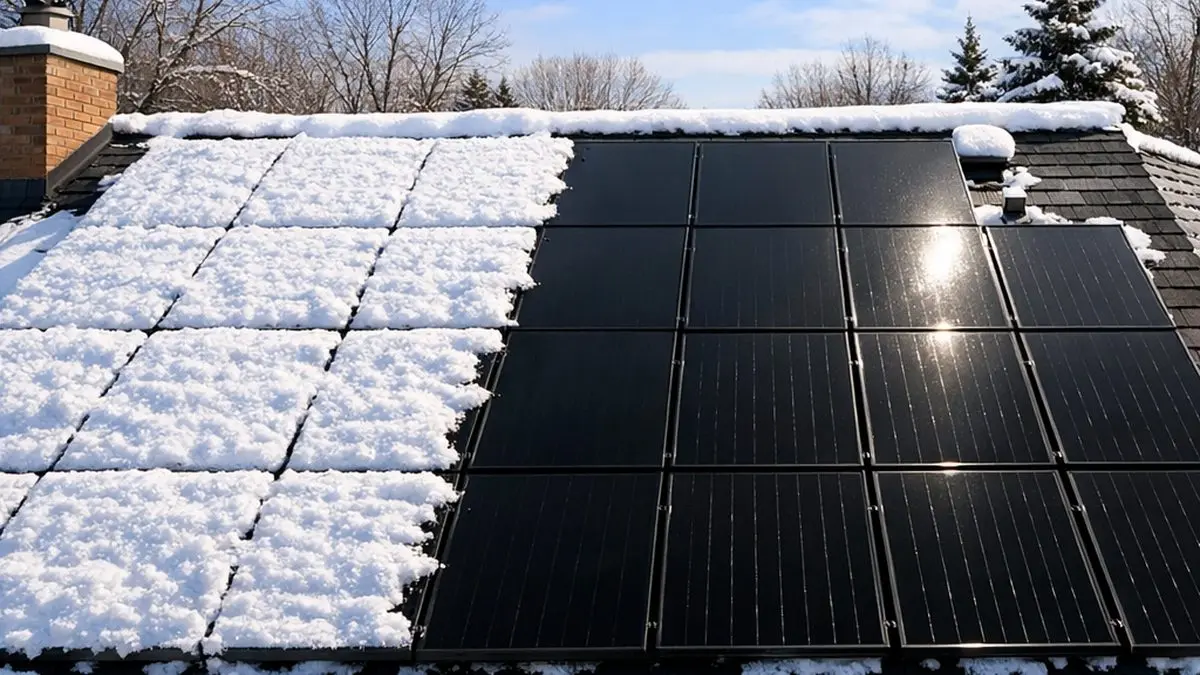
Solar panels don't create ice dams, and they don't warm your roof deck. The array sits a few inches above the shingles on rails, and the panels themselves don't heat the roof underneath. The heat that melts snow from below still comes from the attic.
That said, panels do change where snow goes:
| Effect | Why it happens | What it means for ice dams |
|---|---|---|
| Snow slides off the array in sheets | Smooth glass on a raised frame sheds snow on sunny days | Less snow on the upper roof, but a pile can land on the eave or gutter below the array |
| Panels shade the roof underneath | The array blocks sun on the shingles below it | Little effect; ice dams are driven by attic heat, not sun |
| Array close to the eave | Some layouts run the bottom row near the roof edge | Ice can build under the lowest row where it's harder to see and clear |
| Attachments in the lower roof | Mounts are flashed into the shingles | Well-flashed mounts shed water; water forced uphill by a dam tests every seam on the roof |
In our experience, homes with chronic ice dams had them before solar, and they keep having them after, until the attic is fixed. A sliding snow sheet can add mass at the eave on a home that already dams, which is one reason we talk about snow guards and layout early. More on that in snow sliding off solar panels: gutters, walkways and snow guards.
Fix the attic first: air sealing, insulation, ventilation
The fix for ice dams is in the attic, and it's best done before the array goes on. That's when access is easiest and you're not working around a system you just paid for.
- Air seal the ceiling. Both University of Minnesota Extension and the Department of Energy's Building America guidance put air sealing first. Seal gaps around top plates, can lights, plumbing and vent stacks, chimney chases, and the attic hatch.
- Add insulation. Once leaks are sealed, more insulation cuts conducted heat loss to the roof deck.
- Ventilate the roof. Keep soffit vents open with baffles and leave an air channel between insulation and the roof deck so outside air keeps the deck cold and even.
- Route exhaust properly. Bath and kitchen fans should vent outdoors through the roof or wall, never into the attic.
Doing this work also makes your solar go further, because a tighter house uses less energy. We dig into the sequencing in should you insulate before going solar.
Plan the array around the eaves
If your home has a history of ice dams, tell your installer before the design is final. Practical layout choices that help:
- Keep the bottom row off the eave. Leaving roof space between the lowest panels and the edge gives room to clear snow and keeps the array out of the ice zone.
- Mind entry doors, walkways and decks. Snow sheds off panels fast. Add snow guards where a sliding sheet would land on people, cars, gutters or a lower roof.
- Check the ice barrier. Minnesota's residential code requires an ice barrier membrane at the eaves on new roofing. If your roof is older or was done without one, that's a reason to reroof before solar.
- Consider roof age. If shingles have less than about a decade left, reroof first. See re-roofing and solar: time it once, pay once.
Our sister company, Three Rivers Contracting, handles roofing, so we can look at roof condition, ventilation and ice barrier on the same visit as the solar design.
Heat cable near a solar array
Heat cable (heat tape) in a zigzag along the eaves can keep a drainage path open. It doesn't fix the cause, and it uses electricity all winter, but on some roofs it's the practical answer. If you use it near solar:
- Never attach heat cable to panels, rails or module frames. Clips belong on the shingles, gutters and downspouts per the cable manufacturer's instructions.
- Keep it below and outside the array. Run it along the eave and gutter line under the array rather than up under panels, where it can't be inspected.
- Use proper ground-fault protection. The electrical code requires ground-fault protection of equipment for fixed outdoor deicing and snow-melting equipment. Plugging a cable into an old exterior outlet isn't the same thing.
- Don't chip or pry ice near solar attachments or wiring. You can cut a membrane or flashing and create the leak you were trying to stop.
- Use a soft roof rake carefully. Extension notes roof rakes can damage roofing. Never drag a metal rake across panel glass.
Our electricians install dedicated circuits for heat cable, so the roofing, solar and electrical sides all fit together.
Roof leaks vs. your roof penetration warranty
When water shows up on a ceiling under a solar array in March, homeowners often assume the solar attachments leaked. Sometimes that's true. Often it's ice-dam backup water that would have leaked with or without solar.
| Clue | Points to a solar penetration leak | Points to an ice dam leak |
|---|---|---|
| When it leaks | During ordinary rain, any season | Only during thaws with ice at the eaves |
| Where it shows up | Directly under a mount location | Near exterior walls, at the ceiling edge, in soffits |
| Ice at the eave | Not needed | Visible ridge of ice and icicles |
| Other parts of the roof | Only at the array | Also leaks away from the array |
Read your roof penetration warranty. These warranties are written to cover a failure of the flashing or attachment, and water pushed uphill under shingles by an ice dam is a different problem. Document the leak with photos and dates, then call your installer. If your installer is gone, our solar repair team can inspect the mounts and tell you which problem you have.
If you have an ice dam right now
Mid-winter, with ice already built up and a solar array on the roof, keep it simple and safe:
- Stay off the roof. Extension warns that anyone working on a roof in winter, or on it from below, risks injury. Panels, ice and snow make footing worse.
- Protect the inside. Move belongings, catch drips, and photograph the stain and the ice outside with dates. Those photos help with insurance and warranty questions later.
- Open a drain channel if needed. A roofing professional can open a drainage channel through the dam at the eave. Extension notes a channel is only temporary and stops working within days.
- Leave the array alone. Don't pry ice from under panels or around mounts, and don't try to lift a panel to look underneath.
- Book the real fix for spring. Plan air sealing and insulation for warmer weather, and have the attachments checked at the same time.
Get ahead of it before winter
If you're planning solar and your house dams up every February, let's look at the attic, roof and array layout together. Request a quote and mention ice dams; we'll check roof age, ice barrier and ventilation as part of the site visit.
Sources
Frequently asked.
Do solar panels cause ice dams?
No. Ice dams are caused by heat escaping into the attic and melting snow, which refreezes at the cold eaves. Panels sit above the roof on rails and don't warm the deck, though snow sliding off them can pile at the eave.
Can I put heat tape under my solar panels?
Heat cable should never be attached to panels, rails or frames. Run it along the eaves and gutters below the array per the manufacturer's instructions, on a circuit with the ground-fault protection the electrical code requires.
Will an ice dam leak void my solar roof penetration warranty?
An ice dam leak usually isn't a failure of the solar attachment, so penetration warranties may not cover it. Read your warranty, photograph the leak and the ice, and have the mounts inspected to find the actual cause.
How do I remove snow from solar panels without damaging them?
Usually you don't need to; panels shed snow on their own after a sunny day or two. If you must, use a soft foam roof rake from the ground and never use metal tools, salt or hot water on the glass.
Should I fix ice dams before installing solar?
Yes, if your home has a history of them. Air sealing and insulating the attic first is easier without an array overhead, and it reduces your energy use so the system covers more of your bill.
Do solar panels make snow slide off the roof faster?
Yes. Smooth glass on a raised frame sheds snow in sheets on sunny days. Snow guards help protect walkways, decks, gutters and lower roofs below the array.


Have a question we haven't covered?
Talk to a local iSolar expert — free, no pressure. Call (651) 565-1140.