
Solar Panel Fences: A Snow-Shedding Vertical Option for Minnesota Land
Stand bifacial panels on edge in a long east-west-facing row and you get a solar fence: it sheds snow, works around equipment and peaks morning and evening. Here's where it makes sense.
Reviewed by John Ihle, MN Master Electrician (AM005101) · NABCEP-credentialed · iSolar, Saint Paul Park, MN · Last reviewed October 2026
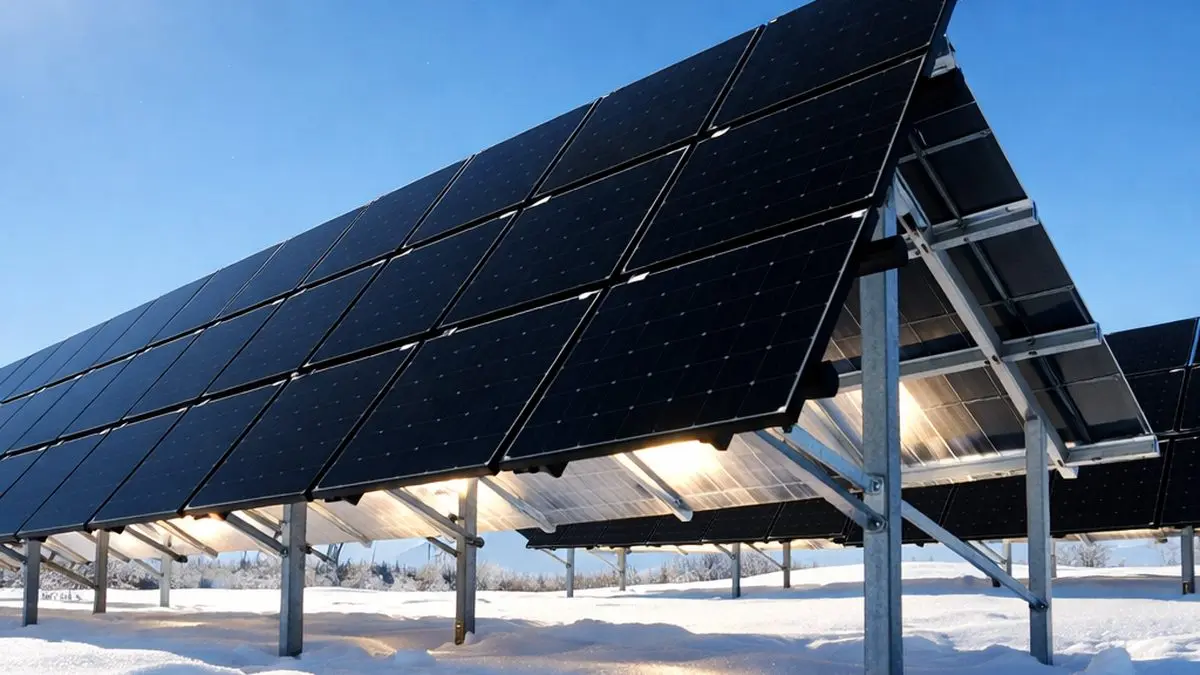
The short answer: A solar panel fence is a single row of bifacial panels mounted vertically, usually with faces pointing east and west. Snow can't settle on vertical glass, and snow cover on the ground boosts the back side. Output peaks morning and afternoon instead of noon. It suits farms and large lots with long open runs, not small yards.
What is a solar panel fence?
A solar panel fence is a ground-mounted array built as one long, upright row instead of tilted rows. The modules are bifacial, meaning they produce from both the front and back glass, and they usually stand vertically with one face pointing east and the other west. Some designs double as an actual fence line along a pasture or property edge. You'll also see them called vertical solar panels or a bifacial solar fence.
The idea is simple. A tilted south-facing panel catches the most sun at midday. A vertical east-west panel catches morning sun on one face and afternoon sun on the other, plus light reflected off the ground, which in a Minnesota winter is often bright snow.
This is a niche layout. For most homes a conventional roof or ground mount still wins. But on farms, rural acreages and commercial land where open ground is cheap and snow is a real production problem, a vertical fence deserves a look.
Why vertical bifacial panels suit snow country
Sandia National Laboratories and the University of Alaska Fairbanks studied bifacial panels at high latitudes. Their project summary reports that modeled annual yields showed east-facing vertical bifacial modules outperforming south-facing latitude-tilt systems in Alaska, that the bifacial advantage grows with latitude and with how long snow stays on the ground, and that vertical modules are expected to shed snow better.
Minnesota isn't Fairbanks, so don't expect the same result here. But the same mechanisms apply:
- No snow load on the glass. Snow can't settle on a vertical surface. After a storm, a tilted array may sit buried for days; a fence starts producing as soon as the sky clears.
- Reflected light. Fresh snow reflects far more light than grass, and the rear face of a bifacial panel collects it. Our bifacial panels in snow post explains the albedo effect in more detail.
- Low winter sun. In December the sun stays low in the southern sky. A vertical surface intercepts low-angle light well, although an east-west fence sees it at a glancing angle around noon.
The trade-off is summer. With a high midday sun, a vertical east-west fence gives up production around noon compared with a tilted array. Whether the fence wins or loses on an annual basis depends on your site, your snow cover and the ground surface. That's a modeling question, not a rule of thumb, so ask for a site-specific production estimate that includes bifacial gain.
Solar panel fence vs a standard ground mount
| Factor | Vertical bifacial fence | Tilted ground mount (south-facing) |
|---|---|---|
| Daily production shape | Two humps: morning and afternoon | One peak around midday |
| Snow on modules | Essentially none | Slides off eventually; can sit for days |
| Land footprint | Narrow strip; can farm or graze on both sides | Rows need spacing to avoid shading |
| Structure per kW | More posts and linear feet per kW | Compact, standard racking |
| Wind exposure | Full face to the wind; engineered foundations | Lower profile at typical tilt |
| Snow drifting | Acts like a snow fence; drifts on the lee side | Snow piles at the drip edge |
| Best fit | Farms, pasture edges, long open runs | Most homes and businesses with open land |
Production timing: when morning and evening output matters
A fence with faces pointed east and west produces two daily peaks. That shape can be worth more than raw kWh in a few cases:
- Dairy and livestock operations with heavy morning and evening loads such as milking, cooling and ventilation. Our dairy farm solar guide covers those load profiles.
- Homes and hobby farms on Xcel's optional time-of-use plan, where the summer peak runs 6 to 9 p.m. at roughly 21 cents per kWh. West-facing output late in the day lands closer to that window than a south array's noon peak.
- Sites with demand charges, where spreading production across the day may line up better with when the operation actually runs.
On standard Xcel net metering with monthly netting, timing matters less, because credits are valued the same whenever you produce them.
Siting, foundations and setbacks in Minnesota
Foundations and frost
A vertical row of panels catches wind like a billboard, so the posts carry real lateral load. Foundations need engineering for wind and for frost heave. For reference, Minnesota's building code frost-protection rule sets minimum footing depth at 5 feet in northern counties (Zone I) and 3½ feet in southern counties including the Twin Cities metro (Zone II). Racking manufacturers typically specify driven piles or helical anchors with their own engineered depths; your installer should show you the foundation design for your soil.
Snow drifting
Here's the field note people don't expect: a solid vertical row is basically a snow fence. Minnesota's prevailing winter winds come from the northwest, and a long fence will build drifts on its sheltered side. Keep the bottom edge of the modules high enough to stay above typical drift depth at that spot, and don't site the fence where drifts will block a farm lane or driveway.
Zoning and setbacks
- Counties and townships regulate ground-mounted solar through their zoning ordinances, including setbacks from property lines and roads. Check with the county before you design.
- If the array doubles as a property-line fence, city fence-height limits may also apply.
- Keep wiring trenches and inverters clear of field equipment paths and livestock.
Electrical
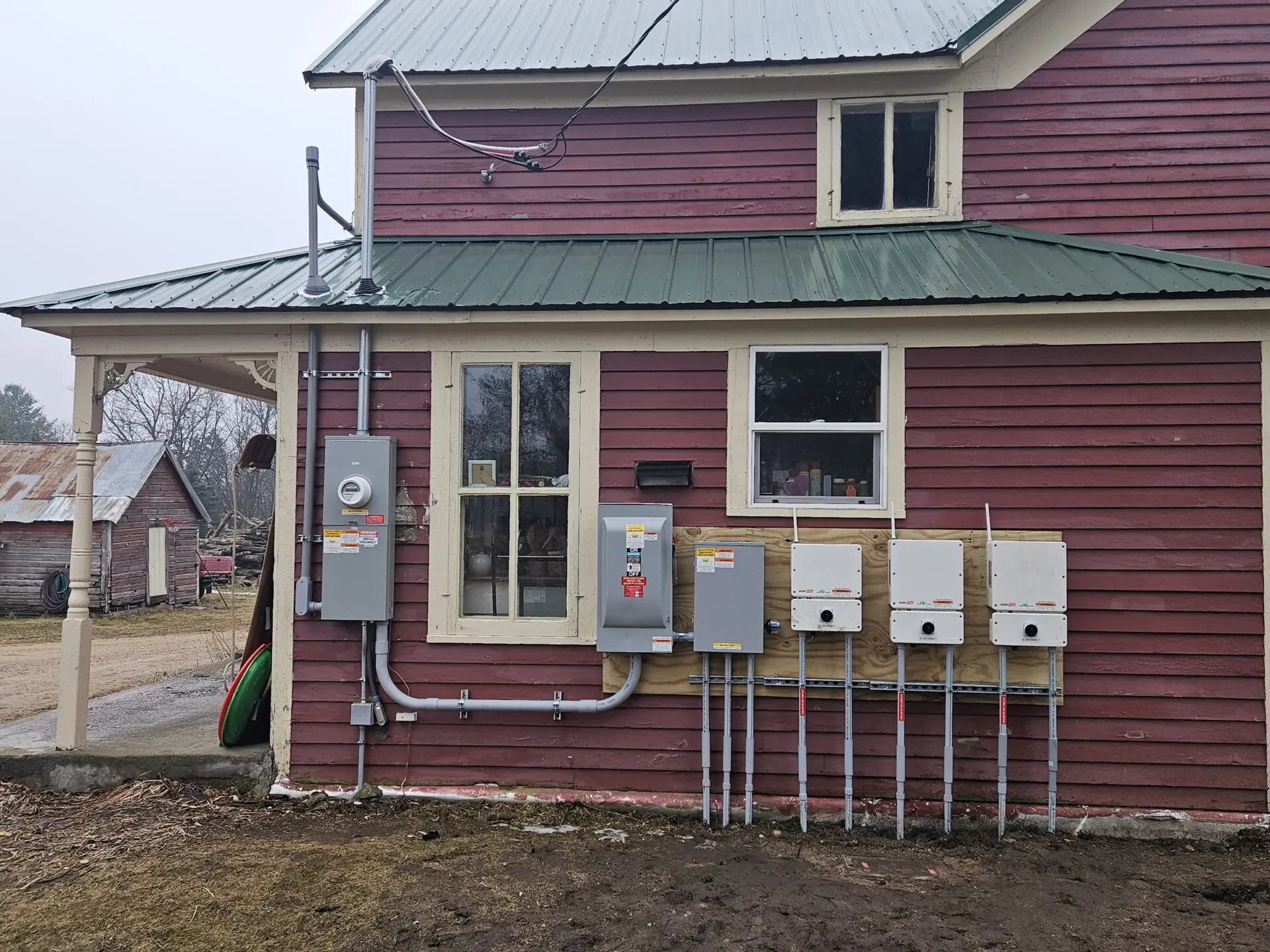
A ground-mounted array that isn't on a building doesn't carry the NEC rapid shutdown requirement that rooftop arrays do, which can simplify the electronics. The trench run back to the barn or house, the interconnection point and the service capacity still need careful design. Our farm ground-mount guide covers siting and trenching for conventional layouts.
Cost and incentives
We don't have a reliable published per-watt price for vertical fences in Minnesota, and we won't make one up. What we can tell you is what drives the cost: bifacial modules, more posts and steel per kW than a compact tilted array, longer wire runs along the row, and engineered foundations. Expect a premium over a standard ground mount and get a site-specific quote.
The incentives are the same as any other ground-mounted system:
- Xcel Solar*Rewards pays $0.05 per kWh for 10 years on systems up to 40 kW sized at or under 120% of annual use, while annual capacity lasts.
- USDA REAP grants remain available to farms and rural small businesses; see our REAP grant guide.
- The federal §48E credit can apply to business-owned systems, with a placed-in-service deadline of December 31, 2027 for projects that begin construction after July 4, 2026. Talk to your tax advisor.
- Minnesota exempts solar equipment from sales tax and the system's added value from property tax.
Is a solar fence right for your land?
If you have a long, open strip that you'd rather farm or graze around, and snow-buried arrays are a real concern, a vertical bifacial fence is worth modeling against a conventional ground mount. If you have a clear south-facing field and no constraints, the tilted array is usually simpler. Our team designs agricultural solar for Minnesota farms; request a quote and we'll model both layouts on your site.
Sources
Frequently asked.
Do vertical solar panels work in Minnesota?
Yes. Vertical bifacial panels shed snow because it can't settle on upright glass, and their back faces pick up light reflected from snow on the ground. They produce less around midday in summer than a tilted array, so annual output depends on the site.
Which direction should a solar panel fence face?
Most vertical bifacial fences face east and west, so one side catches morning sun and the other catches afternoon sun. A south-facing vertical layout is possible, but it gives up the two-peak production shape.
How much does a solar panel fence cost?
There isn't a reliable published per-watt price for Minnesota. Vertical fences generally cost more per watt than a standard ground mount because they use bifacial modules, more posts and longer wire runs. Get a site-specific quote.
Does a solar fence need rapid shutdown?
The NEC rapid shutdown rule applies to PV systems on or in buildings. A free-standing ground-mounted fence generally doesn't carry that requirement, though local inspectors make the final call.
Can livestock graze around a vertical solar fence?
Yes, and that's one of its advantages. The array occupies a narrow strip, leaving land on both sides for grazing or crops. Wiring, inverters and module edges should be protected from animals and equipment.
Will a solar fence qualify for Xcel Solar*Rewards?
It can, if it meets the same rules as any system: Xcel service, up to 40 kW, sized at or under 120% of annual usage, and program capacity available. The incentive is currently $0.05 per kWh for 10 years.


Have a question we haven't covered?
Talk to a local iSolar expert — free, no pressure. Call (651) 565-1140.