
When Is the Best Time to Install Solar Panels in Minnesota?
Short version: sign in fall or winter, install whenever the roof and ground allow, and be producing before the long days of spring. Here's the calendar we actually work from.
Reviewed by John Ihle, MN Master Electrician (AM005101) · NABCEP-credentialed · iSolar, Saint Paul Park, MN · Last reviewed October 2026
The short answer: For most Minnesota homes, the best time to buy is fall or early winter and the best time to be finished is by March. Roof-mount installs work year-round, ground mounts should get footings in before frost, and January through April produce roughly 31% of a south-facing array's annual sunlight, so waiting for spring to sign costs real production.
When is the best time to install solar panels? Work backward from March
People ask us when is the best time to install solar panels, expecting us to say June. In Minnesota the better question is when you want the system producing, and the answer is before the long days of spring. Work backward from there and fall and winter become the smart time to sign.
The reason is the paperwork, not the panels. A typical residential install takes one to two days on site. Design, the city or state electrical permit, Xcel's interconnection review and the final inspection take weeks around those two days. Our installation timeline guide walks through each step. If you start in October, the slow parts run while the days are short and you lose little production waiting.
Two things changed the calendar in 2026. First, the year-end rush is gone. The federal 30% homeowner credit used to push everyone to finish by December 31. The IRS says the residential clean energy credit is not allowed for expenditures made after December 31, 2025, so there's no federal deadline to chase now. Second, Xcel's Solar*Rewards incentive has limited capacity each program year, so being ready when applications open matters more than the season.
What each season looks like on a Minnesota install
| Season | Good for | Watch out for |
|---|---|---|
| Fall (Sept to Nov) | Signing, site surveys, ground-mount footings before freeze-up, roof installs in mild weather | Short window for any concrete or ground work; roofers are busy finishing storm jobs |
| Winter (Dec to Feb) | Permits and interconnection moving while production is low; roof installs on clear, dry days | Snow and ice on the roof, very cold days, frozen ground for trenching |
| Spring (Mar to May) | Being live as production climbs; ground work after the frost leaves | Wet soil, road weight limits for heavy equipment in some counties, growing backlog |
| Summer (Jun to Aug) | Easiest roof conditions and long workdays | Peak demand for crews and inspectors; you give up the best production months while you wait |
None of these seasons is off-limits. We install roof-mount systems in every month of the year. What changes is how much you lose by waiting, and what kind of site work is practical.
How much production you give up by waiting
NREL's long-term solar data for Minneapolis puts a south-facing panel at about 2.3 peak sun hours a day in December and 6.4 in July. Add the twelve monthly averages and January through April supply about 31% of the year's sunlight, while November and December together supply only about 9%. Our peak sun hours guide has the full table by city.
A worked example: a 10 kW array in the Twin Cities makes roughly 12,000 to 12,900 kWh a year. If you sign in April instead of October and go live in June instead of February, you skip most of that January-to-April share, roughly 3,700 to 4,000 kWh. At an all-in Xcel cost of roughly 14 to 16 cents per kWh, that's on the order of $500 to $650 of electricity you buy instead of make. Snow cover trims some of the January and February number, so treat it as a ceiling, not a promise.
Going live in late November costs very little, because there isn't much sun to miss. Going live in late May costs a lot, because you are starting just as the best months arrive.
Frozen ground and ground-mount timing
Roof-mount systems don't care much whether the ground is frozen. Ground mounts do. Racking has to sit on foundations that won't heave, and in Minnesota frost reaches deep. The state building code sets minimum footing depths for frost protection at 3.5 feet in Zone II, which covers the Twin Cities and southern Minnesota, and 5 feet in Zone I across the north. Ground-mount foundations are engineered for the site, but that frost depth is the backdrop.
In practice that means:
- Get footings or piles in before hard freeze-up whenever you can. Digging or drilling through frozen soil is slower, harder on equipment and can add cost.
- Trenching to the house is the other ground-work item. A trench across a frozen yard is a different job than the same trench in September.
- Spring thaw is its own problem. Saturated soil and seasonal road limits can delay heavy equipment in rural areas until things firm up.
If you're weighing a ground mount, our comparison of ground mount vs. roof mount solar covers the trade-offs beyond timing.
Winter roof installs: what we do differently
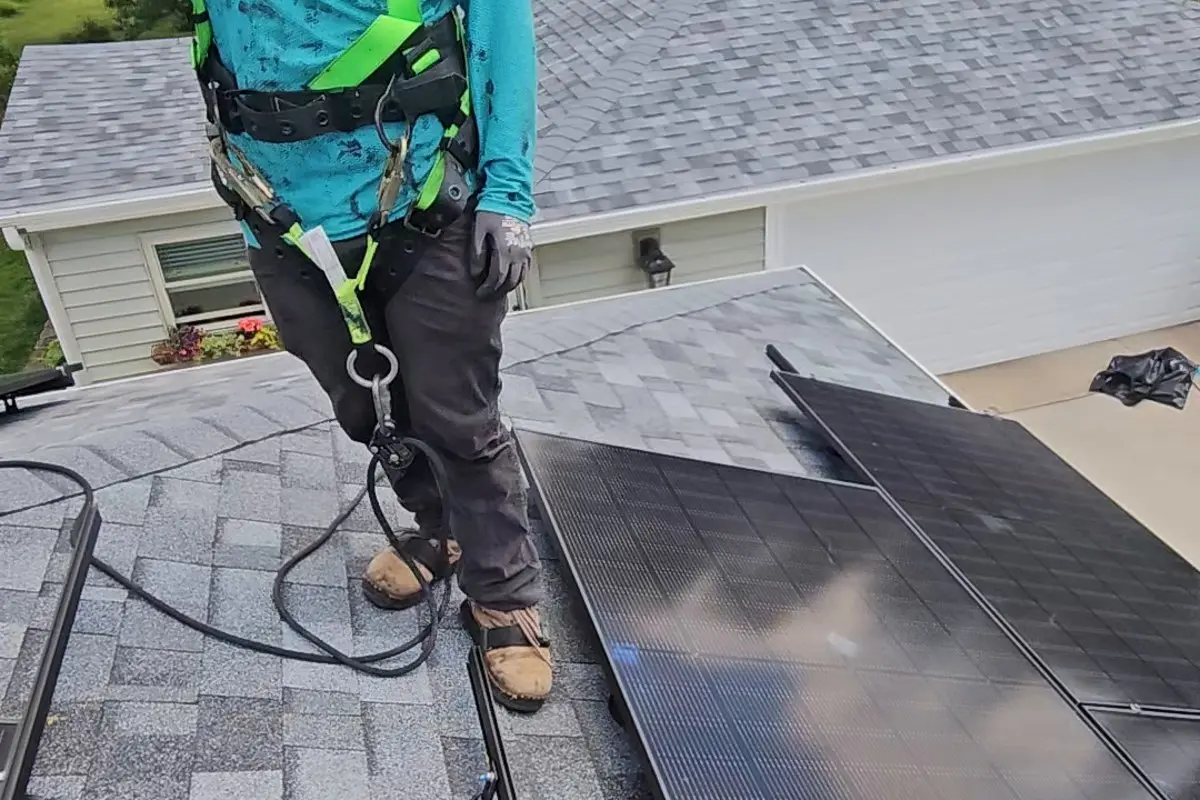
On Twin Cities installs in winter, the work itself is the same: attachments flashed into the roof, rails, panels, conductors, rapid shutdown equipment and labeling. The prep is different.
- Snow comes off the work area first. Crews clear only what they need, keep fall protection anchored and work the dry, sunny days.
- Shingles are stiffer in deep cold. Lifting shingle courses to slide in flashing takes more care, and on bitter-cold days we'd rather reschedule than crack shingles.
- Short daylight sets the pace. A job that fits in one long June day may stretch to two in December.
- Ice dams are a red flag. If your eaves build ice dams every winter, deal with the attic and roof issue before panels go on. See our guide to ice dams and solar panels.
The roof decides more than the calendar
The biggest timing mistake we see isn't the season. It's putting a 25-year array on a roof with eight years left. If your shingles are near the end of their life, replace the roof first and install solar right after, in the same season if possible. Removing and reinstalling panels later is a separate job with its own cost.
That can push your solar date. A roof replacement in October followed by solar in November is a great sequence. A roof you can't get scheduled until next summer may mean waiting, or it may mean the roof has more life than you think. Get it looked at before you sign anything.
A simple decision checklist
- Pull 12 months of usage from your Xcel or co-op account. Xcel's Solar*Rewards requires the system to be sized at or under 120% of annual use.
- Get the roof assessed for age, condition and shading.
- Sign when the design and price make sense, not when the weather looks nice. Fall and winter signings usually go live sooner relative to the sunny season.
- Ask your installer about Solar*Rewards timing. The incentive is currently $0.05 per kWh produced, paid for 10 years, but capacity is limited each program year. We confirm current status at quote time.
- For ground mounts, plan footings before frost. If that window has closed, discuss winter foundation options or a spring start.
Start the clock this fall
If you want to be producing by spring, now is the time to start. Run your roof through our free roof solar estimator, then request a quote and we'll map out permit, interconnection and install dates for your address.
Sources
- Internal Revenue Service — FAQs for modification of sections 25C, 25D, 25E, 30C, 30D, 45L, 45W and 179D under Public Law 119-21
- Minnesota Rules 1303.1600 — Footing depth for frost protection (Office of the Revisor of Statutes)
- NREL via U.S. DOE OSTI — Solar Radiation Data Manual for Flat-Plate and Concentrating Collectors
Frequently asked.
Is it bad to install solar panels in winter in Minnesota?
No. Roof-mount systems can be installed in winter on dry days once snow is cleared from the work area. Crews take more care with cold shingles and short daylight, but the finished system is the same as a summer install.
What is the best month to buy solar panels?
In Minnesota, signing in fall or early winter usually works best. Permits and Xcel interconnection can move while production is low, so the system is ready before the high-production months of spring and summer.
Can you install a ground-mount solar system when the ground is frozen?
It's possible but slower and often more expensive, because foundations and trenches have to go through frozen soil. When we can, we schedule ground-mount footings before freeze-up and finish the array afterward.
Do I still need to finish my solar install by December 31?
Not for a federal tax credit. The IRS says the residential clean energy credit is not allowed for expenditures made after December 31, 2025, so there is no year-end federal deadline for homeowners now.
How long before my solar panels start producing after I sign?
The install itself is usually one to two days on site. Design, permitting, inspection and utility approval add several weeks around that, and the exact timeline depends on your city and utility.
Does solar*rewards timing affect when I should install?
It can. Xcel's Solar*Rewards has limited capacity each program year and applications open in rounds, so having your design ready early helps. We confirm the current program status when we quote.


Have a question we haven't covered?
Talk to a local iSolar expert — free, no pressure. Call (651) 565-1140.